
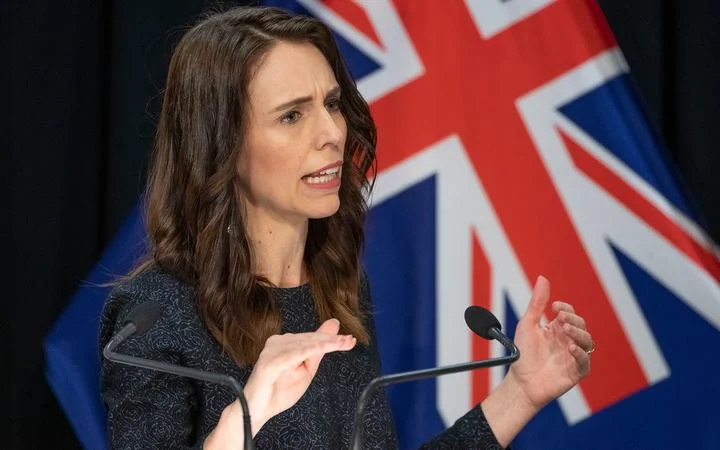
All of New Zealand - except for Auckland - will move to alert level 2 at 11.59pm on Tuesday, Prime Minister Jacinda Ardern has announced.
Schools can re-open from Thursday morning. However, there will be differences to previous versions of level 2.
Cabinet would further review those levels on Monday, along with Auckland's level 4 settings.
Ardern said the change was difficult for Northland, which would be cut off from the rest of the country. But those who needed to pass through Auckland to get elsewhere would be able to.
Ardern said level 2 will be different under Delta. Under "Delta Level 2", face masks must be worn inside most public venues, including shops, malls, and public spaces.
Ardern said mask-wearing in schools wasn't mandatory, but director-general of health Ashley Bloomfield said it was recommended, especially for students 12 and older.
Masks could be removed at bars and restaurants, for eating and drinking. However, staff would have to wear masks.
Ardern said new rules on scanning also applied at level 2: mandatory scanning at bars, restaurants, cinemas, churches, hairdressers and anywhere where there was close contact between people.
"To keep it simple, if you're out and about and visiting indoor venues, please wear a mask."
At private events, a record had to be kept of people attending.
There will be a limit of 50 people at hospitality and event venues, while outdoor venues can have up to 100 people.
The old rules of customers being seated and separated would continue to apply.
At indoor public facilities, such as gyms and libraries, the same rules would apply as for supermarkets: a 2-metre space would be required.
"Wear a mask, scan everywhere you go," Ardern said.
People needed to remember that venues were more limited in the numbers they could take, and should be patient.
"We are within sight of elimination, but we cannot drop the ball."
Ardern said the changes for large nightclubs would be hard on those businesses, but the risk needed to be addressed.
"We've learnt from experience. It's the social events when people know one another, when they're indoors for long periods of time with socialising."
Bloomfield said there would also be twice-weekly testing of staff at quarantine facilities, and weekly testing would be introduced for workers who had to cross the boundaries around Auckland.
Those people would not be required to stay home while they waited for the results, unless they had symptoms.
Bloomfield said those workers would have to show a negative test result at the borders, under a spot-checking scenario.
Those tests would be nasal swabs initially, but the health ministry was working to allow saliva testing to be rolled out for those essential workers crossing the borders.
There were about 3000 essential workers out of 22,000 such workers in Auckland who cross the boundary in and out of Auckland.
Bloomfield said the additional testing requirements might be inconvenient and unwelcome, but they were needed to try to ensure Auckland could move down the alert levels more quickly.
Those workers would have until 11.59pm on Thursday to get their first tests done, Ardern said.
Those measures gave extra confidence to change alert levels outside Auckland, she said.
20 new community cases today
It comes as 20 new cases of Covid-19 were reported in the community today - all in Auckland.
The total number of cases in the community is 821.
Five cases from today are yet to be epidemiologically linked to the outbreak. Bloomfield said numbers were moving in the right direction, "which is reassuring".
Bloomfield said three days of 20 daily cases was a "remarkable coincidence", but a higher proportion of those cases were down to household contacts.
Only one of yesterday's cases was an essential worker, he said.
Just five of yesterday's 20 cases have been infectious in the community. The rest were in isolation throughout the period they were infected.
Eighty-six per cent of all contacts of cases have been called by contact tracers, the Ministry of Health said. Ninety-one per cent have received at least one test result.
Bloomfield said the total cases unlinked to existing cases as at this morning was 33.
There are 40 Covid patients in hospital, and six are in ICU or a high dependency unit.
There are eight patients in North Shore Hospital, 18 in Middlemore Hospital, and 14 in Auckland City Hospital with the virus.
The lowest number of test swabs were taken since the start of the outbreak yesterday - 4750 in total and just over 2000 in Auckland, Bloomfield said.
He said that was partly because other illnesses were not spreading - but high testing was essential and anyone with symptoms should get tested.
