
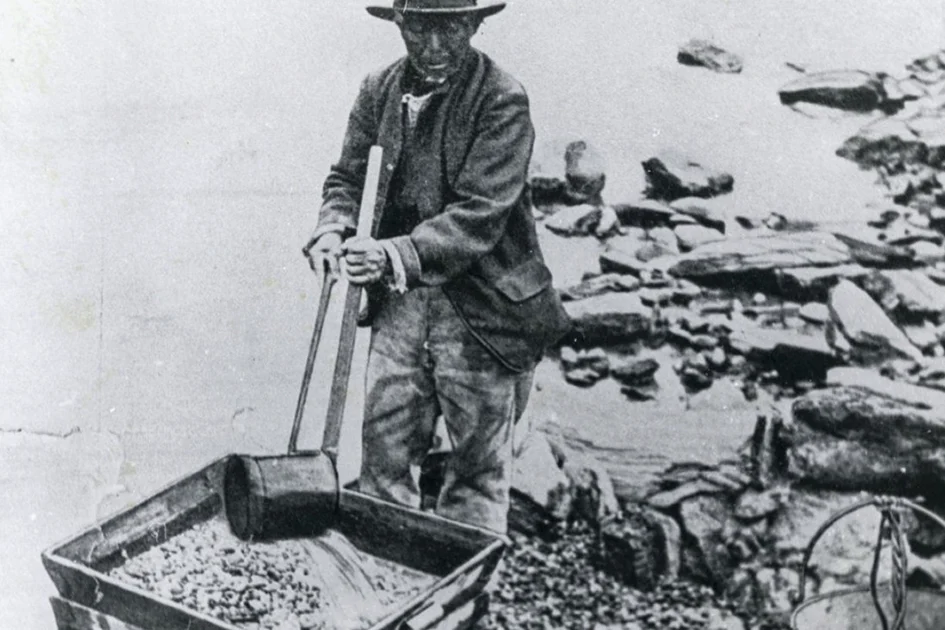
In the late 1850s, the Aorere gold diggings had 1,300 Europeans and 600 Māori working there.
One of the Māori diggers was Pepene.
Originally from Waikawau in the Coromandel, he was connected with Ngāti Kinohaku and Ngāti Rarua.
After accumulating around £100 worth of gold, he used his money to visit relatives in Waikato.
While up north, he began a relationship with a woman named Pare (Ngāti Maniapoto).
After Pepene’s gold money was gone, he borrowed money to return to the Nelson region in September 1862, sailing into Port Nelson with Pare and some of her relatives.
From here they made their way to the gold diggings along the Buller River near Kawatiri, where amongst a community of both Māori and Europeans, they shared a whare with Lydia Marore, a married Māori woman (her husband may have been Rewi).
The whare was made of plank walls with a toetoe roof and was near or perhaps even at one of the region’s pā.
The Māori who mined at Buller were very successful, obtaining large quantities of gold “chiefly by fossicking with their knives”, according to the Marlborough Press.
Pepene and Pare appeared to live together peaceably, although Lydia observed Pare say to Pepene one Saturday, “I don’t like you, Pepene; I shall go [back] to Waikato.”
On the Sunday, perhaps to placate Pare, Pepene tried to buy a belt for her.
The next day, Pepene and Pare were alone in the whare.
Lydia had left the whare around lunchtime and was outside for less than an hour when Pepene quietly emerged.
Wearing only a blue shirt, he walked away from the whare and from the watching Lydia and disappeared into the bush.
Lydia approached the whare, peered through a window opening, and saw Pare lying on the floor, her hand beneath her head as though she had been sleeping.
But an axe lay next to her.
Terrified, Lydia ran in search of Rewi, finding him with his mate, who then entered the whare and turned Pare over to find her dead with a large cut across her face.
Rewi and his friend wrapped Pare’s body in a blanket, then went for John Jacobsen, a mariner on the other side of the river.
When Jacobson arrived, he cleaned some of the blood from Pare’s body and revealed the extent of the gruesome damage to her face.
Pare’s relatives, upon learning of her death, wanted to avenge her death by killing Pepene, but nobody knew where he had gone.
He had, in fact, disappeared into the bush with a measure of poison.
In the bush, he meditated upon taking his own life, and decided to drink the poison.
But it didn’t kill him.
