
By Robyn Parkes
John Wallis Barnicoat was born in Falmouth, on the south coast of Cornwall, England, on June 3, 1814.
After leaving school he was selected to learn civil engineering and surveying.
At the end of his Barnicoat practised for a time on his own account, but later was employed by a leading railway engineer in London.
Some years later he was working as a surveyor in Cornwall, but being attracted by the prospect of emigrating to New Zealand, he left England on the the Lord Auckland, and landed at Nelson in February, 1842.
Barnicoat was at once engaged by the New Zealand Company and was employed with his partner, Mr T. J. Thompson, in cutting up suburban and rural lands in Waimea East, Moutere, and Wairau.
He was among those who escaped from the Wairau Affray and became a prominent figure in society.
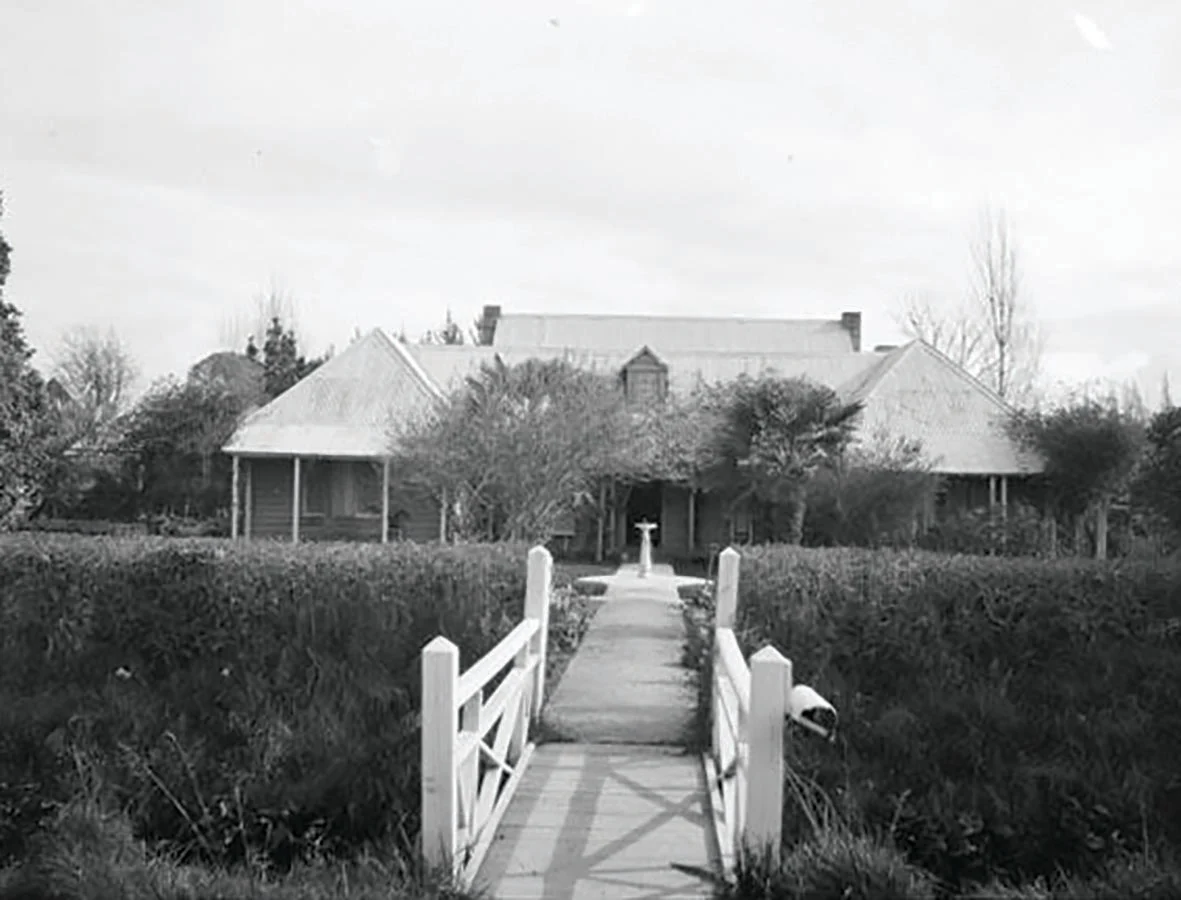
In 1844, having made up his mind to occupy Section 168, in the swamp area of Lower Queen Street, Richmond, he purchased Mr Thompson’s half of the property for 30 pounds.
He named it, “Ashfield” where he remained for 50 years.
He then converted 140 acres of rush-covered swamp into one of the best kept farms in the district.
Barnicoat realised that, on the bleak wind-swept plains, shelter for stock was necessary.
So, he planted the numerous hawthorn hedges which became a feature of “Ashfield.”
The hedges were so successful that other farmers followed his example and purchased from him the haws and berries from which seedlings were raised.
Barnicoat was a lover of trees, and he brought acorns from England which were later planted, forming the nucleus of the oak plantation.
Ash trees were also raised, hence the name of the property “Ashfield”.
Owing to the scarcity of materials, Barnicoat’s residence was built by degrees, and all the timber had to be pit sawn. For the current time it was thought to be a grand structure.
Barnicoat always maintained a beautiful garden, a feature of which, was a wistaria planted by himself in front of the house and was trained along the verandah.
By 1934, the trunk of the wisteria measured about 30 inches.
As he grew older, and with his wife having died earlier in 1902, he sold his property in 1903.
The Ashfield property was then sub-divided into three lots. One lot was purchased by Mr Hammond and one by Mr Haycock.
The old house, over the years, was painted and photographed on numerous occasions.
The house ceased to exist in its original state after being remodelled in 1934 by the then owner.
In September of 1942, an oak seedling that had come from one of the old oaks on the Barnicoat homestead was raised and planted in Jubilee Park as a memorial to John Barnicoat and done so in accordance with the wishes of the family and descendants.
