
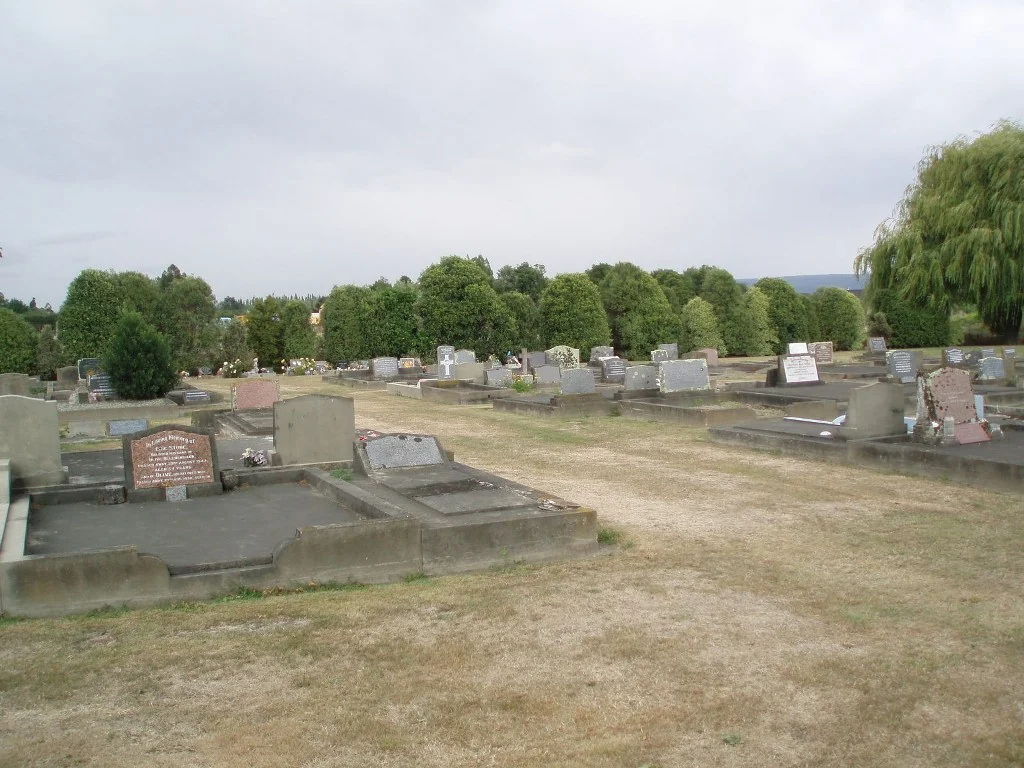
In 1856, discussions were held concerning a burial place for Richmond.
Up to this time, most deceased were taken to the town cemetery. In May of 1856 it was confirmed that a block of land had been purchased and was open to all to use for payment of a small fee.
Residents were kept up to date on the progress of the cemetery land and opening, through articles in the newspaper.
Six acres were purchased and was described as being a gentle slope overlooking the Waimea Plains.
Funds were raised for the grounds to be “tastefully” laid out should afford a pleasant promenade.
The property was vested in trustees in perpetuity to ensure there would be no fears of the possible violation of the resting place of the dead.
William Cleaver, aged 33, was the first to be buried in the cemetery, which occurred in August of 1856.
In one corner, an oak tree was donated and planted by a Mr Lee, a gentleman who was engaged in gathering a collection of native birds to take to England.
Mr Lee lived in Dorset Street and grew the oak in his garden. On leaving for England, he presented it to Richmond and it was planted out by Mr Joseph Hammond.
Mr Lee sailed for England but never arrived as the ship he sailed on was lost.
Rules were set for the use of the cemetery. Plots were able to be purchased for 5 shillings per square yard, payable at the time of selection, and the sexton could not dig the grave until payment had been made.
Graves would be a minimum of 9 feet by 4 feet with each plot being staked off.
In 1872, a small chapel costing £70 was built on the cemetery grounds and was the first occasion in the province that the powers of the 9th clause of the “Public Cemeteries Act 1859”, which allowed trustees to erect such a building, were used.
It was noted at this time that the cemetery was prettily planted, well laid out, and kept with an amount of care not always directed in this part of the world to the preservation of the receptacles of the dead.
The creditable condition of the cemetery was in a great measure due to Mr. Thompson, one of the trustees, on whom the chief trouble of management had always fallen.
Unfortunately, in 1893, it was noted to be in a disgraceful state.
A Richmond resident, who penned a letter to the papers and signed himself, “everything in order”, described his dismay.
It was the custom to mow the lawns at least once a year and give the place a general tidy up, but apparently even this had not been done.
The result was that the place was so overgrown with rank cocksfoot grass, broom, fennel, and briers that in some areas it was almost impossible to find any grave at all.
If wet, one would get wet up to the knees.
We can be thankful that today the cemetery is beautifully kept and provides a peaceful setting to visit our deceased.
By Robyn Parkes.
