
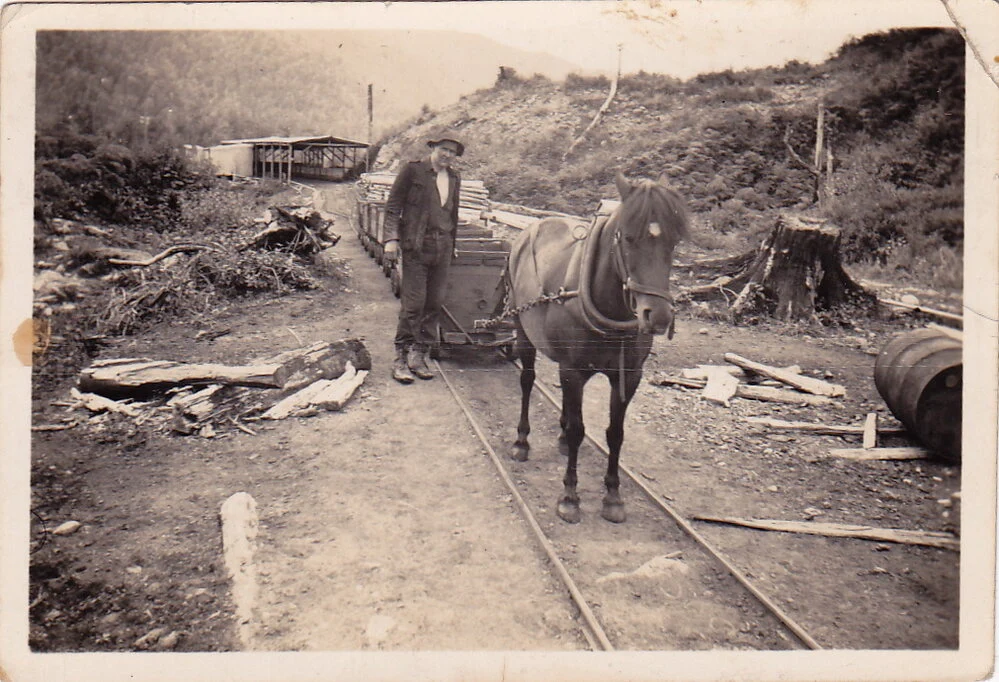
The operations of the Nelson sawmilling industry date from the earliest days of the settlement.
When the first white settlers arrived on the Waimea plains, north of Spring Grove was of a swampy nature covered with tutu, flax and toi-toi, but south of Spring Grove and also in Waimea West, continuous areas of magnificent milling bush existed and in this region were established the first, power-driven Nelson sawmills.
These early mills were all driven by waterwheels and often combined sawmills and flourmills. The sawmilling working by day and the flour milling at night. All log-hauling was done with bullock teams.
In those days great difficulty was experienced in transporting the sawn timber to market, the only road from the Waimeas into Nelson being a roughly laid-out track following the foothills to the eastward of Waimea plain, and along this track the wagons were wearily hauled by bulls.
Owing to the difficulties of cartage by road, several experiments were made by rafting the timber down the Wai-iti and Waimea rivers then around Blind channel over Tahuna flat, but although several rafts arrived safely so much timber was lost that the millers went back to the wagons.
As roads and transport improved, more powerful steam-operated plants were installed, and operations were extended in other areas, all of which had good milling bush available.
Mr L Baigent spoke in 1930, at a review, that operations in the district had been hampered by the fact that the milling timbers grew on low-lying flats, and the back country was covered almost entirely with poor quality beech of little value as timber.
The result being that there were no large bush sawmills operating between Nelson and Inangahua Junction.
The operations in the area were small portable plants cutting isolated areas of bush. The large areas of accessible bush had gone.
The sawmilling industry steadily evolved towards greater use of machinery and power-driven appliances. The bulls were replaced by steam logging winches, the water-wheel gave way to steam plants, while the wagon with its daily travel of 15-20 miles per day had been replaced by the pneumatic-tyred lorry, travelling up to 200 miles per day.
In the sawmills, power-driven feeds replaced handleman, while old planing machines, feeding at a rate of 15-25 feet per minute were machines operating at up to 165 feet per minute.
The sawmilling industry was, in the 1930s, rapidly passing into fewer hand. The more efficient firms were expanding while small plants disappeared.
With many of the early pioneers making their living from milling native timbers, a review of forest policy in 1925 predicted the resource could be exhausted by 1965-70.
As a result, state plantings of exotic forests were increased to 300,000 acres between 1925 and 1935. By 1939, Golden Downs covered 19,250 acres.
Forest plantings, mainly pinus radiata, covered a total of 120,000 hectares by 1992.
Written by Robyn Parkes
