
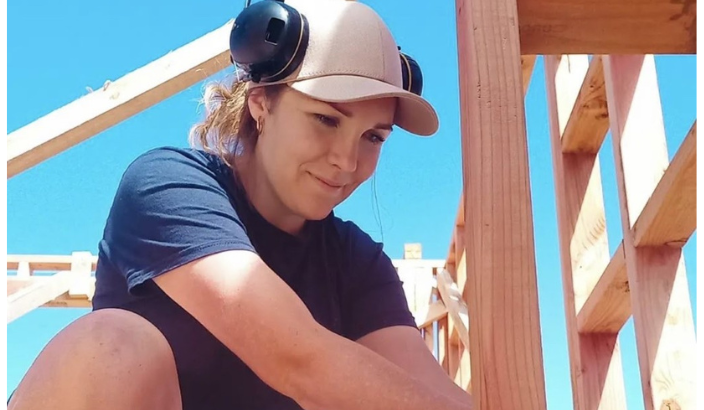
Neave Osborne is leading the way for women in trades in Nelson, all while building 14,000 followers on her Instagram page detailing her journey as an apprentice and co-owner of Osborne Build.
Neave enrolled at Nelson Marlborough Institute of Technology (NMIT)’s construction and joinery pre-trade course after a head injury saw her rethink her future work options.
“It’s been quite a journey, but I am pretty stoked with where I’ve ended up,” Neave says.
She says the pre-trade course gave her invaluable hands-on experience
“We worked all day and completed three, full-sized three-bedroom houses for Habitat for Humanity as well as five tiny homes.”
She still keeps in touch with the other four women who were on the course.
“They are all doers, really active, and love problem-solving.
She says, the line of work has other benefits too.
“Why not do a job you are interested in where you get paid really well?
“You get all the benefits of working 9-5pm Monday to Friday and get the weekends with your family,” she says.
Melissa Malett, apprentice electrician of the Electric Company, started her work journey in Nelson with Fulton Hogan when the work offered more money than the office job she had applied for.
“My dad always told me you can always fall back into work with a truck driver’s licence.
“I never in a million years would have chosen truck driving, but I really liked it.”
After a few years of driving trucks and sealing roads, Melissa says she was working on a subdivision and saw the electricians happy and having a great time.
“I was bored, so it was time to try something else’.”
Owner of the Electric Company Marc Edgar says there is almost an equal ratio of male to female employees in his company.
“I don’t really see the need to determine the outcome of a potential employee by their sex.
“I have found that, generally, the females have shown themselves to be the most proactive and persistent in gaining the opportunity to work within the industry,” he says.
Skills Consultancy group account manager Georgie Kerby says women make fantastic tradies.
“There is definitely an increase in women in trades thanks to some great government initiatives,” she says.
“Things are improving. I think it’s a great opportunity for women. They are a great resource for employers.”
Georgie says, with current staff shortages employers are more open to resourcing with women.
Mechanical engineering tutor at Te Pūkenga, formerly NMIT, Donna Connell, says there is still a long way to go to equal the male-to-female balance in the workplace but they are making progress.
Although female workers have much lower rates of participation in apprenticeships, data collector EducationCounts says last year 13 per cent of men working in construction were apprentices compared to 3.1 per cent of women.
Overall, 4.4 per cent of the male workforce were apprentices compared to just 1 per cent of the female workforce.
“If there are any women out there who think they would like to get into the construction industry, then go for it, is my advice,” Marc says.
