
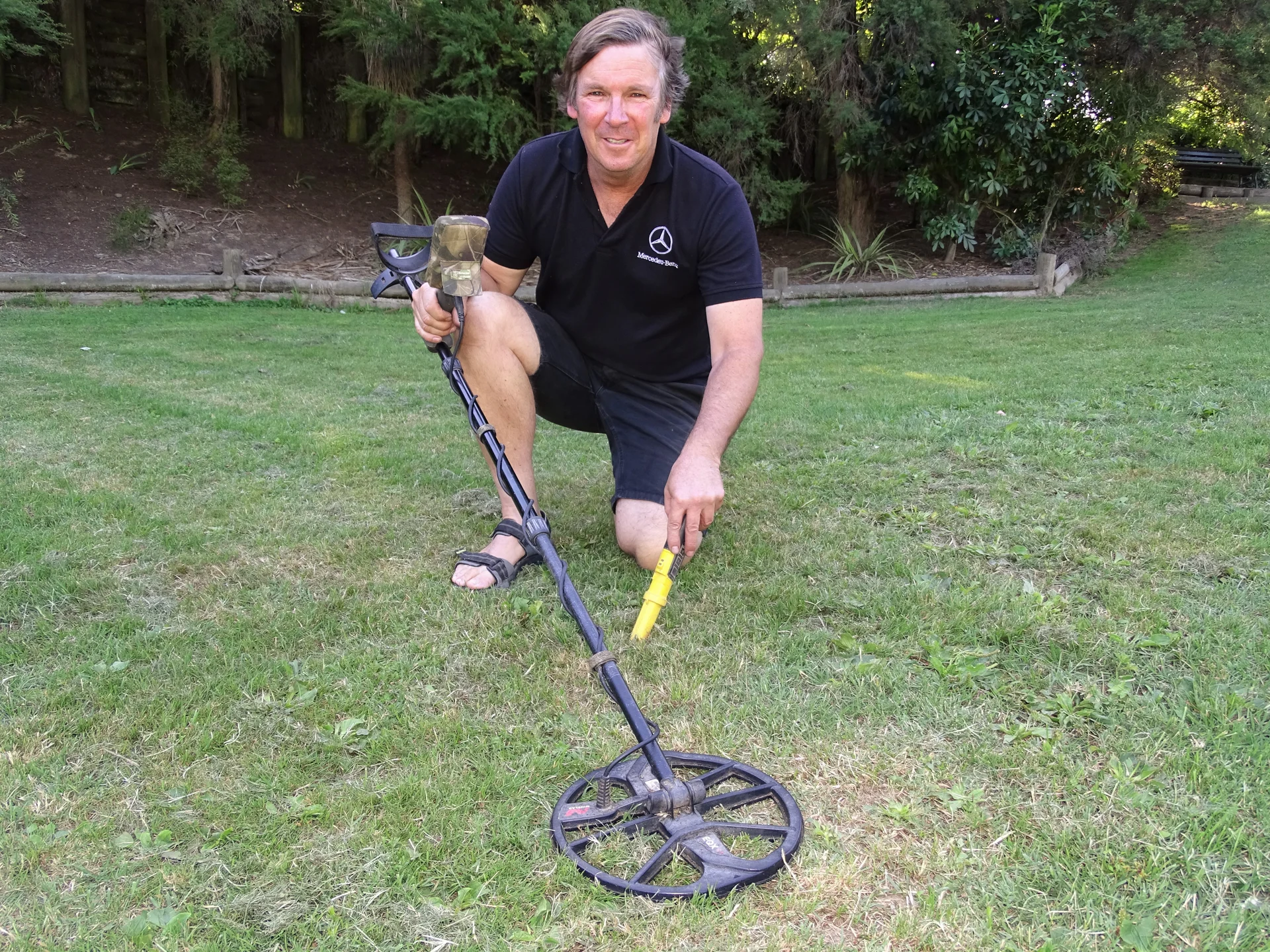
The best part about being a detectorist for Karl Borgfeldt is finding someone’s precious jewellery and in the past few weeks he has returned two rings to their relieved owners.
Using his trusty metal detector, he was called upon to find a wedding ring belonging to an elderly woman who had lost it swimming at Kina Beach.
The previous week found another wedding ring at Rabbit Island that had slipped off an elderly woman’s finger.
He has even donned a wetsuit in the past at Lake Rotoroa to retrieve a ring that flew off a woman’s finger and was picked up by a duck that then dropped it in the lake’s chilly depths.
In the Kina Beach find, an elderly couple were swimming when she realised her ring had slipped off. Karl says her husband lined the spot up with points on the land and paced it to the shore, so knew the general whereabouts of the lost ring.
They found Karl on Neighbourly, and he was able to find the ring within 10 minutes, buried under sand at low tide.
“It was her mother’s wedding ring and her own wedding ring melted down and made into one ring, so it was very special. I love doing things like that.”
At Rabbit Island, the wedding ring was lost on a Saturday and he found it in the sand the following Wednesday and was able to return it to the woman.
“I got a massive hug from her. She had been married 30 years and her husband had passed away 10 years earlier.”
He has searched the peak of Mt Arthur for a lost ring – once in snow and returning in summer – but was unable to find that one. He did bring back all the metal rubbish he found though, like tear tabs off cans, bottle tops and squashed cans.
“Everywhere I go I bring the trash back home. Tear tabs can sound similar to silver or gold, so you come home with a lot of tear tabs and it’s cleaning up the area.”
The metal detector has a different sound for each metal, which usually helps sort out the interesting items from old pipes and metals of no value.
Most of his detecting is around old houses, searching for historical pieces such as old coins.
His best finds to date include 1934 and 1936 half crowns and a shilling which he says would have added up to a week’s wage for someone back then. He also has a 1911 metal baby’s whistle/rattle which has its maker’s mark on it.
“For me it’s about older coins and saving bits of history.”
But it is becoming harder to find ‘permissions’ to dig. He keeps an eye on older properties being subdivided, where he can get permission to go in and search the area for old relics buried in the soil.
Karl says he is one of an increasing number of people getting out and about with metal detectors, with many joining Nelson Metal Detectorist on Facebook where they can find out where they are allowed to search and how to dig properly without damaging the site.
“The whole idea is to not leave a trace.”
He suspects social media and technology is leading more people into the hobby and the realisation they can find interesting historic pieces as well as someone’s precious item.
