
Rona Hulme was at her home in George Street, Richmond, carrying out housework tasks on the 15 October 1941, completely oblivious to the news she was about to receive.
On responding to a knock at the door she found the local postmaster with a telegram from the Ministry of Defence.
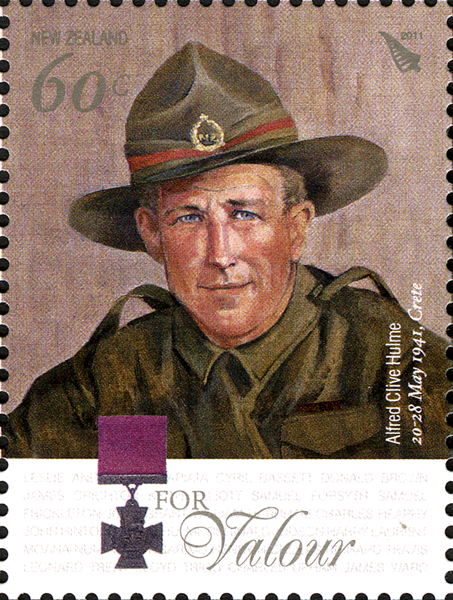
The telegram was to inform her that her husband, Sergeant Alfred Clive Hulme, had been awarded the Victoria Cross for outstanding and inspiring qualities of leadership, initiative, skills, endurance and most conspicuous gallantry and devotion to duty.
In recounting the event, Mrs Hulme said: “He (the postmaster) said he had a thrill for me and because I was in so much of a tremble, he had to open the telegram for me. I was so thrilled that I hardly knew what to do afterwards, but certainly could not get very much work done because the news travelled fast and there were a great many callers.”
When Sergeant Hulme arrived back in Richmond in October following treatment, he was accorded an enthusiastic welcome by a large crowd of residents assembled outside the Borough Council building for a civic welcome.
The mayor A R Tuffnell presided, saying it was a unique experience in the history of the borough to have the privilege of extending a welcome to the winner of a VC.
On behalf of the residents of Richmond he congratulated Sergeant Hulme on gaining the award which his deeds rightly deserved through a series of deeds of valour and courage.
In return, Sergeant Hulme said he was very pleased to be in Richmond, where his wife and family had taken up residence and where he hoped for a time to live and come to know the people of the borough.
Although many complimentary things had been said about him, he relayed that he found it difficult to stand in front of gatherings of people and hear references to his own actions.
In conclusion, he thanked the mayor and people of Richmond for the manner in which they had received him.
To find out how this came about we must go back to the beginning.
Alfred Clive Hulme was born and educated in Dunedin, coming to Nelson when about 19 years of age. He was married in 1934 to Rona Marjorie Murcott of Dovedale.
After marrying, the couple moved to the Auckland district briefly before returning to Nelson to a dairy farm at Braeburn.
Alfred enlisted in January 1940 and embarked for Egypt with the 2nd Echelon of the Second New Zealand Expeditionary Force on 1 May.
While at sea he was promoted to the rank of Sergeant. He joined the 2nd NZ Division in March of 1941, just before the first engagements in Greece and Crete.
During the Crete campaign Sergeant Hulme distinguished himself through a number of acts of gallantry.
At Maleme he led counter attacks against German paratroopers and also led his men with distinction during the counterattack at Galatos.
When his unit came under heavy sniper and mortar fire during the withdrawal from Stylos, Alfred infiltrated enemy lines and stalked and shot German snipers from the rear.
He was reported wounded on 13 June with a gunshot wound which perforated his right forearm and left his hand paralysed. Alfred was invalided back to New Zealand and was transferred to the Sanatorium Rotorua for treatment before returning to Richmond.
Some years after the war the family relocated to Pongakawa, near Te Puke. He died at this home on September 2, 1982.
By Robyn Parkes
