
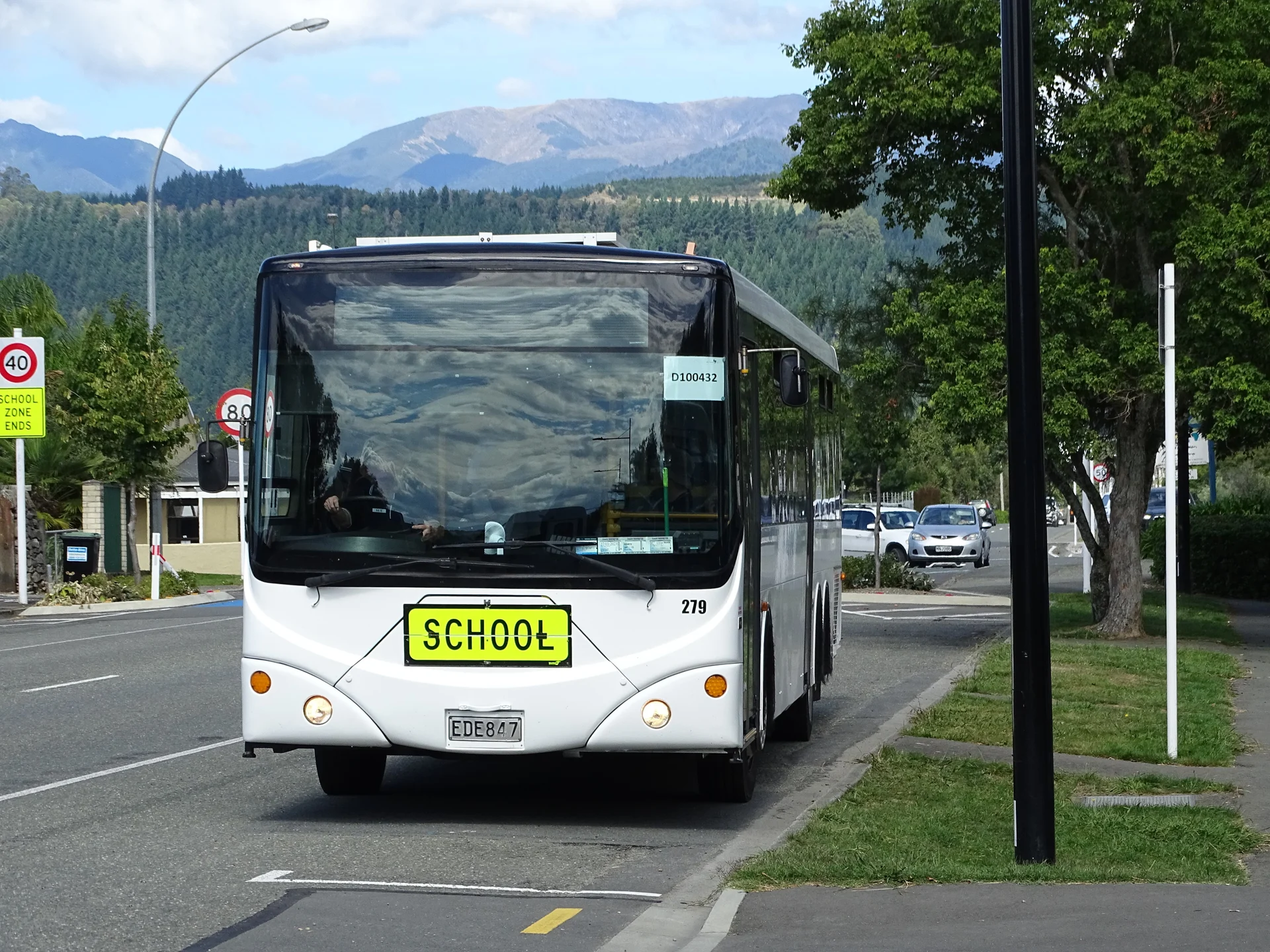
Wakefield parents who bus their children to secondary schools in Nelson will soon have to pay up to $50 per student each week to get them to school.
The Ministry of Education covers the cost of bussing students to and from school within its transport eligibility zone, which is usually the closest school.
For Tasman secondary students, the closest school is Waimea College.
However, families choosing to send students to Nayland and Nelson colleges have to put them on a commercial bus.
Nelson Coachlines operates the services for students going to other schools.
In a letter to parents, it said it had been a challenge maintaining the sustainability of the services on a commercial basis.
The buses are not part of the public transport system and need to be financially self-supporting.
That has forced it to increase prices from the beginning of next term.
For Wakefield parents, that will be an increase from $4.50 for a one-way fare to $7 and a return trip will be $10.
Wakefield parent Kim Salmon has no gripe with Nelson Coachlines which she says has to run a business, but she would like to see the Ministry of Education provide funding for all students to their nearest school.
She says students used to be able to get to Waimea College on school buses for free, where they can then pay about $1.20 for a bus to Nayland and Nelson colleges.
But students going to out-of-zone schools can no longer use the school buses.
“I understand every child has free transport to their closest school, so they should have free transport to Richmond.”
In three years she will have three kids at college. That will be $150 per week to get them to school. She says there are families facing that now.
Other families already bring their kids from further out, such as Tapawera, to get on the bus for Nayland College and Nelson College.
“It’s totally unaffordable,” she says. “I’m sure there’re parents who have kids staying home sometimes because they can’t pay for the bus.”
The Ministry of Education has three criteria that must be met to qualify for school transport assistance.
Students must attend their closest state or state-integrated school, secondary students must live at least 4.8km from the school and there must be no suitable public transport option.
In a statement, group manager for school transport James Meffan says caregivers have the right to choose where they enrol their children.
However, the eligibility criteria for school transport assistance is intended to ensure the ongoing viability and integrity of local schooling networks by supporting students to attend their closest school.
He says this helps to prevent inefficiencies in the network due to excess demand at some schools and surplus capacity at others.
Kim says parents choose out-of-zone schools for a variety of reasons and that, for her family, a girls-only school with smaller class sizes was the best fit.
She says the bus is about two-thirds full when it leaves Wakefield and is full by the time it gets to Richmond, where a large number of students transfer to buses to Nelson.
Many students have sports and after-school activities.
Kim says parents already have the cost of getting them home after that.
One-way travel is one of the challenges for Nelson Coachlines.
It noted more self-driving by students with friends, one-way travel, casual travel and car-pooling in recent times, with one-way and casual travel having the biggest impact on the service.
It said the business operated the service throughout the Covid-19 period at a cost to itself and kept the costs down as much as possible.
Now in inflationary times, it has had to review the fare structure and pass on reasonable cost increases.
