
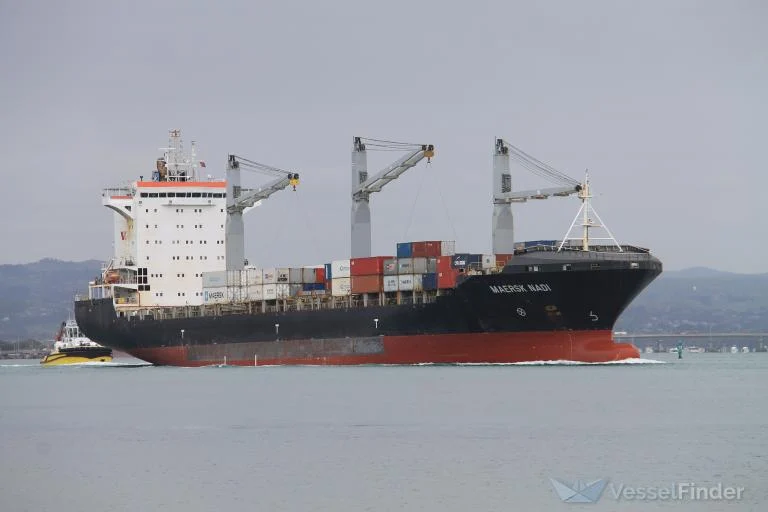
After less than a year, Maersk is cutting its Coastal Connect service which saw a dedicated shipping service between ports in Nelson, Auckland, Tauranga, Lyttleton and Timaru.
The closure of the service has resulted in the loss of all New Zealand jobs related to the service.
Two 2500 TEU (20-foot equivalent container) capacity ships, Maersk Nadi and the Maersk Nansha, have been providing the service between the New Zealand ports.
Unions representing ships crews say the withdrawal of a dedicated Maersk shipping service on the New Zealand coast is a step backwards for New Zealand’s supply chain security.
“If New Zealand does not get its act together with a national port strategy, we are going to see hubbing happening in Australia, and New Zealand ports further down the pecking order," Maritime Union of New Zealand national secretary, Craig Harrison, says.
The coastal service was seen as a breakthrough in providing reliable services to New Zealand ports following massive disruption to shipping schedules following the Covid-19 pandemic.
Craig says the sudden withdrawal of the Coastal Connect service shows how volatile and insecure New Zealand’s supply chain remains.
The cancelled Maersk services will be replaced by new international services that drop some New Zealand ports off their calls and use Australian ports as hubs.
“This continual market volatility is bad for New Zealand and will have a flow on effect to importers and exporters, and thus the whole economy.”
Craig says New Zealand is making good progress with coastal shipping, and although the Maersk decision was a setback, there is still an overall positive trajectory for coastal shipping.
“We saw a number of new ships and services coming onto the New Zealand coast in the last year, largely due to Government engaging with industry and having a plan which we haven’t had for decades.”
He says there is currently high demand for New Zealand seafarers, and he is hopeful redundant crews would be re-employed in the industry.
He says the maritime unions will be asking Maersk to provide training positions for New Zealand crew aboard the new services.
“This is a company that has made very large profits from New Zealand over decades, and they need to show stronger commitment and social responsibility.”
Craig says the clear message is New Zealand is at the bottom of the priority list for global shippers.
He says an obvious option for improving New Zealand's connection is to get state owned enterprise KiwiRail, who operate inter-island Cook Strait ferries, to diversify by leasing ships to meet the demand for coastal shipping.
The three unions all have members aboard the affected Maersk vessels – the Maritime Union of New Zealand representing seafarers, the New Zealand Merchant Service Guild representing ship’s masters and officers, and the Aviation and Marine Engineers Association representing marine engineers.
