About 70 per cent of our native fish are threatened or at risk. Our waterways need to be carefully managed so native fish can access the habitats they need to thrive, so, a team of freshwater fish experts have been put to work.
New Zealand has more than 50 species of native freshwater fish and 20 of those are present in Tasman.
Of the 20 in the region, 11 are classified as ‘in decline’.
Many of these species, like whitebait and eels, need to move between freshwater and the sea to complete their lifecycles. Some also ‘pass’ upstream and downstream between different habitats in waterways.
If their movement is delayed or blocked completely, fish may not be able to get to the habitats they need to complete their lifecycle. Their numbers can then reduce, or they may be completely lost from a waterway.
The ability for fish and organisms such as koura (freshwater crayfish) and aquatic invertebrates to move through a waterway and complete their lifecycle is referred to as “fish passage”.
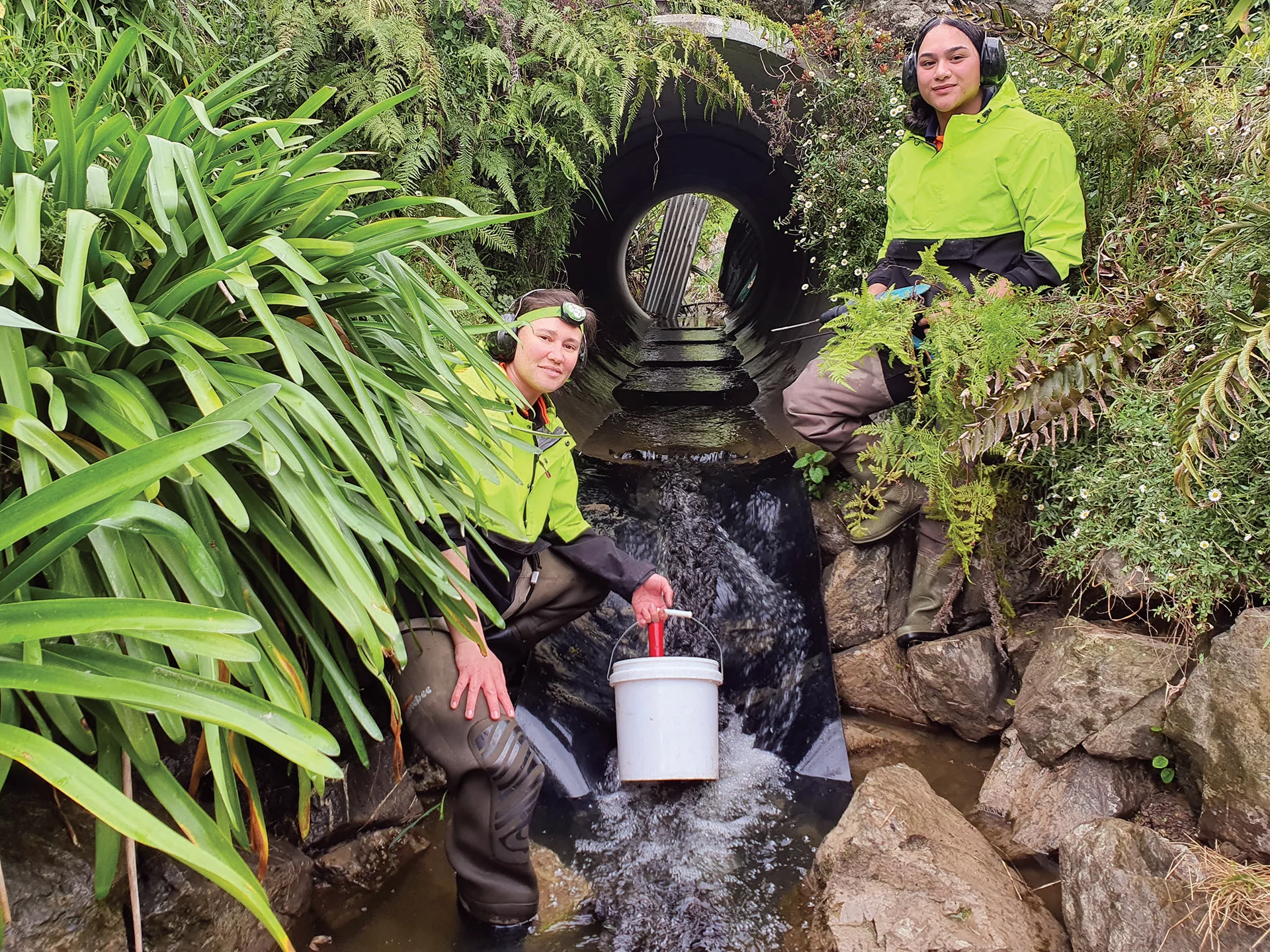
A team of fish passage experts from Tasman Jobs for Nature, Kūmanū Environmental, are visiting private land to help connect waterways. The work is free to landowners and simple to carry out.
“The team looks at in-stream structures, like culverts, to see if fish can pass through. If they can’t, or are unlikely to, they try and ‘fix’ that by adding materials that reduce water speed and create surfaces for fish to swim or climb over, within and through a structure,” explains project manager Kerry South.
Soon landowners of Waimea and Tākaka can expect to see the distinctive fish passage ute, kotuku white with native fish on the sides, making the rounds to help freshwater fish.
Bill Booth, a sheep farmer from the Sherry River, had the team come to his farm around 16 months ago.
“When they came here they did quite a lot of work, a few rope ladders were installed which has helped the eels and fish. The fact that we have fish indicates that our streams here are healthy,” Bill says.
“Freshwater crayfish were around over Christmas and they don’t like polluted water, so if they are here then it’s a good sign.”
With support of landowners across the district, the project aims to complete 4,350 assessments and 1,655 “fixes” between July 2021 and June 2026.
“The fish passage team can only carry out the work with the support from the landowner, it really is a team effort, luckily we find farmers are just as passionate about freshwater fish as we are,” Kerry says.
While not quite at the end of year two, the project is about to arrive at 2000 assessments. This work is part of a Tasman Jobs for Nature Project which is funded by Ministry for the Environment and Tasman District Council.
