
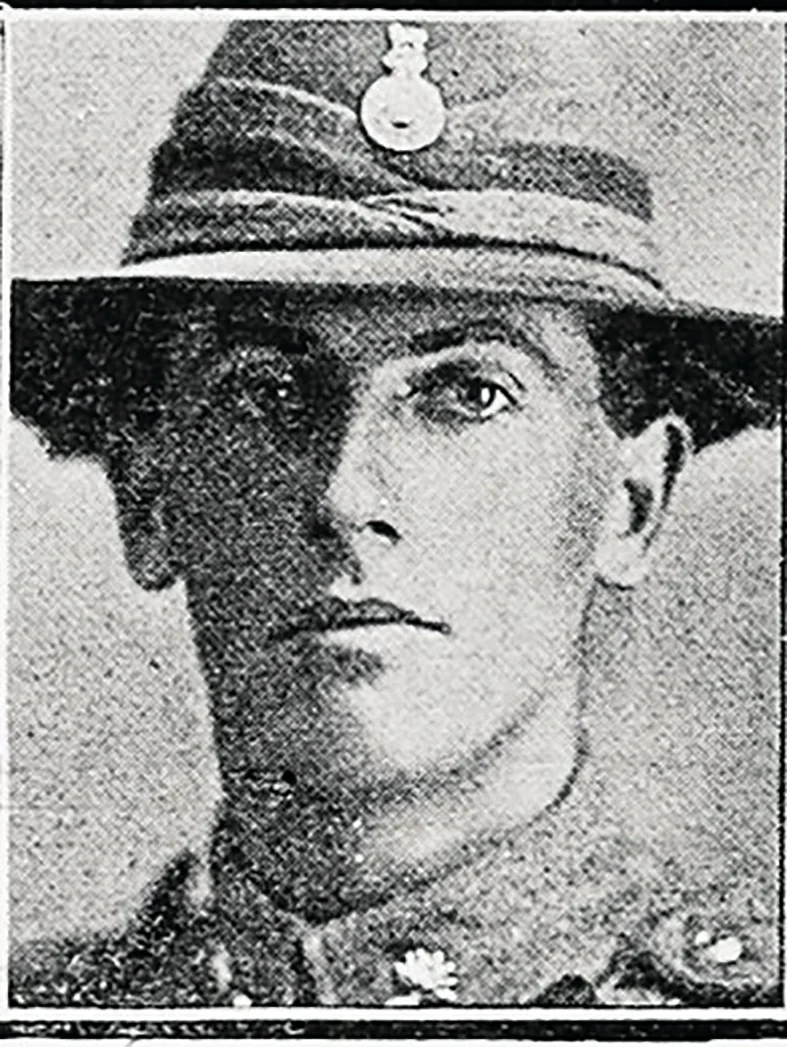
Two sons went to war but only one returned.
Henry and Howard, sons of Robert Ellis of Brightwater, both heeded the call of World War 1.
As a young lad, Henry attended Nelson College and after leaving college he took up farming, but later followed in his father’s footsteps and went into electrical work.
For a time he worked with Mr Wedderspoon, the electrical engineer engaged on the Richmond electric lighting scheme.Henry undertook the installing of the electric lights and was well-known for his ability in this capacity.
After his attestation Henry embarked 1 April 1916 from Wellington with the 11th Reinforcements New Zealand Field Engineers, No. 2 Field Company. On arriving in England, he was engaged in electrical work at Sling Camp, Salisbury Plains, and eventually at Christchurch in Hampshire
After some six months he was sent to France where he continued in electrical work at the base he was posted to. In January 1917 Henry moved forward on special work at the front.
The work was classified as urgent and secret and at the time was one of the most zealously guarded positions.
Records showed that he had worked extremely hard and done a good job.
Within two days of the completion of the work, in late March, a shell made a direct hit on his position and he and another soldier were badly wounded.
Three other sappers, also injured, dressed both men’s wounds and got them to a place of cover while in the middle of a barrage of shrapnel.
They managed to transfer them to the advanced dressing station where they were both treated by doctors before carrying on the casualty station.
After a leg amputation, little hope of recovery was forecasted. Unfortunately, Henry succumbed to his injuries on the 30th of March 1917, aged 27.
His parents received notice of their son’s death by mail from France. Henry’s commanding officer wrote that Henry was “a splendid fellow and had set a fine example of courage and his high character”.
Henry was buried in Bailleul Communal Cemetery Extension, Nord, in France, in the presence of his officers and mates who had walked several miles to pay their last respects.
The major closed his letter by reinforcing that Henry had laid down his life for his country, thus making the greatest sacrifice ever possible for one to make.
Henry’s younger brother, Howard, also enlisted and wrote home to his parents regularly to inform them of his movements.
In October 1915, after five weeks fighting at Gallipoli and during a tough struggle, he was struck in the hip by an explosive bullet which paralysed his legs.
In the skirmish he was left behind and captured by the Turks where he fully expected to be killed.
After a time however, a storming party rescued him, and he was sent to Malta and then England to recover.
Once recovered he returned to Gallipoli but then contracted scarlet fever and was sent to hospital in Egypt. On this second recovery he was sent to France.
In late November Howard sent a letter home to inform his parents that he had been injured on the Somme battlefield but was thankful to be alive after a very narrow escape.
He had been hit by a piece of high explosive shell which had torn his throat. After quite some time he was invalided back to New Zealand.
