
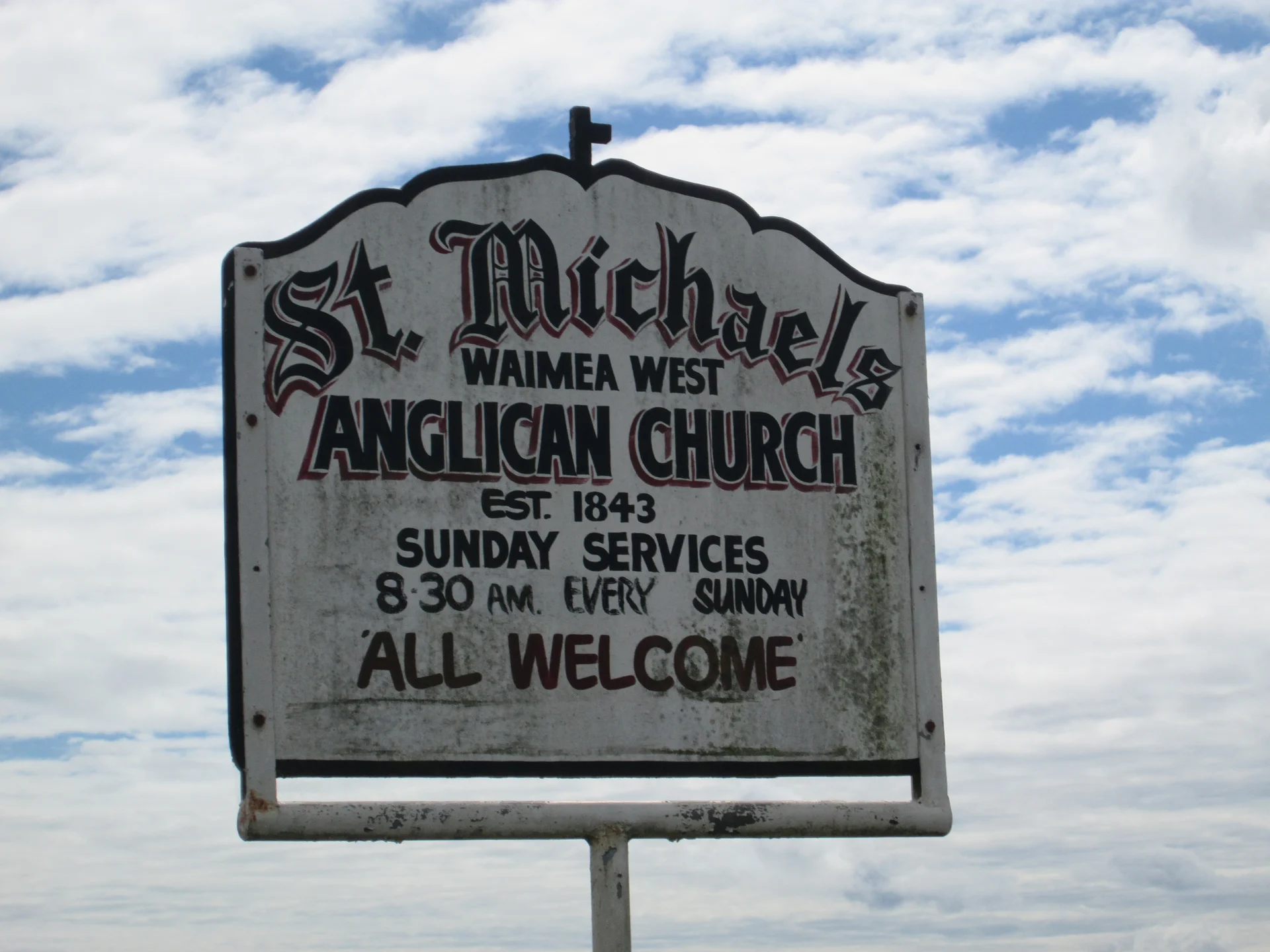
St. Michael’s, Waimea West, was the first Anglican Church in the Nelson settlement and commemorated its centennial on the weekend of the 17 December, 1943.
By the end of 1842 nearly a hundred people were settled in and around the village, as the locality was known, as far down as Cotterell’s Landing.
Among the families were men who became well-known in Nelson history, while other men became prominent in the public life of New Zealand, these being Dr. David Monro, Edward William Stafford, Alfred Domett, and the Hon. Constantine Dillon.
Dillon took a prominent place in the history of St Michael’s, for his leadership in the infant community was mainly responsible for its early foundation.
From the beginning many of the Waimea West settlers felt the need for a place in which to carry on their public worship.
A divine service was held in the district on 6 November, 1842, by the Rev. C. L. Reay, Nelson’s first Church of England clergyman.
At the morning service there were 42 present and in the evening 48.
Those services were notable events because, from them, developed the church and parish of St. Michael’s.
For over a year, services were held in John Kerr’s brick barn. Though it served the purpose well, the barn was inconvenient and soon the urge came to build a church.
The Rev. C. W. Saxton, an Anglican clergyman and graduate of Christ Church, Oxford, who came to Nelson as a settler and used occasionally to assist with early services at the village and elsewhere, offered an acre of land for the purpose.
A subscription was taken up which realised £35 in money, promises of labour, timber, etc.. The total cost of the church was £lO5, the balance being contributed by Bishop Selwyn from special funds.
By the middle of November 1843, the building was complete and had already become a landmark, resembling very much the small country churches of England and reminding the settlers of home.
Standing in the fenced acre, part of which was later consecrated as a burial ground, the body of the building measured 30 feet by 12 feet and the chancel 14 by 12. Its overall length was 52 feet.
The windows were lancet-sharped but a deficiency of lead in the early settlement made it necessary to use wood for the frames, thus preventing the full execution of the original design.
On Christmas Eve. 1843, St. Michael’s was first consecrated for public worship, the services being conducted by the Rev. Charles Lucas Reay, the clergyman who had the whole of Nelson Settlement for his parish. Attendances at the church in the first few years were consistently good, varying between 30 and 40.
In 1844 either Mr Reay or Mr Butt were able to come at intervals and others supported so that services were able to be held every Sunday afternoon.
On 7 January 1856, a meeting of the congregation of St Michael’s resolved to form a parish and proceeded to appoint wardens.
Mr Saxton and Mr D. Wootten were elected the first wardens, and Mr Francis Blundell, son of Captain Blundell, assistant warden. It was decided that the Parish Church be named St. Michael’s.
With the establishment of a diocese the work of the church became more organised and a desire grew to build a new church to replace the old one which had served the community for 23 years.
