Elderly residents crossing the road at Richmond’s notorious Queen St lights say red-light running is getting worse, but authorities all say it is not their responsibility.
Arvida Oakwoods’ Village Residents’ committee secretary Alec Waugh has been emailing the Tasman District Council about problems at the lights, including the increasing red-light running.
He says it is an intersection that would benefit from red-light cameras but has learnt there are no red-light cameras operating anywhere in the South Island.
“There’s no red-light camera anywhere in the South Island,” he says. “They’re all in the North Island.
“This intersection would be a good one for a red-light camera.”
Police told Nelson App that cameras are owned by the council or Waka Kotahi, while the council says Waka Kotahi is the agency that operates the cameras.
Waka Kotahi, however, says it is the police who are responsible for them.
A Waka Kotahi spokesperson says the responsibility for road safety cameras is going to be transferred from the police to Waka Kotahi, but the formal handover has not happened yet.
In the year to the end of March, police statistics show there were 10 incidences at the lights due to people failing to comply with yellow or red lights.
A police spokesperson says people who take the risk to run a red light put themselves and the lives of innocent members of the community at risk.
They also say police regularly carry out operations targeting red light runners because of the danger that behaviour poses.

But while police are in charge of infringements, cameras were the responsibility of Waka Kotahi or the council, depending on whether it was a State Highway or not.
Council’s transportation manager Jamie McPherson says that even on council-owned roads, cameras are a considerable expense and may not be the best use of limited road safety funding and would only be considered if a problem emerged that put people at high risk.
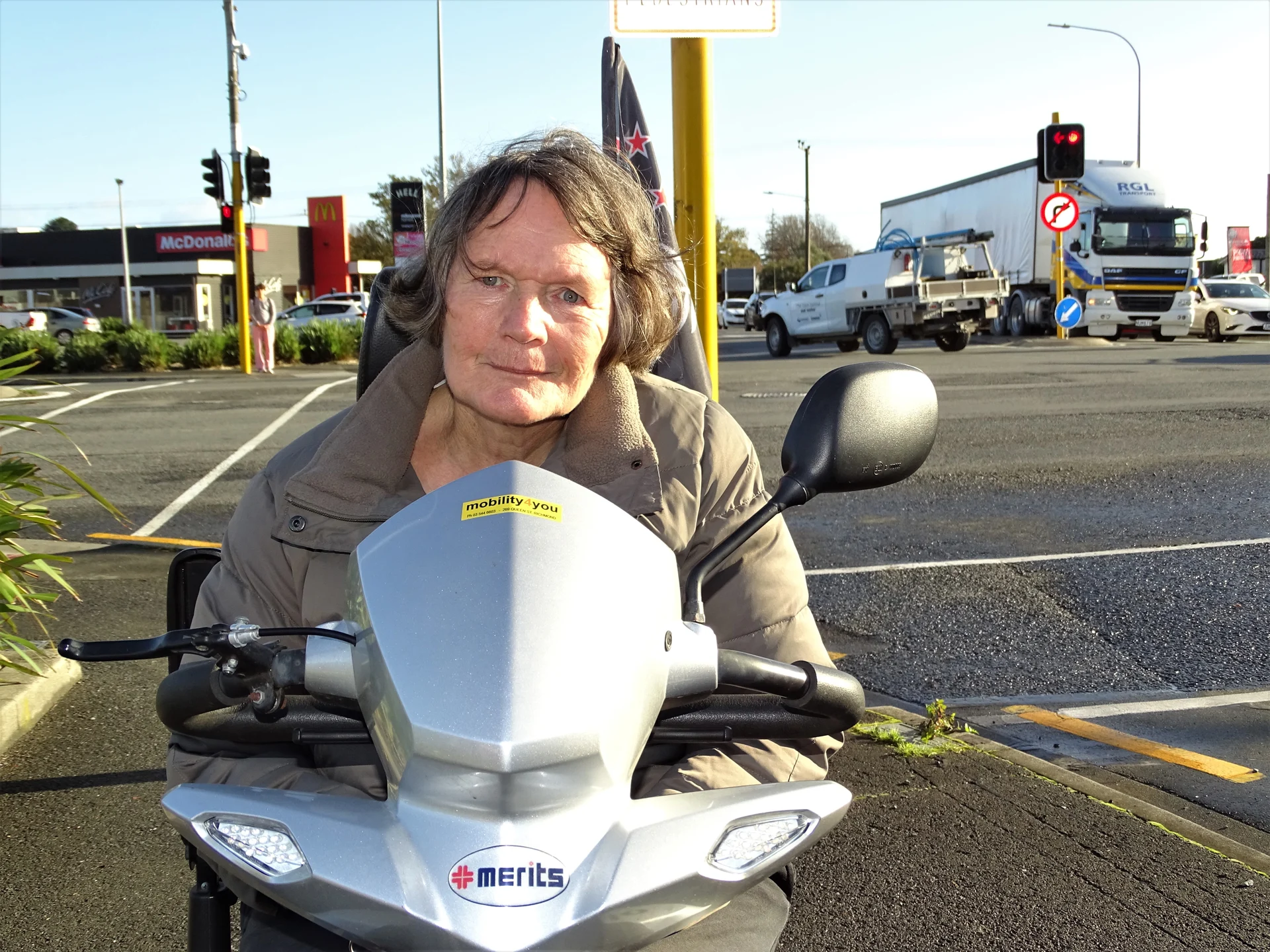
Meanwhile, an elderly retirement village resident, Julie Ivory, says more and more drivers are running red lights at the intersection and she has had “a lot of near misses” when negotiating her mobility scooter across the road.
“It’s worse as hell.”
She knows another resident who was pushing a wheelchair across the road and had to stop suddenly as a car came through on a red light, and she says it is frightening.
Yet she does not blame drivers entirely but rather the intersection.
“I have a lot of empathy for the drivers, especially truck drivers. It’s not a drivers and pedestrian issue – it’s a management issue.”
Alec says traffic continues to increase and put more pressure on the intersection while more and more elderly people from retirement villages down Lower Queen St are trying to get across the road on mobility scooters or on foot, alongside bikes and pedestrians.
“The retirement villages on Lower Queen Street have people on mobility scooters and on foot who are old and frail and grey. They’re not the fastest or most agile people.
“It’s a combination of the lights, traffic and senior aged people, sometimes with mobility and health issues, which are ingredients for problems.”
Added to the issue of lights, Alec says there is little space for the mix of footpath users to cross the road.
“We’ve got this increasing density and increasing use of scooters and walking frames and the age and frailty of so many of the people crossing. At the same time there’s the increasing impatience of drivers because of the amount of traffic and they don’t want to miss an opportunity and have to wait three to four minutes for the lights to change again.”
