
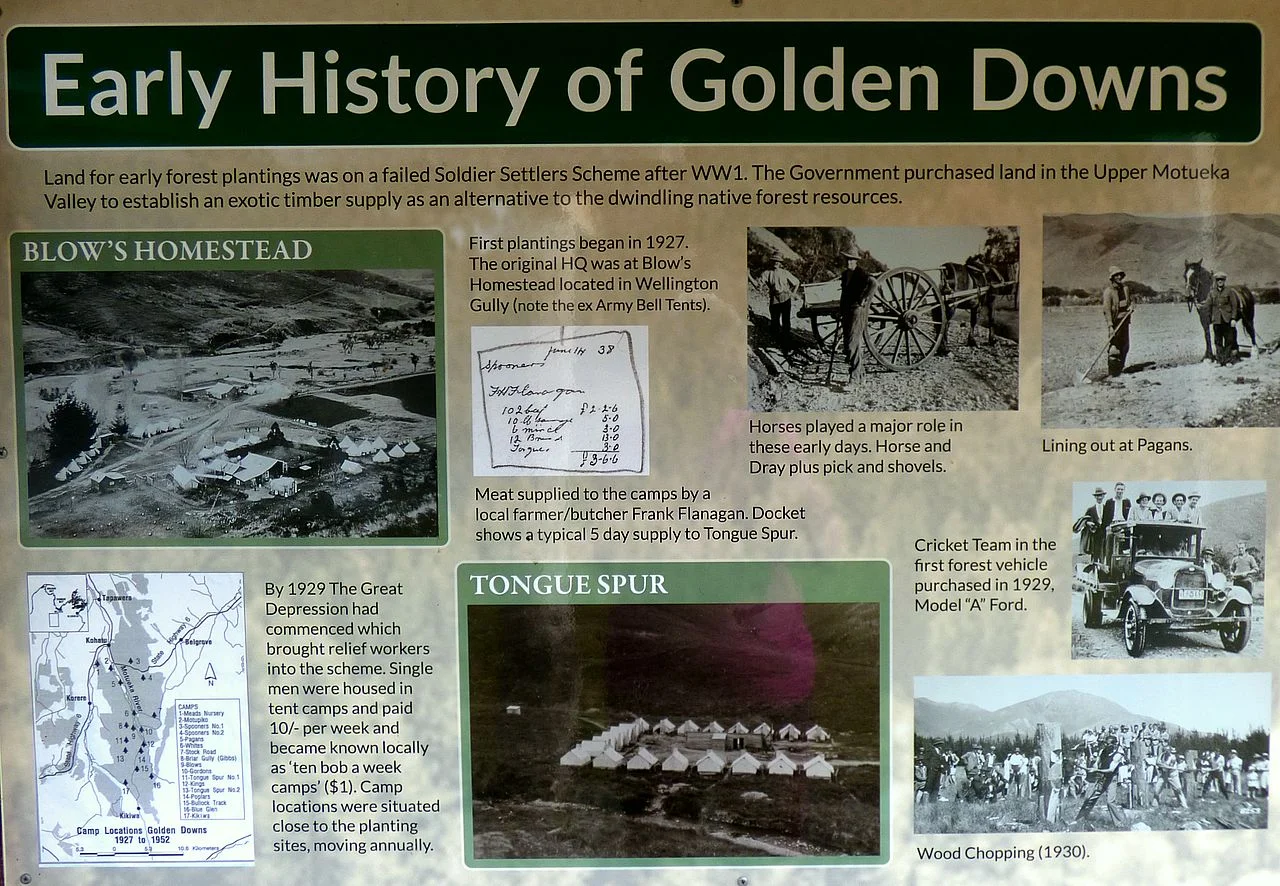
At the beginning of June 1932, the Conservator of Forests was planning to commence tree planting operations.
Initially, 150 men, all unemployed and registered with the Government Labour Bureaux, were wanted with wages offered from 10s per week for a single man to 40s per week for a married man with three or more children.
Tents with fireplaces, wooden walls and floors and bunks, palliasses and firewood were provided. Among the areas to be planted were Golden Downs and the south side of Spooner’s Range.
Names such as Norris’s Gully, Tongue Spur, Toc H and Gibbs’ camp became familiar with those in the industry.
To begin with everything appeared to be going well in the camps with meals said to be of good quality and life in general of a good standard.
Hours of work consisted of eight hours per day with a half holiday on Saturdays.
Within a fortnight, however, things had changed as complaints began to circulate.
The men reported that they were badly off for trousers, playing cards, tobacco and cigarettes.
Efforts made on behalf of the men resulted in a supply of cigarette papers, cards, sweets and tobacco from local businessman and an appeal was made for clothes.
A year later, in 1933, came more complaints with 55 single men ceasing work at Spooner’s Range camps 1 and 2.
Forty-four of them left the camp with blankets as they planned to walk to Nelson.
The men stated that the camp conditions were no good with no bathing or washing facilities, food at times raw, and rigorous conditions that took a toll on their bodies.
They took no food but intended to camp overnight somewhere in the country and complete the 30-mile journey the following day.
En route to Nelson they stopped at Belgrove where the local publican provided tea and scouts were sent out to neighbouring farms for donations of food.
Once rested, the men continued to Brightwater and found tea and food ready for them, provided by local residents.
Despite being very tired and footsore they decided to make for Richmond and stay there for the night.
Arriving at Richmond the mayor and council had made arrangements for more food and accommodation in the Institute building where a fire and hot water was made available.
Following breakfast, the next morning the party continued into Nelson.
A letter asking for healthier and more hygienic conditions in the camps was presented to authorities.
After lengthy discussions and a fair amount of to-ing and fro-ing it was agreed that a visit would be made to the camps.
Eventually, 29 of the men decided to return to the camps but would not return to working until the unhygienic messroom was improved.
Agreements for improvements were made with more clothes promised and loads of available firewood to be delivered to the camps.
All 29 returned to Spooner’s that afternoon.
