
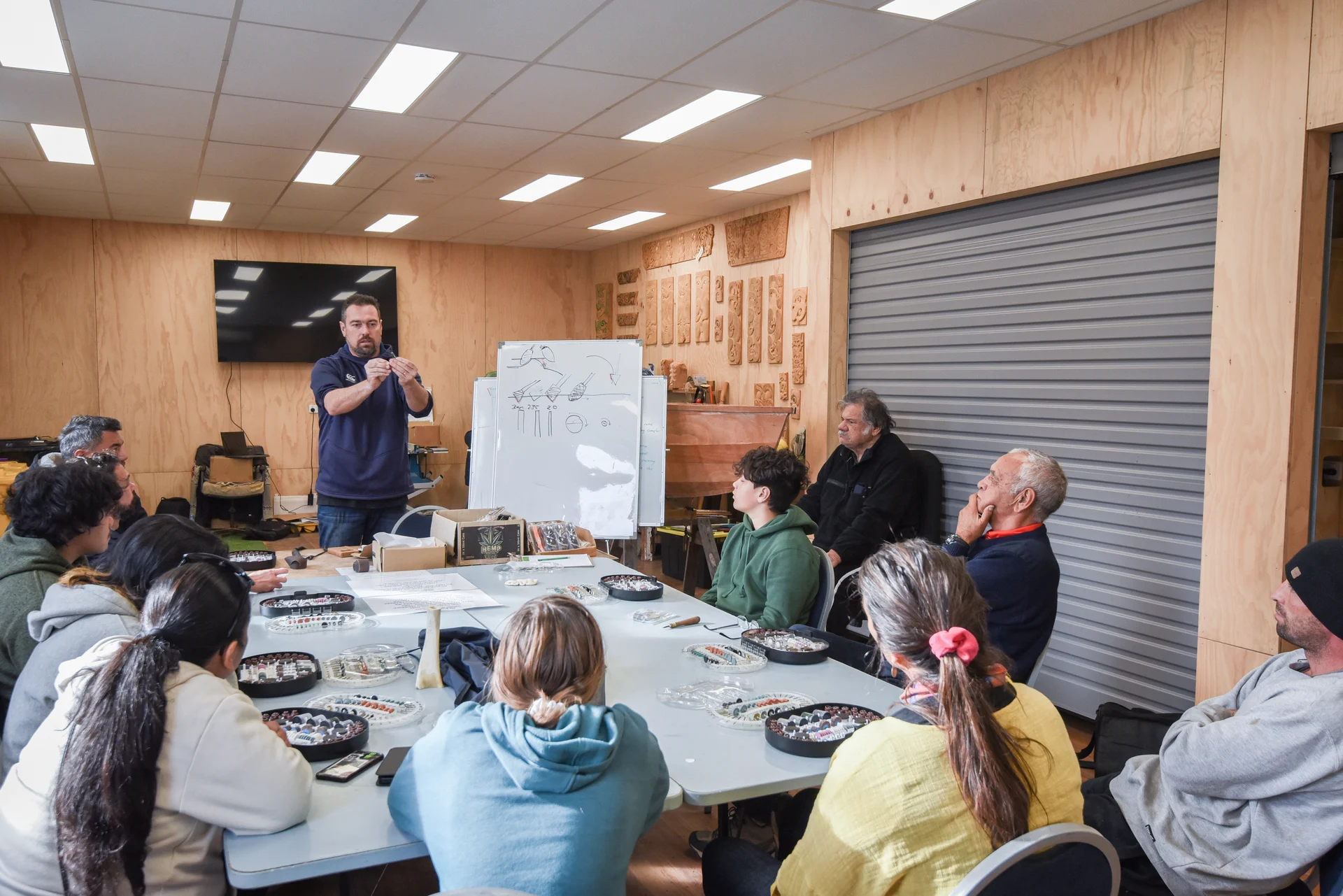
The art of whakairo (carving) has long been held close at Te Āwhina Marae, in Motueka.
Tohunga Whakairo (Master Carver), kaumātua John Mutu, has been based at the marae since 1987, making the carving house the longest continuously occupied marae-based wharewhakairo (carving house) in Aotearoa.
Last month, the fourth in a series of learning wānanga was held as part of a wider strategy to nurture the next generation of carvers and stamp Te Āwhina’s mark as the leading centre for Toi Māori (traditional Māori arts) in Te Tauihu.
Tutor for the course, artist Kahu Paki Paki (Te Ātiawa, Taranaki Iwi, Ngāti Ruahine, Ngā Rauru, Ngāi Tahu) says the Hei Taonga (Worn Treasures) wānanga series, funded by Whānau Ora Commissioning Agency for the South Island, Te Pūtahitanga o Te Waipounamu, was focused on rangatahi (youth) but brought whānau and generations together.
“We are using the Tuakana-Teina model which is focused on the relationship and partnership between rangatahi and pākeke (adults). Each participant attends with a learning partner, that might be their mum or koro, so that they can go away from here and carry on.
“One of the critical things is that everyone who has completed the programme gets a set of basic tools they can take away, so they have what they need to get started at this level independently.”
The Hei Taonga course covered different aspects of Ngā Toi Māori, including history, mythology, whakapapa, material preparation, design and practical sessions.
By the end of the four-day programme, students had made their own bone taonga.
Kahu says moving the wharewhakairo into its own freestanding building at the marae had been a game changer and was integral to a wider revitalisation strategy to secure the future of Ngā Toi Māori.
“Previously, we could only have four people carving at one time. We were fortunate to secure funding from Ministry for Culture and Heritage and Te Pūtahitanga o Te Waipounamu as well as support from ITM Motueka and Nelson Builders to be able to renovate an old building that was past its used-by date and make that shift.
“Now, we have a purpose-built facility that we can welcome whānau into, and better share our mātauranga (knowledge) around whakairo.”
Part of the initial funding also meant the marae was able to employ a project lead.
Long-time understudy to John Mutu (Ngāti Mutunga, Ngāti Tama) and a natural fit was Roni Petley (Ngāti Pāoa), a now established carver who learned under John at the marae.
Roni says being able to be at the wharewhakairo fulltime meant he was able to also spend more time with the first official residential carving apprentice, rangatahi Hoani Broughton-Hippolyte.
“‘I teach you; you teach many’ is part of the tikanga of learning and carving,” Roni says.
“John taught me that and he was taught the same. I have always worked with rangatahi and feel a deep sense of duty to pass on the skills I have learned, but as a full-time artist, training was hard to balance with the need to make a living. This way, I get to put my full attention into teaching Hoani.”
He says he was inspired by the marae redevelopment in progress.
“This kaupapa, and the wider redevelopment plans for the marae, mean we can keep traditions alive. The biggest thing today with Māori art being more accessible through technology is it can get scary, and there is a fear that traditional knowledge can get lost to a degree. There are artists and there are traditional artists.
“Here, we are rooted in the whenua, in the stories of this place and the marae, and this facility is keeping whakairo alive and keeping it to the standard that it should be. It’s holding that tradition at a level of excellence.”
Applications for the 2023 round of the RUIA fund, a partnership between Te Pūtahitanga o Te Waipounamu, Rātā Foundation and the Ministry of Youth Development, are now open. Applications close at noon on Friday, 16 June.
