
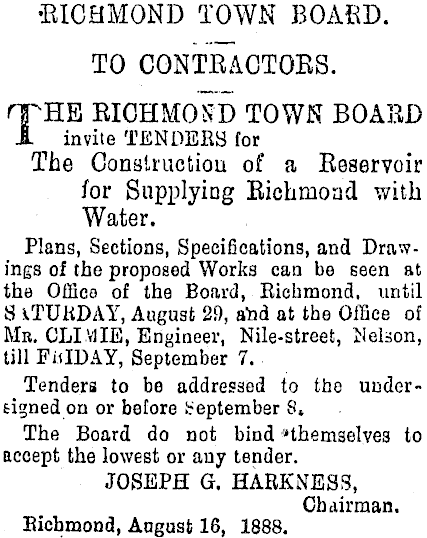
In mid-September 1885 a meeting of residents was called to discuss a proposed water supply for Richmond, in part after the Fire Brigade had expressed they needed a better supply with good pressure for firefighting.
Up to this point the principal source of water was from wells, tanks, and ditches, the water from which was frequently unfit to use for domestic purposes.
The suggestion was to bring water in from one of the gullies adjacent to the township. With those attending agreeing to the scheme, it was resolved to take advantage of the Town Districts Acts of 1883 in order to apply for a loan to carry out the work.
Town Board minutes between September 1885 and August 1886 showed ongoing discussion, but without much progress.
In a mid-August meeting Mr Lightfoot produced a plan with estimates for a water supply at around £1750, which was thought to be manageable.
Messrs Croucher, Harkness and Molesworth had examined the stream in Higgs Gully and found that it gave double the quantity needed, and this site was recommended after carefully considering other different sources of supply, quality and altitude for a dam and reservoir.
Discussion on various points took place, including any claim for compensation by the owners of property near the site of the proposed dam and stream, but the Public Works Act provided for all such cases and the Town Board had the power to take the land, and compensation would be settled by arbitration.
The proposal was accepted.
Debentures to the amount of £2,500 were to be issued under the authority of the “Local Bodies Loan Act 1886” the security being a special rate of 6 per cent on the annual rental value of all property included in the proposed waterworks scheme, together with the ordinary rates of all property within the town district.
A man paying 6 shillings a week rent would pay 4¼ pence for water, and 8 shillings a week would pay 5 ¾. The total estimated cost, under the supervision of Mr Climie, was £2300.
The first tender accepted was that of Mr Robert Lyon for the dam’s construction.
In October 1889, as work progressed, the money was running out and the Board took steps according to the Act to raise another £600 to complete the works.
Opposition was quashed as residents were informed that if this was not accepted the money needed would be paid for by a heavy rate levy.
The stream on the ranges was around three miles from the railway station; with an altitude of roughly 330 feet above the level of the street near to the Railway Hotel. The reservoir could store more than a million gallons of water.
From this fountain-head about five miles of main pipes were laid to convey the water to the streets, which had capacity to discharge as much as 30 gallons per head per day to a population exceeding 7000.
The water was supplied on the constant high-pressure system. For the purpose of firefighting, fire plugs were fixed to the main pipes at intervals along the route of from 80 to 100 yards.
