
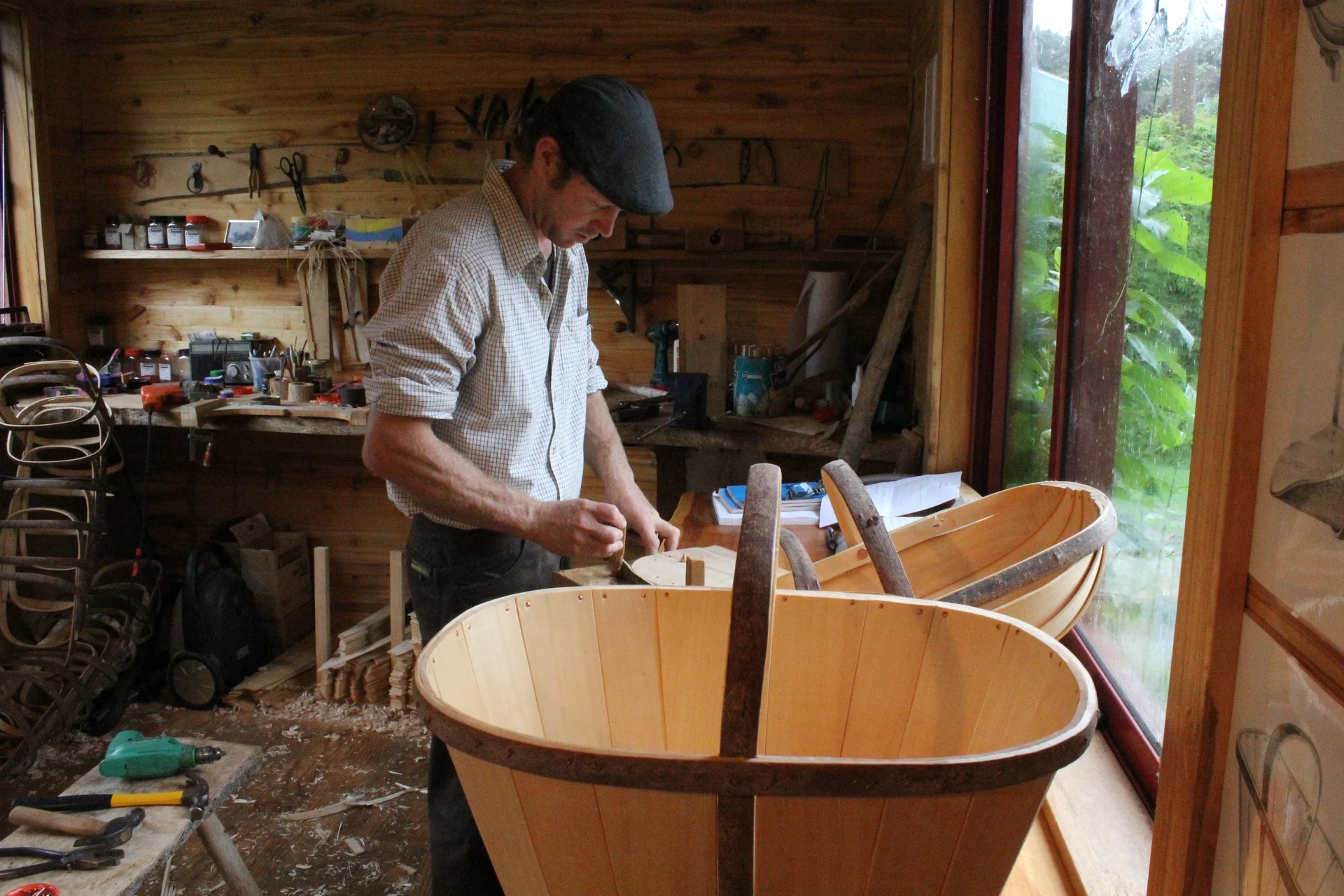
From his rural workshop near Takaka, trug maker Tony Hitchcock brings two hundred year old wood working techniques into the twenty-first century. Alistair Hughes pays him a visit.
Golden Bay artisan woodworker Tony Hitchcock is apparently part of an endangered species. According to the Heritage Crafts Association, (of which King Charles is president), Tony’s mastery of trug making is an ancient skill in danger of dying out in its home country of England.
Trugs are traditional shallow baskets made from shaped slats of wood, used for carrying garden tools and produce. Perfected in Sussex two centuries ago, Tony still uses original techniques to keep the craft alive, from his workshop just outside Takaka.
“After I made the first one I was quite excited," recalls Tony. “It just feels so natural, working with untreated, alternative timbers. In winter you harvest your rims and handles and it’s such an enjoyable process. Taking a little handsaw, pottering along the river bank, and bringing timber home to render and steam. And with coppicing, it grows back.”
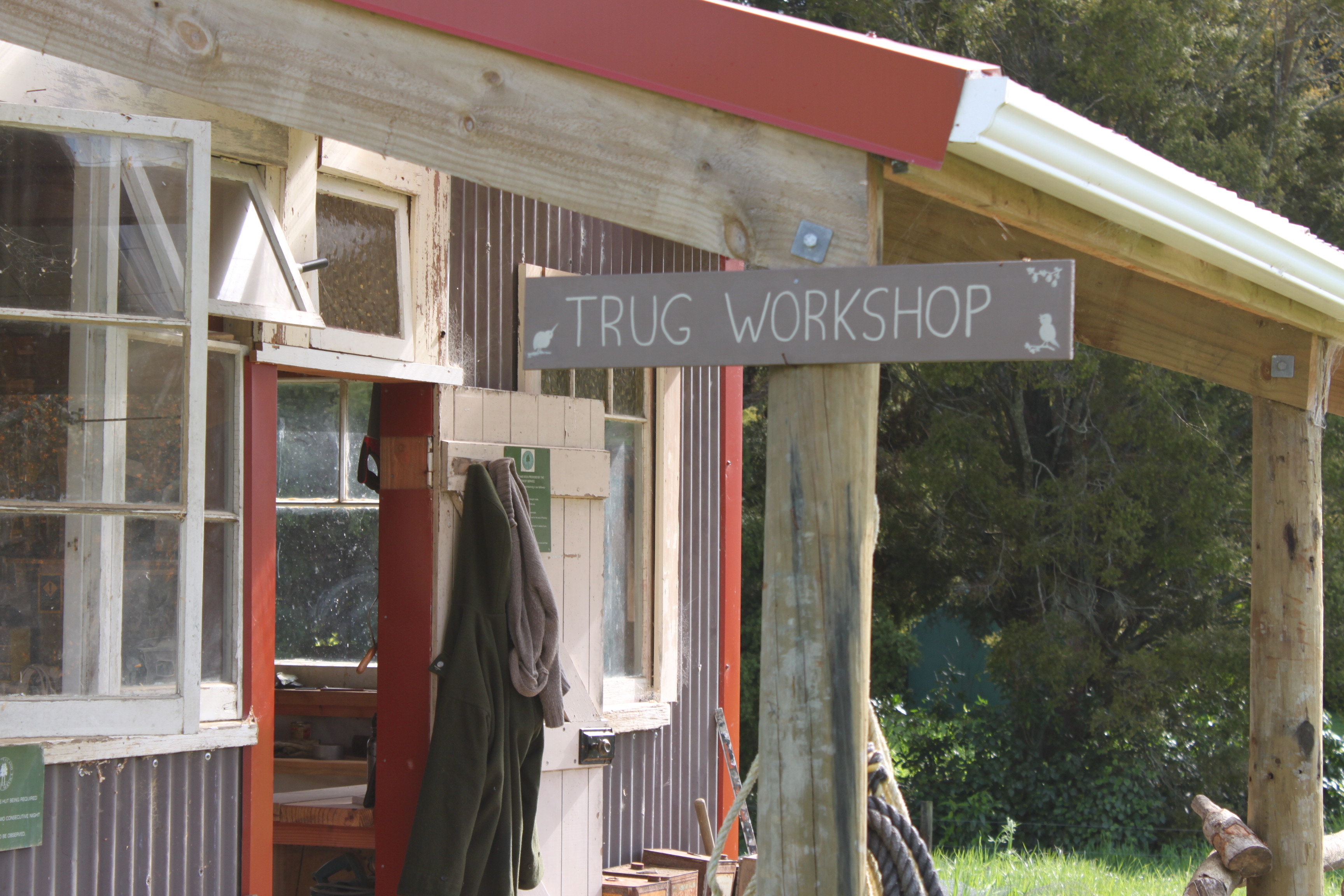
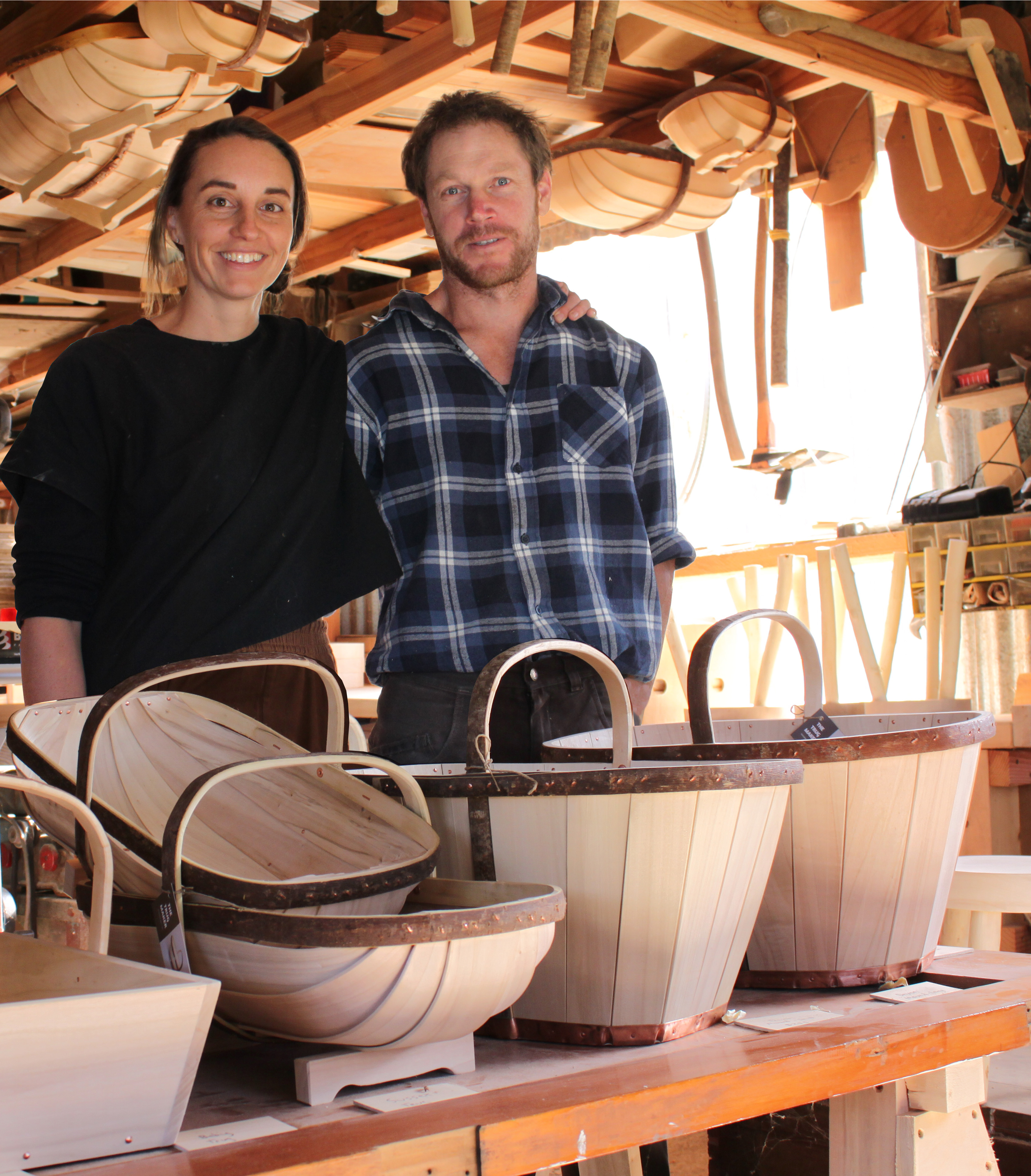
Tony is describing only the first steps in a precision process which results in a truly beautiful, and practical receptacle. The frame is generally made of hazel or willow with the slats which form the basket shaped from aspen poplar. The design also incorporates locally sourced copper boat builder’s nails and a finishing strip, also copper, is salvaged from retired hot water cylinders.
On seeing the final product, there’s an irresistible tactile quality to the combination of planed timbers and carefully assembled curves.
“You can show people a photograph of a trug," smiles Tony, “but when you actually hold one out to them, everyone wants to touch it!”
Tony has been in this unique line of work for five years now, after inheriting the business from his mentor and neighbour on the other side of the nearby Anatoki River, Brett Hutchinson. Their association stretches back a long way, to when Tony mowed his lawn as a teenager. Always interested in carpentry, Tony and a young friend even constructed a bush hut on Brett’s property — which is still standing and a popular neighbourhood destination today. After leaving school and working with the forest industry, Tony popped in on Brett for a cup of tea, little realising it would change the direction of his life.
“Brett announced that he’d just made his made his last trug,” recalls Tony, “and seemed quite happy to retire and focus on other things. My ears pricked up and I told him that in all these years I’d never actually watched him make a trug or learned how. And he said that if I was interested in taking over the business then he’d teach me.”
Tony describes the process of learning as casual, but intense at the same time.
“He was very gentle, but his attention to detail and commitment to quality meant that he would always tell me if something wasn’t good enough.” This extended to Brett retrieving an early trug which Tony had sold. “He told me I needed to go back over it, and he was dead right, you know. So I think I really learned a huge amount from that.”
Tony particularly took to this venerable craft because his long-held desire to work in artisan wood crafts had always been frustrated by dyslexia.
“I told Brett that it had made any sort of woodworking in the past a battle, and he took out a tape measure and told me to drive a four inch nail through the middle and forget it. Because trug making is all to do with feel and done by eye. There are a few basic measurements, but it’s about knowing what is going to look good and also hold together well.”
Tony gained his skills over a season with Brett, but actually running a business would involve more than just that. And this is where Maddy - the cousin of his childhood hut-building friend, and now Tony’s partner — brings another set of skills.
“I do the accounts and admin,” explains Maddy, “managing the website and updating social media.” She jokes that Tony seems to have his own ‘magnetic field’ which somehow slows computers down whenever he goes near them, so their separate roles are ideal for each other. “In a partnership it’s important to realise where our individual talents lie. And it’s given us a confidence that I don’t think we would have come across individually," says Tony.
Maddy was able to utilise the time which the 2020 lockdowns provided to overhaul their administration processes.
“Customers used to email us and there would usually be a story attached about their personal connection with trugs, and then we’d discuss shipping and I’d write an invoice. It was very personal but also very time consuming.” They have since moved to handling all orders through their website, which has instantly made a difference.
“We initially thought business was slower," laughs Maddy, “but it’s actually because we’ve become more efficient. It’s streamlined things, and when you’re bringing up three young kids that’s really important.”
Episode 11 - living locally and working globally — The Nelson Pod
Customers still contact the couple to pass on their trug stories or leave comments online.
Tony feels this is an important element of what they do. “We were very hesitant to lose that human connection and become just another business which processed orders automatically. But Maddy has done so well with designing the system that people can still communicate with us if they want to.”
He describes the process of creating a trug as ‘a full and focused day’. “Add getting the base and boards ready, it’s three days, really. And then if you go right back to coppicing the timber, then probably a week in total.”
Tony claims making your first trug can make you ‘wish you were an octopus’. “You’re trying to hold a drill and a hammer and a nail at the same time, and obviously if you press too hard you’ll break the wood. If you’re too gentle, or too slow, it will start to dry out. But once you get a rhythm to it, it’s quite beautiful.”
As well as the trug, Tony also makes an elegant flower basket constructed of a single shaped piece of timber, and then the much more complex ‘Devon maund’. Larger and deeper than a trug, the maund was originally used to gather and store produce like potatoes and onions.
Orders are despatched in plain cardboard boxes, as the classic trug and maund designs are surprisingly robust. Dispensing with unnecessary polystyrene packaging fits with Tony and Maddy’s desire to run a sustainable business, and any waste from the manufacture originally became firewood or mulch.
However, once again due to the pandemic, Tony has had time to further refine his technique and increase his product range, which helps further reduce any otherwise unusable timber. He picks up a perfect replica of his renowned classic Sussex trug, intricately fashioned at half size.
“I was able to develop these ‘child’s trugs’ and that’s been a lot of fun.”
Unable to use the templates which he had for the full-sized versions, Tony admits that scaling them down required a lot of trial and error. “But it's a fantastic way of using wood which might have snapped if used for a full sized trug, which has cut down waste phenomenally.”
Tony’s further refinements in the steaming and shaping processes mean that a lot less boards break. The neighbourhood has cause for a little regret, however, as this discarded timber would otherwise have been bagged up and distributed as the driest kindling available anywhere.
Other new products include milking stools, and a more bench-shaped seat called ‘Roger’s stool,' named after Tony’s uncle who created the prototype many years ago. Finally, a robust and perfectly mitred ‘tool trug’ completes the new range, its straight edges contrasting with the more curved garden variety. “Brett had a cardboard prototype which I was able to use as a basis, although the angles were still really challenging,” says Tony. But he enjoys the variety which the different processes these newer products require.
Visitors are welcome at his workshop by appointment, where they can see a trug take shape before their eyes. The area alone is worth a visit, bordering the Kahurangi National Park and rich in local history.
“We wanted to be part of something which is more gentle on the world, and the environment,” says Tony. “And I’ve always been really passionate about anything to do with trees, whether it’s wood working or planting. So it’s a great blessing to have had all of this passed onto us, really.”
