
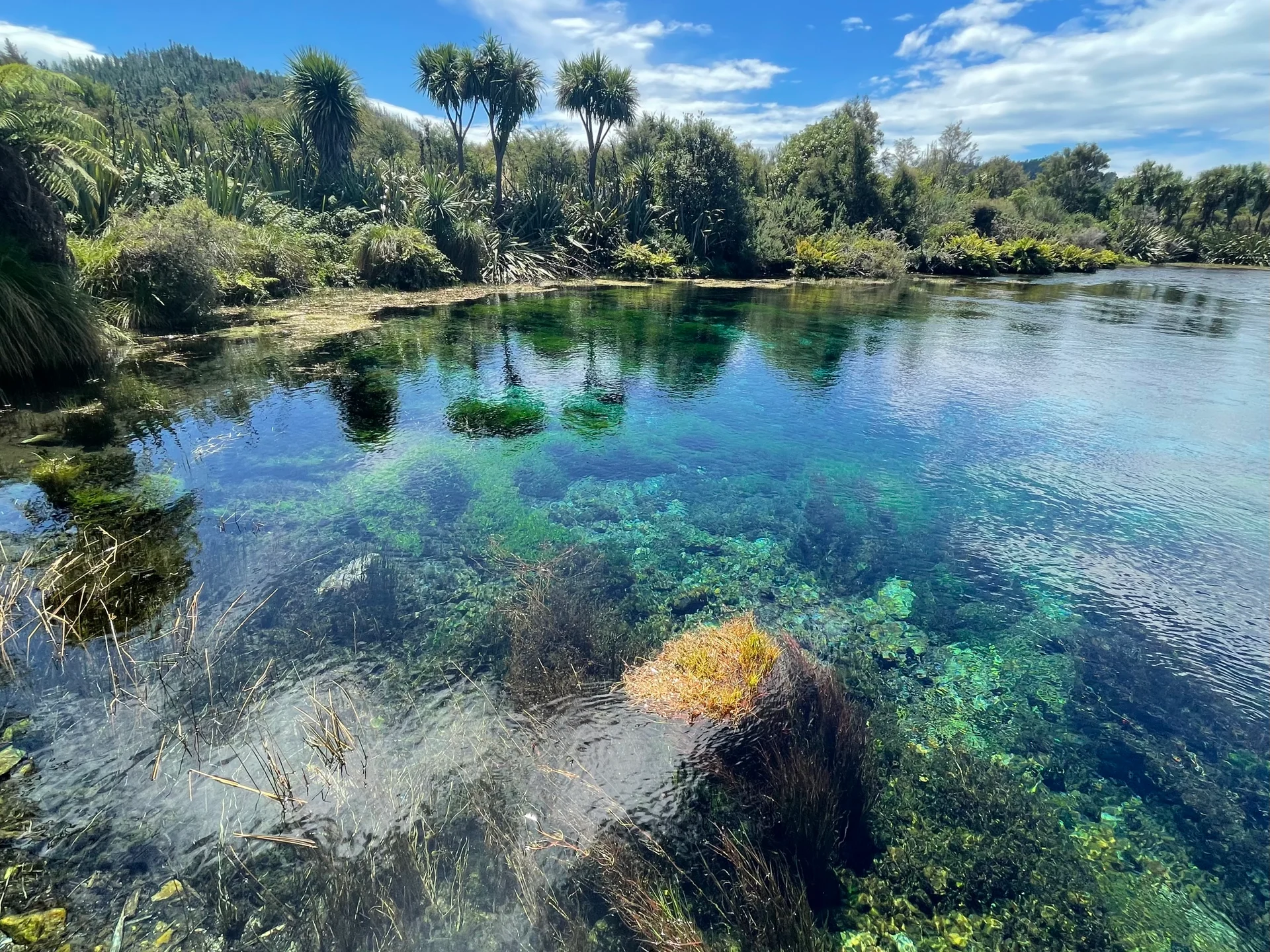
The Environment Court has recommended that a Water Conservation Order (WCO) be put in place for Golden Bay’s Te Waikoropupū Springs and its associated water bodies.
The order comes with tough conditions on nitrate levels and irrigation for the surrounding area that feeds the freshwater springs – the largest in the southern hemisphere.
The court found that all parties involved, which included Tasman District Council, local iwi, farmers, Save our Springs Alliance, and Friends of Golden Bay, agreed that a WCO was needed to protect the springs. Their differences were about how the WCO should be framed, particularly around nitrates.
A WCO is a form of secondary legislation that can prescribe restrictions or prohibitions on the exercise of a regional council’s powers under the Resource Management Act.
The court found that for local iwi - Ngāti Tama ki te Tauihu, Te Ātiawa and Ngāti Rarua - the springs are one of the most sacred places in Mohua Golden Bay. The WCO will also include the associated water bodies that feed into the springs’ area.
“The exceptional clarity of those bubbling waters is renowned and connotes what we adjudge to be an outstanding spiritual quality,” the report read.
The 314-page report says that Wharepapa Arthur Marble Aquifer is part of a highly complex and vast karst hydrogeological artesian system that, along with the Tākaka River and its tributaries, feeds the springs.
Te Waikoropupū has important scientific and ecological value, being listed as a Water of National Importance for biodiversity.
Their underground ecology is understood to contribute to the springs’ exceptional water clarity. Amongst the diverse assemblage of small aquatic invertebrates inhabiting the groundwater feeding the springs are stygofauna about which little is known (including their sensitivity to changes in water quality).
Those qualities contributed to the court’s judgment that the subject waters have “outstanding values”.
Monitoring data, primarily gathered by members of Friends of Golden Bay Inc. had revealed a progressive increase in the springs of levels of potentially harmful nitrate-nitrogen.
The court’s evidential findings found that the natural state of the springs and its outstanding values are at significant risk from human-induced pollution, particularly increasing levels of some nitrates.
The court process has defined a water allocation limit for the catchment and a minimum water flow to protect the springs and has also defined a nitrate target at the springs to be reached by 2038 and is the first WCO in New Zealand to seek improvement in water quality.
As a submitter to the hearing, Tasman District Council focused on ensuring the WCO is able to be implemented in a practical way.
“We want to see the best outcomes for the springs, the wider Tākaka catchments, iwi and the community,” a statement said.
“We maintain our commitment to improve freshwater management in the Tākaka Valley, to ensure existing good water quality and health is maintained and improved where needed.”
