Climate change is starting to affect us here in the Tasman region with farmers and growers already feeling the heat.
The national average temperature has already increased by 1.1 - 1.2 degrees. South Island glaciers are retreating, we are experiencing fewer frosts and more frequent extreme weather events resulting in increased insurance costs and disturbed livelihoods, and unfortunately, climate modelling is projecting that there is more to come.
The terms ‘global warming’ and ‘climate change’ are sometimes used interchangeably, but ‘global warming’ is only one aspect of climate change. ‘Global warming’ refers to the long-term warming of the planet. ‘Climate change’ encompasses global warming but refers to the broader range of changes that are happening to our planet.
These include rising sea levels, shrinking mountain glaciers, accelerating ice melt in places like Greenland, Antarctica and the Arctic, and shifts in flower/plant blooming times.
“Human activities in the form of greenhouse gas emissions are the biggest contributor to climate change and global warming,” says Andrew Fenemor, a hydrology expert from Landcare Research Nelson.
Greenhouse gas emissions are gases in the earth’s atmosphere that trap heat. Our greenhouse emissions come from things such as burning fossil fuels for electricity, heat, and transportation as well as fuels used to power businesses such as meat, dairy and steel companies which all put out heat-trapping gases into the air.
“Climate change for us means warmer temperatures all year round, increased extreme weather events, and in Nelson-Tasman, slightly more rainfall annually,” says Andrew.
“We are seeing the effects of global warming now with the extreme heat wave in Europe.”
Examples of extreme weather events include floods, thunderstorms, cyclones and droughts.
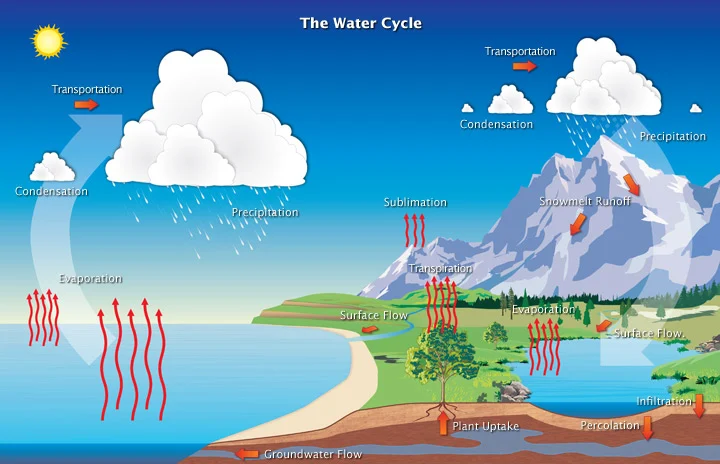
An increased global temperature has a big effect on the hydrological cycle (global water cycle) which is how water moves from the land and ocean surface to the atmosphere and back in the form of precipitation (rain).
“When you boil the jug, as it gets hotter more steam is released - this is because air at a higher temperature can hold more water droplets. The same happens with global warming as it forces our water cycle to move at a faster pace, increasing the intensity and frequency of wet and dry spells,” explains Andrew.
“Even though annual rainfall is projected to increase slightly here, we actually expect longer droughts and worse floods - talking about averages sometimes isn’t helpful,” he adds.
Records from the major ports indicate that the local sea level has risen by 15–20cm in the last 100 years and advice from the Ministry for the Environment is that a sea level rise of at least 0.9m (90cm) should be planned for by 2090.
“From this, we can expect an equivalent rise in the water table adjacent to the coast, and for the salt-water wedge in our coastal aquifers and rivers to move inland 0.9m higher in elevation. In the absence of higher summer river flows (as planned with the Waimea Community Dam), a 0.9m rise in sea level would increase the risk of seawater intrusion into coastal wells along the Waimea Inlet and up the Waimea River towards the Appleby Bridge,” says Andrew.
A few of the predicted challenges climate change will bring to farmers and growers in our region are increased irrigation demand and the need for more water storage to meet this demand.
“If our summers become hotter and drier then irrigation demand will increase, as will water demand in town. And longer summer droughts will mean lower river flows and groundwater levels, so water storage and efficient water use become even more critical.”
New Zealanders produce a lot of greenhouse gases. We are a small country but our emissions per person are big. Per person, we’re one of the thirty biggest emitters worldwide.
With the increased temperature, we are already in the position of needing to adjust and make a number of changes in response. The key now is to take vital steps to limit any further warming.
As individuals, we can do this by supporting businesses that are reducing their emissions, reducing their impact on forests, water and agriculture, moving out of fossil fuels and using renewable energy.
We can also speak up to local leaders, council members and policy makers and keep climate change in mind when making decisions regarding our households heating, consumption, waste and transport.
