
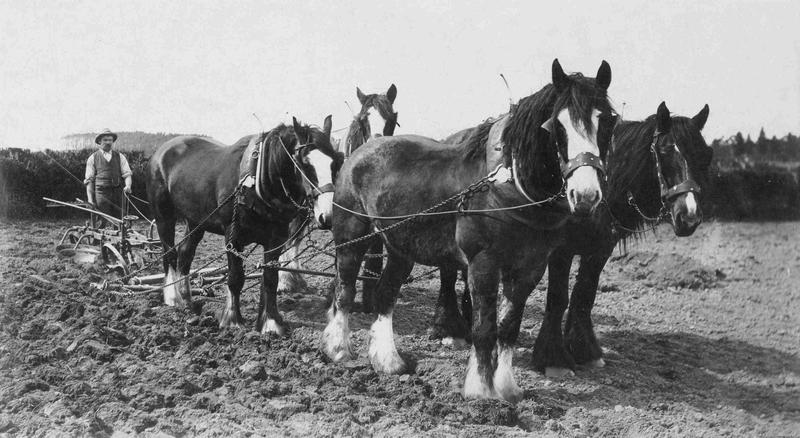
In August 1869, Judges Stratford, Castle and Smith oversaw a ploughing match, advertised by the Agricultural Association, which took place in a grass paddock on Mr Thompson’s farm in Richmond.
Twenty ploughs were all at work together, and each one was watched keenly and critically by a large number of spectators, which created a scene of interest and bustle amongst an otherwise quiet Waimea settlement.
The paddock in which the match took place was thirty acres in extent, with a very closely cropped and rather dense expanse of short grass, covering a rich but somewhat shallow loam.
Previous to the start it had been divided into about forty allotments, each measuring an exact half acre, and each clearly defined by stakes and distinguished by a number. At the appointed time of 10am, fifteen wheel ploughs and five swing-ploughs had entered the field. They were all drawn by horse teams but disappointingly there were no bullock teams present. Each ploughman having drawn a number from a box went to the corresponding allotment.
One of the ploughs, owned by William Bell of Waimea West, was 48 years old and was said to be one of the first plough that broke ground in the country. It had belonged the Williams’ father who, in the very early days of Wellington, used the plough to break up the virgin soil of the settlement.
At about three in the afternoon, the ploughmen, having completed their work, retired to await the judges decisions which, after a careful scrutiny of about an hour and a half, announced the numbers of the prize allotments.
The successful competitors were:
First in wheel ploughs – Thomas Russ (£3 prize)
First in swing plough – William Bigger (£3 prize)
While the Judges were engaged in going over the ground, at the request of several of the bystanders, another match was held, and a prize of £1 offered for the straightest furrow, which was awarded to William Eden.
All were able to agree the match was a credible one and showed marked improvements on the previous year with many of the ploughs on the ground being of the most improved construction and included the most recent improvements of their respective makers, (Ransomes, Hornby, Howard and Dray and Dinnow).
Also noted was the superiority of the ploughs used over those brought into the field at previous matches; the substitution of implements being lighter, and of much easier draught; the change from bullock teams to horse teams, and the character of the greater portion of the ploughing created a good impression of agricultural progress.
The benefits to the agricultural community through the means of ploughing matches were thought to be greater and more perceptible than any other operations of the Association. Many of the ploughmen were colonial-born youth who had never been accustomed to exercising the skill, care, and nicety which was essential to good ploughing, and it is only on such occasions as the matches that they had an opportunity of seeing and studying the best examples of their craft by learning from experienced ploughman who had received their training in the old country.
Following the match, a dinner was provided by Mr Tovey, the new landlord of the Star and Garter.
