
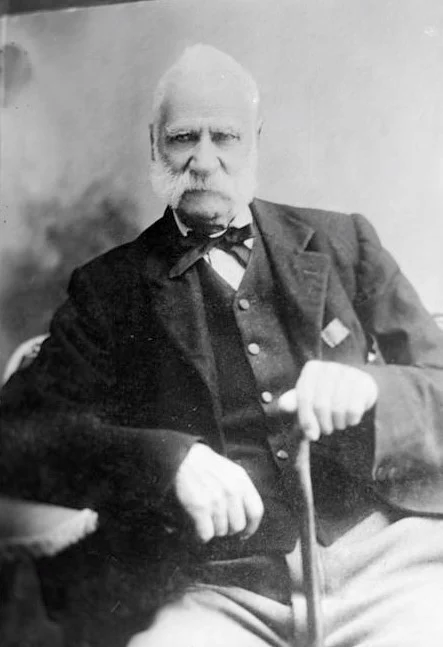
In 1876 at the age of 54, John Humphreys (Captain) retired from army life after a career of 33 years, with almost all this time spent in India serving in the British Army regiments. A whole new life beckoned and decisions had to be made as to what to do next.
John’s uncle, Edwin Humphreys, had immigrated to New Zealand in 1842 and settled in Dovedale, therefore it seemed a great move for John to join him in a new country. John, his wife Mary Jane, and all but two of their children, sailed from England in October of 1876 on the ship “Kent’ to Australia and from there to Nelson aboard “Tararua”.
On arrival in Dovedale John purchased a farm of 100 acres and began a life of farming that was quite foreign to him. He quickly took an interest in the community and civic matters and at one time represented the Anglican Church in Dovedale, being instrumental in the building of a new church in Dovedale, and was a committee member with the Waimea Road Board.
It was not an easy life and was physically hard. To purchase supplies, the family travelled, often on foot, over the Dovedale Hill to Wakefield and back, a round trip of approximately 50 kilometres.
Unfortunately, the early years in Dovedale were not kind to John as he lost his beloved wife in October 1884. By 1885 bankruptcy proceedings were taken against him. John was a soldier not a farmer, and his inexperience in farming, along with failed crops, put him in the position of being unable to pay his debts. The farm was sold, and John had to start again.
To give back to the community he often gave speeches, talking about his life in India. The fees charged for this were donated to needy causes such as the unemployed.
The content of the speeches were about his military career in India which began with him leaving the family home in Worcester at a young age and walking to London to join the army in 1842, a distance of 112 miles. He spoke of the early days in the 94th Regiment of Foot in which he was a private, and the many manoeuvres in various parts of India where he saw action.
In 1849 John married Mary Jane Campbell, a young Indian girl at Fort St. George. The ensuing years saw the couple have 13 children born in five different countries.
On joining the army, John was surprised to learn that he was at once a debtor of over £3, having been charged for his uniform. In questioning this he was told not to ask questions and just sign the accounts. After leaving England to join the regiment in India he received another kit for sea and on reaching India was given another kit for the hot weather, which he had to pay as well.
Army pay was low at £1, 12s, 6d per month and acquiring kits were costly. In his first two years as a private he was left with one penny per day. His dedication saw him move through the ranks, from private to captain, which was quite an achievement for a non-commissioned soldier.
John died in March of 1910 from a heart attack. He had requested that he not have a military funeral but would like the last post to be played. His obituary stated that John was greatly esteemed by all who knew him for his ‘kindly disposition, his benevolence, and his fortitude under misfortune.
Many of his descendants continue to live in the Tasman region.
