
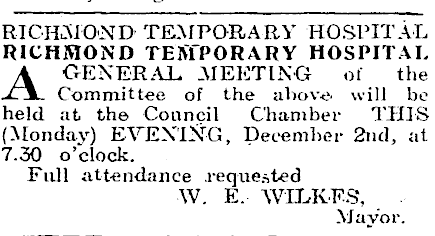
As the Influenza epidemic of 1918 hit Nelson and the outlying country districts, the main hospital fever ward was at capacity and could not take in any further patients.
A meeting was held at Richmond where it was decided to ask the Agricultural and Pastoral Association to allow the new grandstand at the park to be used as a temporary hospital for influenza cases.
Following an inspection by Mr T Neale, Chairman of the Hospital and Charitable Aid Board, the buildings were deemed to be highly satisfactory for the purposes of an emergency hospital. The buildings and location provided the perfect location, being well isolated and yet still in close proximity to Richmond.
The larger building containing a refreshment room was handed over to the Epidemic Committee and the Nelson Jockey Club building was used as quarters for the nursing and cooking staff.
Together these buildings provided a well-arranged kitchen with water laid on, with the main building being partitioned into two wards containing six to seven beds.
The grounds, kitchen, scullery and wards were fitted with electric lighting by the Waimea Electric Light Power Company in very quick time. In the space of a few short days the empty buildings were transformed into a well-equipped hospital presided over by Mrs E Thomas and a band of volunteers.
However, not all were happy, with the heading “Hospital Board’s Charges Resented’ appearing in the newspapers.
The argument followed that the impression among the public was that the hospital was opened as an emergency measure to assist in stemming the epidemic by isolating in the institution everyone suffering from influenza, and that no charges were to be made, as well as relatives of the patients and others sending in generous supplies of milk and general produce.
Some were surprised and full of indignation to find that fees had been charged. Explanations given were that all temporary hospitals were under the direction of the various hospital boards, and before they could be established, they had to be recommended by the board for the approval of the department, and once approved the board was responsible for their maintenance.
The question of fees to be charged at these hospitals naturally occurred. The fees in the general hospital were six shillings per day, including medical attention. The Chairman of the Board made the argument that due to the valuable voluntary helpers and the generosity of Dr Washbourn treating patients for free, the fees could be reduced to four shillings per day with special consideration for particular cases.
As to the amount of the accounts rendered, the secretary of the board stated that the largest amount was £12 for the treatment of one family of two adults and two children for 20 days, at 4s per day for the adults and 2s per day for the children.
After the initial wave of patients, influenza cases in the district quickly receded. The temporary hospital was closed, and Richmond Park returned to its usual function in time to host the delayed Annual Show on the 19 February, 1919.
A large picnic was held at Baigent’s property in Wakefield as a thank you to the workers who helped at the hospital, and Mayor Wilkes delivered a speech crediting the workers and the ‘isolation method’ for the successful treatment of 32 patients, with no deaths.
