
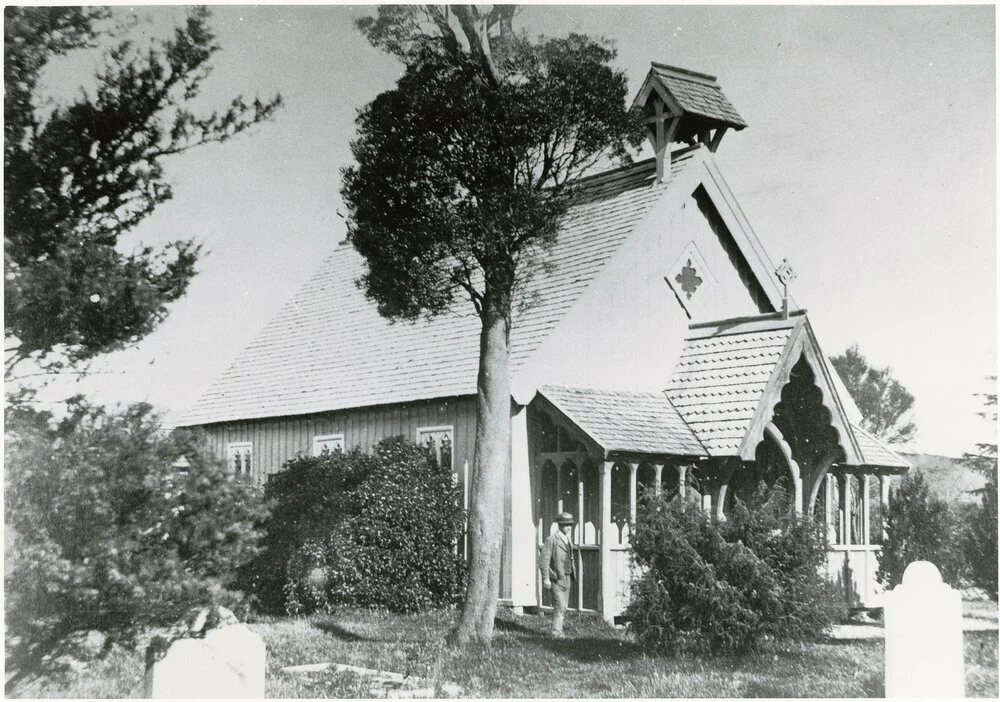
In 1856 Rev. Thomas Bowden was approached by a deputation of Messrs Blundell, Baigent, Dickenson and Gore, representatives from the three districts of Wakefield, Spring Grove, (as Brightwater was then called), and Waimea West, asking him to become their Minister.
Thomas was ordained a priest in 1848 at the Chapel Royal, St James’s Palace. In 1855 Thomas, his wife Caroline and four children emigrated on the John Phillips to Nelson. They settled in Upper Moutere where they built a cottage and started to farm.
A site for the church and parsonage had already been identified but was yet to be built. Thomas and family moved to Wootten’s cottage, which was situated on church property at Waimea West, and resided there for several months until the seven-room parsonage was built.
With the house completed, the focus became the church. While it was being built services were held in a tent. The minutes of the first meeting of the Archdeaconry Board held on 26 January, 1856, recorded Rev. T. A. Bowden’s position as representing St Paul’s, Spring Grove.
This proved that the tent, even if was not consecrated, had been named and was officially recognised as a church. The new church building was opened on Sunday, 9 August, 1857. The architect was Mr Barleyman and the builder, Mr Wood. Other noted clergymen who supported the church in its early years included Rev. Samuel Poole, and Rev. R Codington.
In early August 1937, on a Saturday afternoon, a large gathering celebrated the 80th anniversary of the Church with the dedication of the memorial walls and gates erected by parishioners.
Bishop Hobhouse congratulated them on their efforts for their anniversary celebrations. The wall and pillars on which the gates were hung were constructed on a concrete foundation from stone sourced from the Wairoa riverbed and capped with white cement.
In each pillar a black marble slab was set, one engraved with the words ‘St Paul’s Church 1857-1937’ and the other ‘In Memory of the Pioneers’.
The stonework was carried out by Mr A. McConchie of Nelson. The gates were constructed of heavy wrought iron and painted black and were made by Mr Frank Robertson, of Brightwater, who was himself a descendant of one of the pioneer families.
A renovation of the old porch made of English oak and erected by Bishop Hobhouse in memory of his wife, was undertaken for the event, after someone had covered it with paint. It dated back to the 1860’s.
Within the porch was a brass engraved tablet with the words, ‘This porch was built by Edmund, first Bishop of Nelson, in loving memory of his wife, Mary Elizabeth Hobhouse, whose soul was required. October 12th A.D. 1864’.
The church still stands as a silent testimony to the work of the church committee, architect, and building.
It was noted that besides the grave of Mrs Hobhouse there were many others buried in the churchyard formerly well known in the district. Among them was the grave of Mrs Agnes Grace, widow of the Rev. T. S. Grace, who did much missionary work among the Māori in the North Island.
Another was that of Captain and Mrs Colt, who came to Brightwater from India and Mr and Mrs Rutherford, grandparents of Lord Rutherford, the Dominion’s most distinguished scientist.
