
In August 1884 the arrival of a new doctor at Wakefield caused great excitement.
Dr Walter Relf Pearless, born 1854 in England, was the son of William Pearless, solicitor of East Grimstead, London.
He studied at Bartholomew’s Hospital in London before taking his degree in 1876.
Sometime after this he immigrated to Victoria, Australia, where he married in 1877 to Marianne Lessel (Raikes), eldest daughter of Judge Raikes of the Indian Civil Service.
Walter set up his practice in Wakefield and quickly established himself as a very capable doctor.
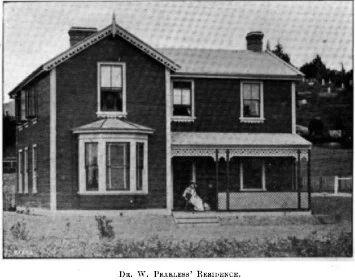
With the support of Henry Baigent, the family rented various places in Wakefield until their new home Felbridge House was completed in about 1885.
It was named after an English settlement in East Grimstead, his home Parish in England.
Upstairs were six bedrooms and a bathroom while downstairs were living areas, as well as a surgery and waiting area.
Walter’s dedication to his profession became well recognised and acknowledged and his diligence, before the advent of the car, saw him travelling long distances to attend to patients and always doing his upmost for everyone.
Soon after arriving in Nelson, Walter became a member of the Volunteer service.
He was then appointed surgeon to the Waimea Rifle Volunteers and in 1897 was promoted to Surgeon Major as well as receiving an appointment in 1899 as Principal Medical Officer of the Nelson Military District and then of the Canterbury Military District in 1911.
When the Boar War broke out Walter immediately volunteered, but was considered too old.
Later he was accepted, leaving for South Africa with the 8th Contingent, Colonial Auxiliary Forces, on the 1 February 1902 where he served as Brigade Surgeon with the rank of Lieutenant Colonel.
After the war Walter returned home to his general practice but within 10 years was serving again in World War 1.
On the outbreak of war, he was one of the first people to put his name in.
After attestation in August 1914, at age 60, Walter then served in Gallipoli, Egypt, France, and England with the Main Body of the New Zealand Expeditionary Force.
His reputation as an officer was one of gallantry and refusing to take any ‘soft’ jobs due to his age. Returned soldiers talked of how he was a great optimist and that his influence sustained them.
Walter and Marianne’s son Hugh also trained as a medical doctor and joined his father in partnership at Wakefield.
Upon retirement he and Hugh swapped houses and Walter remained in Brightwater until his death on 23 December 1924.
On his passing it was expressed that, ‘the passing of a brave, patriotic, and loyal gentlemen and soldier would leave a gap in the community’.
He was buried with full military honours at St Johns Churchyard.
In recognition to the service Lieut-Colonel W. R Pearless gave to his community and to his country, the people of Wakefield looked for an appropriate memorial.
An original idea was to erect a memorial stone on his grave, but the response had been so great that Memorial Gates and an arch on Wakefield Domain were decided upon.
The opening in April 1926 was a grand affair with a large crowd attending for the ceremony.
