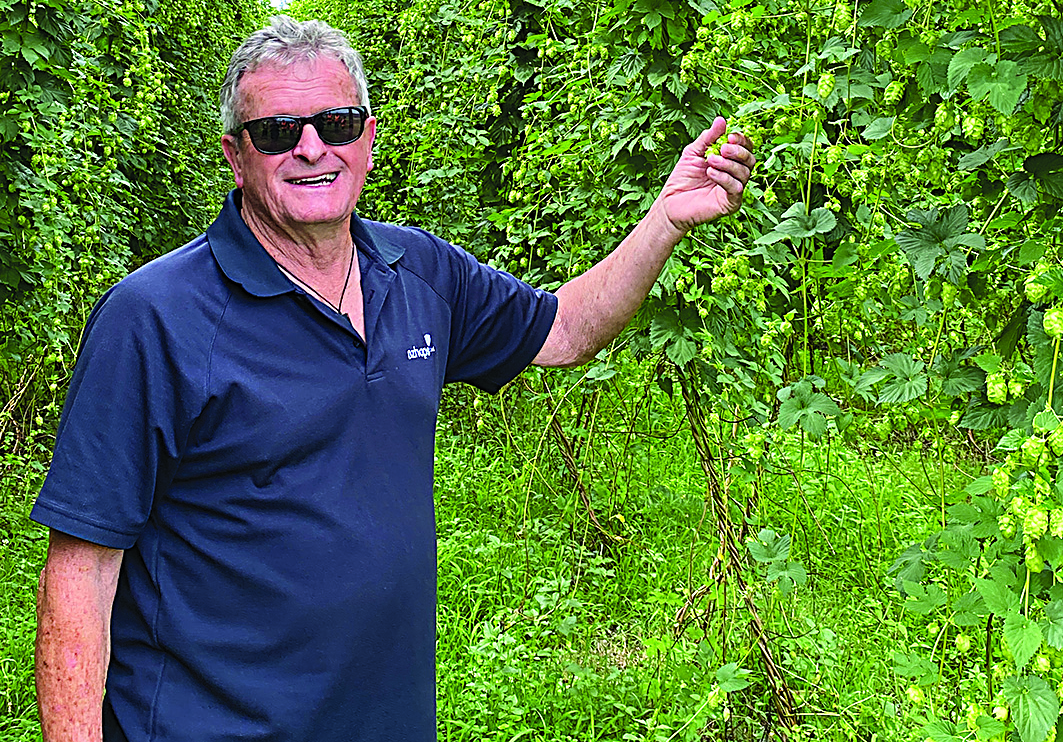
Half a century on and Motueka- based ‘hop-legend’ scientist Dr Ron Beatson is still creating new hop flavours and aromas. Ron recently retired from his 38- year role in the research and development of hop breeding and genetics under the umbrella of Plant & Food Research Riwaka, which is now led by his successor Kerry Templeton.
He hasn’t retired fully - instead he has stepped into a part time role for NZ Hops Ltd Grower cooperative, as their Brand Ambassador where he is currently involved in a joint breeding programme between Plant & Food Research – NZ Hops Cooperative.
“As a scientist, my work involved developing hops for the New Zealand industry. Since our country has very few pests and disease issues, it enabled the breeding programme to concentrate mainly on developing new flavours and aromas for use in a wide range of beer types,” Ron says.
Flavour and aroma are what allow brewers to craft a beer that is unique with each variety of hop providing its own flavour profile. “Our flavours are recognised as being particularly good for ‘hop-forward’ beer styles such as IPAs, Pale Ales, and Pilsners which means craft brewers are particularly fond of our hops and this has proven to be an advantage to the industry,” Ron says.
It’s a complicated process to create a new flavour and once a ‘cross’ is completed it usually takes around 10 years of rigorous selection and testing before a selection can be released to the industry. It’s Ron’s job to ensure any new varieties have all the critical properties. “It needs to have a good yield and be a plant that grows well in the spring. Machine harvest properties are important as well as harvest maturity, and what date it will be ready for harvest,” Ron says.
To start with, female hop flowers are placed inside a large pollen- proof bag, to exclude any ‘foreign’ pollen from getting in. Just before they flower, pollen from a
hand-selected male plant is introduced into the bag. By early March, the female flowers have developed into the characteristic ‘cones’ when they can be hand-harvested and dried at a low ambient temperature so as not to kill the seeds inside. From this, the seeds are extracted, germinated and raised in a glass house, and then placed in nursery pots.
After this stage, the seedling plants are transferred to the field and once they are established, the selection process commences on 2-year-old plants. Ron simply explains it as: “Essentially, we cross the chosen parents and keep the seeds from the cross for growing on.” Once a selected individual from a seedling population has been made, further trials are necessary to determine their commercial prospects.
The chosen plants are cloned, and larger-scale trials begin for a range of factors including yield, plant chemistry, harvest maturity timing, machine harvest properties, and most importantly, the performance of the selection in beer to determine its flavour characteristics.
Next, a process decides if the new selection should be trialled by the brewing industry. Both domestic and international brewers are helping with this vital stage to test the brewing properties of each selection. Once the brewing trials are completed for each selection which usually takes at least two to three years, it is ‘decision time’ for which selection or selections have merit for commercial release as a new cultivar or variety. “Since 2010 we have produced six new cultivars, so that will give you an idea of how in-depth the process is,” says Ron. Two of these cultivars were the recently released, ‘Nectaron’ in 2020 and ‘Superdelic’ in 2023.
“To emphasize the timeframe to breed a new cultivar, it took 16 years to develop Nectaron after it was ‘crossed’ in 2004.” Each year 2,000 seedlings are created from several crosses made. Usually less than 5 per cent of these seedlings are selected and after further extensive trialling, sometimes none make the final cut. It’s a high attrition rate, but it is a necessary process to undertake, laughs Ron.
“It takes time but it’s a good process. It involves growers, brewers, and science and it’s a tried-andtrue process. I have loved my science work, I’m passionate about hops, and enjoy the selection process amongst the unknown seedlings each year, it really is fascinating.”
