
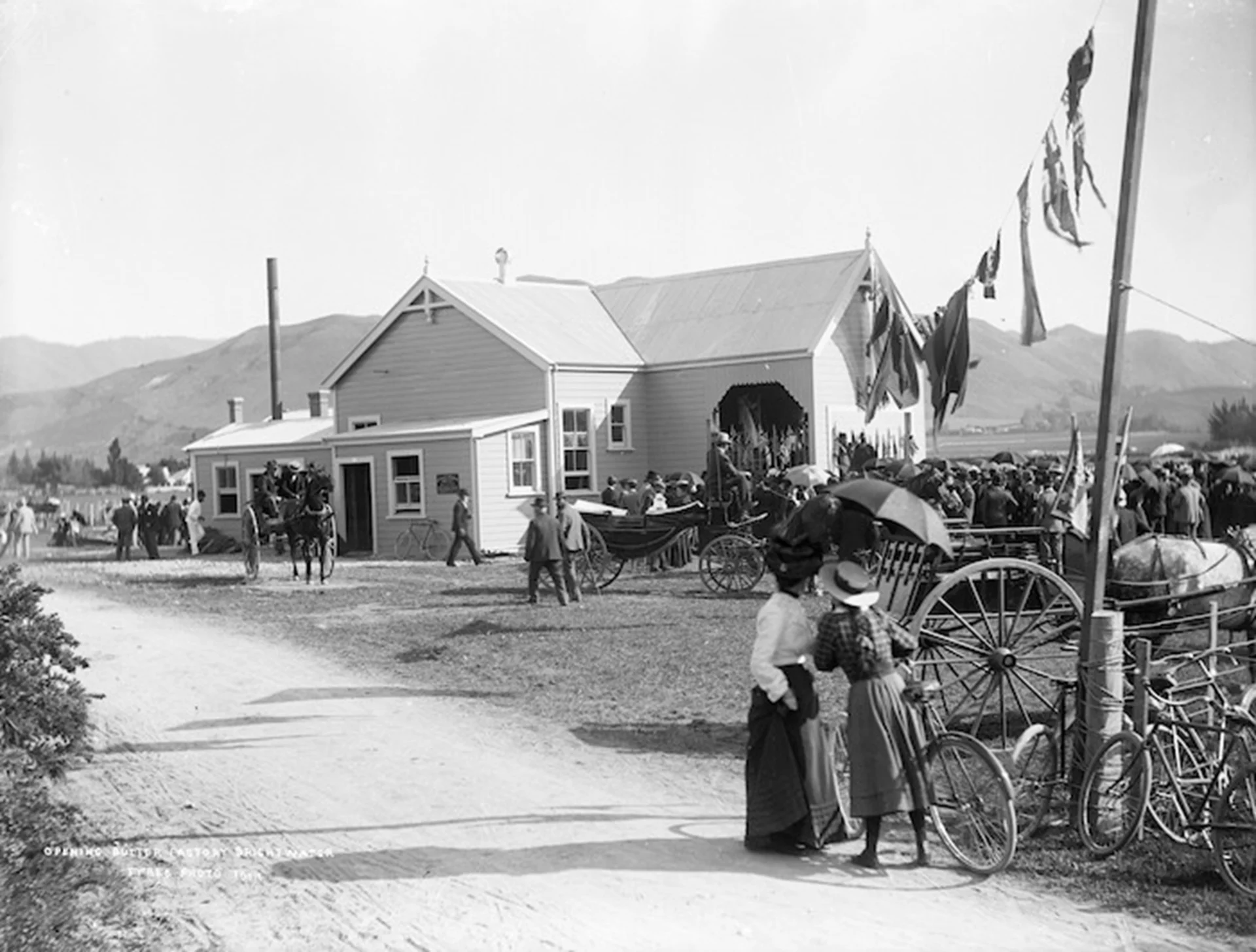
An enthusiastic meeting of dairy farmers was held in Brightwater in January 1902 with a view to establishing a co-operative butter factory.
Mr W. Lightband, as chairman, advocated co-operation and a system of close farming as the best means of bettering the condition of the farmers. The Department of Agriculture referenced that 400 cows were the lowest limit on which a factory might be started and £850 quoted as the cost of the buildings and plant. A proposal put forward for a co-operative factory was unanimously carried.
Several farmers were elected to canvass the districts to ascertain the number of cows that would be guaranteed.
By April, milk from 800-900 cows had been promised. The question of the central site was still up for discussion, with Appleby and Brightwater put forward. Creameries were suggested for sites in Appleby, Stoke, Wakefield and Wakapuaka provided each could guarantee a minimum of 150 cows for three years.
The Brightwater site was chosen, and land purchased from Mr R. Disher. It was centrally-situated, about 200 yards from the main road, midway between the Brightwater Hotel and the Wairoa Bridge and was close to the river, giving an unfailing supply of pure water and drainage facilities.
In July 1902 Wilkins and Field Ltd were allocated the whole of the work of construction and equipment of the factory. Mr Thomas Roberts was the architect and Robertson Bros. the builders.
The plant was installed under the immediate direction of Mr Shirley from the dairying branch of the Department of Agriculture. To avoid any possibility of damage to stock from floods, the floors of the storage and chilling rooms were raised 18 inches above ground level, and the ground floor concrete, while the wooden portions of the building rested on a base wall of concrete so that the woodwork would not come into contact with the water which constantly streamed over the floors.
The 5th of November, 1902, was a red-letter day for Waimea as a large gathering of around 700 assembled to witness the opening of the factory. The factory was operating at the time so that guests were able to watch the complete operation of butter-making, tracing the milk from the vat to the separator, the cream emerging from its pipe and being automatically carried to the cooling chamber, the skim milk running down its race to the tank outside, and ultimately, from ripened cream, the butter being made in the churn and worked in the immense machine adjoining.
One of the new technologies installed to reduce labour were automatic self-tilting buckets. The cream entered one stationary bucket which, when full, tilted and emptied into a similar but travelling bucket which conveyed cream to the elevator where it was then poured into cooling pipes.
The milk suppliers’ carts drew up under cover, and the cans of milk were swung overhead by a derrick crane with the milk emptied into a weighing can. Each supplier was given a brass key regulating the quantity of skimmed milk to which he was entitled.
The key fitted into a pump attached to the skimmed milk tank and thus the supplier pumped just the quantity of milk he had a right to remove, eliminating previous frustrations of time and delays in measuring out skimmed milk.
The butter made, it was placed on a large circular revolving table, dished inward, over which were suspended two large wooden fluted rollers, which, revolving, worked the butter to the required degree.
It was then made up into marketable form, and placed in a cool room where it was put into one pound pats, wrapped in the company’s printed wrappers, and placed in boxes ready for despatch to the retailer.
