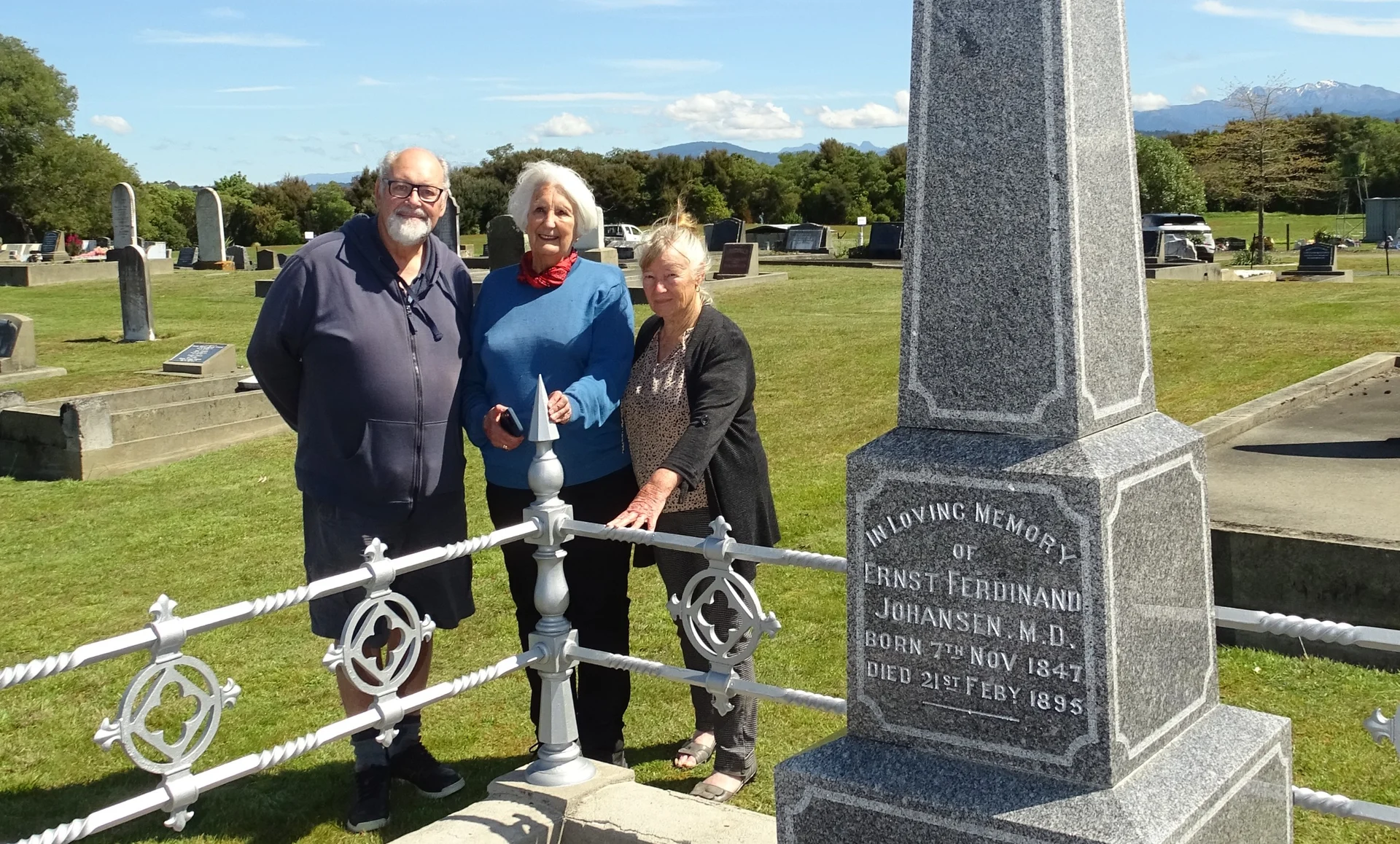
When Catherine Drew saw the monument atop her great-grandfather’s Motueka gravesite last year, she was horrified.
The granite headstone had aged terribly since she had last seen it 30 years ago, with the creeping lichen threatening to obliterate the chiselled words that honoured Johan Peter Ernst Ferdinand Johansen, who had served as a doctor and surgeon in Motueka in the late 19th century.
She sprang into action, contacting Tasman Monuments and Headstones to have the pillar carefully restored to its former glory.
Catherine lives in Melbourne, where several more family members are buried. The reconnection to her Motueka family is increasingly important to her as the years pass, and the thought of her ancestors slipping into oblivion was something that she simply wasn’t willing to accept. Indeed, Dr Johansen is a notable figure in Motueka’s history.
Catherine has done extensive research about her ancestry and, gathering with relatives Gaile Douglas and John Shone at their shared ancestors’ gravesites, the family shared some of their findings. Catherine said that Ernst – for that was his preferred name – was born in Germany and moved to New Zealand when he was 28. He was “mad on horticulture”, advocating for tobacco to be grown before it was a crop in the area. He also imported peach species from Germany.
Ernst was most well known, however, for his services to the town as a doctor. He set up here in 1875, two doors down from Parkers Hotel, which was on Greenwoood St. He wasn’t registered until the following year, but “they were desperate for a doctor…so that didn’t seem to matter”.
“Personally, I think Motueka was very lucky to have such a skilled doctor and surgeon,” Gaile said.
When the doctor died suddenly in 1895, The Colonist newspaper printed a lengthy obituary, complementing his skill, energy and enterprise.
Looking around the Motueka cemetery, Catherine lamented about the state of some of the other headstones and monuments, as their markings would also eventually be relegated to oblivion if they were not restored.
The family pondered whether this was something the community could do, for the betterment of the town and the longevity of its history. However, a spokesperson for the Tasman District Council said that memorials in cemeteries are owned by next of kin, and so permission must be sought before cleaning or restoring them.
“There are some cemeteries in Tasman, like the historic Collingwood cemetery and other generally rural facilities that are run by trusts and community organisations and they may have their own rules.”
Tasman Monuments and Headstones owner Patrick Day cautioned people against taking on amateur restorations, as the process depended on the material used for the headstones and in some cases, “they can do more harm than good”.
“People’s intentions are good, but they have to be very very careful with what they’re doing.”
He said that a professional restoration varied in price, depending on the materials involved and the process, but is typically around $200.
