
You would be hard pressed to find anyone more passionate about art than Nelson creative Lee Woodman. Lee talks to Matt Lawrey about his work, his home, the impact of being excommunicated from his religious family and his favourite artwork.
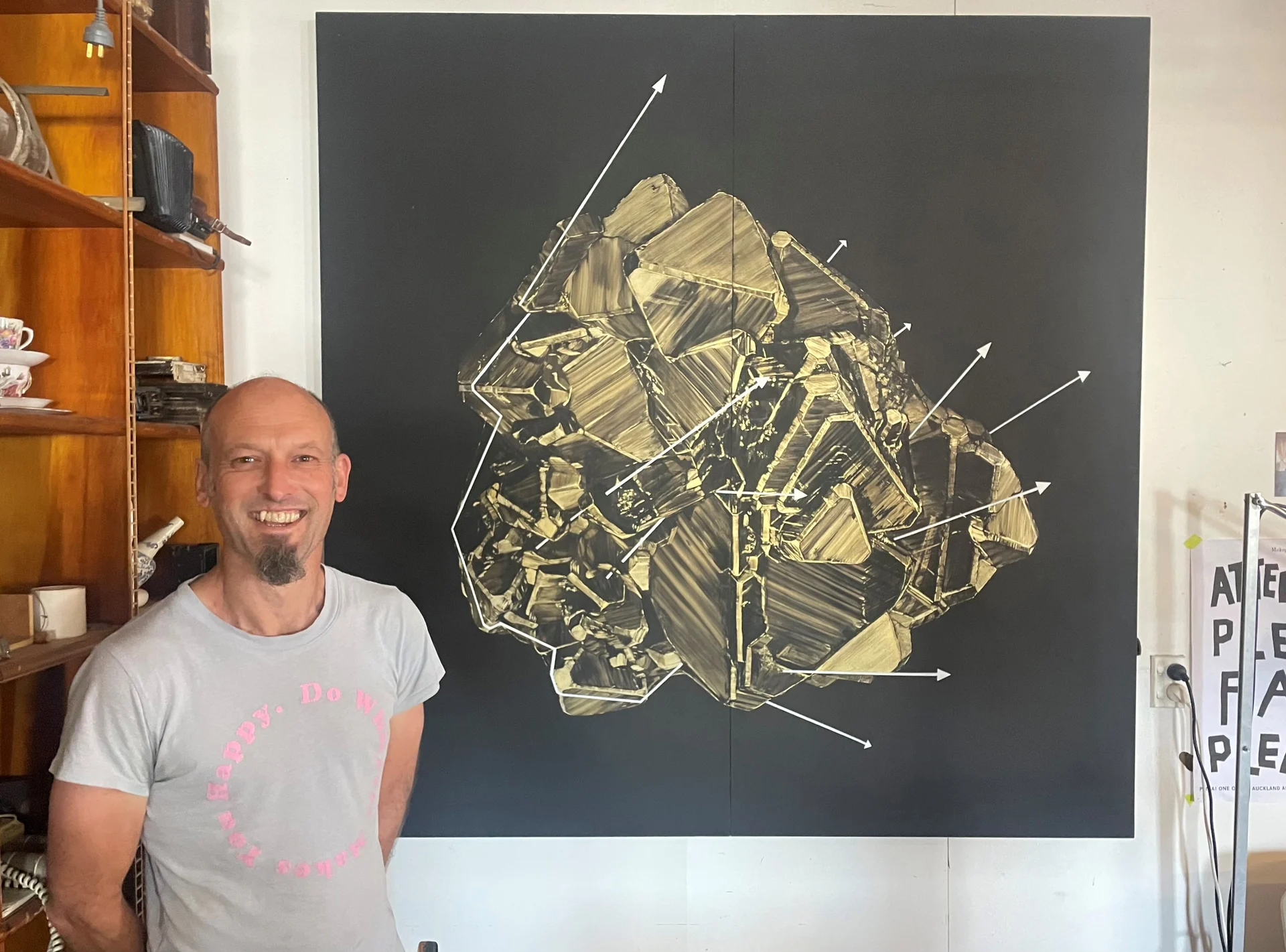
Lee Woodman practically pulses with energy when he talks about the huge Josephine Cachemaille painting that hangs in the central city warehouse that he and his partner call home.
Titled Defender, the black and gold contemporary work depicts a magnified nugget of pyrite, also known as Fool’s Gold, that was part of Cachemaille’s 2017 exhibition at The Suter Art Gallery Te Aratoi o Whakatū. Lee worked as a technician setting up the show, something he describes as “a beautiful experience.” It didn’t take long for him to fall in love with the painting.
“I was just infatuated with it. I thought it was the coolest thing in the room,” Lee said.
Defender became his after the exhibition when he and Cachemaille came to an agreement that saw him build a wardrobe in her home in exchange for the painting.
It’s possible that Lee is even more enamoured with the painting today than when he first acquired it.
“It’s just a stunner. It actually glows, just with basic daylight on it, and that’s what I love so much about the painting, it changes throughout the day,” he said.
“Josephine is a very dear friend of mine and, at times, the painting glows when I’m thinking of her. It sort of speaks to me.”
A builder by trade, Lee’s creative talents include sculpture, furniture design, set design and more. His notable public works include the hugely popular yellow and black hammocks in Upper Trafalgar St and the stylish seat/skate feature outside the Pūtangitangi Greenmeadows Centre in Stoke.
Lee is chuffed at the way the public has embraced the hammocks.
“For such a low impact piece they are super successful and I love seeing kids on them.”
However, after years of enduring the elements, Lee does think the hammocks are looking “a bit tired” and he would relish the opportunity to upgrade them.
“They were just supposed to be tactical, short-term and cheap and cheerful….I’d love to refurbish them with hardwood seats, re-powder coat them, and get some tighter nets in there.”
After being flat out building things for the Nelson Arts Festival, Lee’s currently working on a wooden screen destined for the Great Taste Trail at the end of Beach Rd in Richmond.
“It’s going to be hard yakka in the heat,” he says.
Lee grew up in Nelson, went to Waimea College, and credits a “hardcore, old school, no-television” Exclusive Brethren upbringing for helping to develop his practical skills and creativity. The faith, however, was not for him and Lee left the church at the age of 19, a move that saw him swiftly excommunicated by his family. Decades later, he remains cut off from his parents and six siblings. For all the heartache that came with being shunned, Lee thinks that it has also helped his creative process.
“Family is a problem, for a lot of people. They can mess you up and they can hold you back. They can really help you too, but a lot of times they can hold you back. I haven’t had that, I haven’t had support from them, but I also haven’t had them holding me back because they believe I’ve lost my way and so I’ve been free.”
Lee says it can be weird running into his parents in town. Many years can go by without them seeing each other. He says that when their paths do cross, they normally have a short conversation but, if his father is there, it soon turns into a lecture about “The Lord God”.
Lee is almost as enthusiastic about inner-city living as he is about art. He and his partner Ann Braunsteiner (also an artist) bought an old two-storey commercial building off Vanguard St seven years ago. In the years since they’ve turned it into a spacious home, workshop and gallery. The place is packed with art and interesting objects, many of which were made by Lee. It also feels like it’s been the scene of some of some big nights.
“We love living in the middle of town and we love living in a grungy old building. We made a pact, Ann and I, that we wouldn’t live in a house. We didn’t care what we lived in, but we didn’t want to live in a normal house. We feel extremely lucky and blessed that we’ve bought this building and we can live this way and have this lifestyle.”
