
Update 9:00am 09/02/2024
The amount of helicopters working on the Lee Valley fire has decreased to three, with 30 firefighters still on site to battle the blaze today.
Today's focus is creating a 1.2-kilometre containment line around the perimeter of the fire, using hand tools to clear a 20 metre space of vegetation on steep terrain.
Incident Controller Steve Trigg says he is very pleased with the progress made yesterday by crews, who put in a massive effort working in very difficult conditions.
"Once the containment line is completed we hope to be able to return evacuated residents to their homes either today or tomorrow, opening the road to residents only, with restricted speed limits in place."
He also wished to remind people to be vigilant around activities that can generate sparks during this very dry fire season, and reminds people that a simple spark can have devastating impacts on people, property and the environment, as well as pets and livestock.
Update 3:15pm:
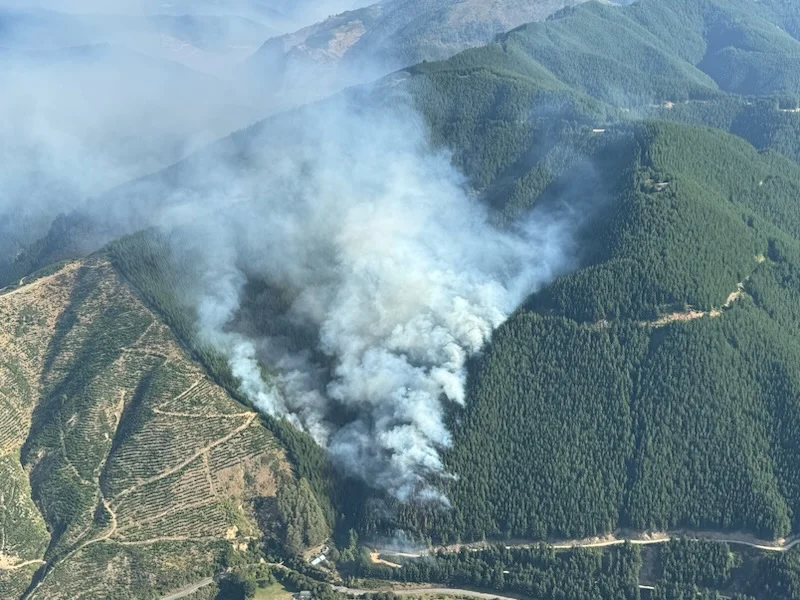
Favorable winds have helped the ongoing helicopter and ground operations, and the fire has been more accurately mapped, covering about 9 hectares of pine forestry.
Fire and Emergency aims to have fully contained the fire by the end of tomorrow, although it will take longer to extinguish.
Managed access to properties will continue until the fire is contained, with residents staying in alternative accommodation overnight.
Once the fire is contained, Fire and Emergency plans to assist residents return to their homes in a restricted capacity, such as lowered speed limits, escorted and resident-only access while fire operations are still underway.
A community hub will be set up tomorrow by Fire and Emergency, with location and opening times confirmed later today.
Update 12:15pm: Efforts are continuing to bring a fire in the Lee Valley under control.
Helicopters, firefighters and two heavy machinery operators continue to work to work on the blaze, which is not yet considered controlled, but has not grown in size from the five hectares it was on Wednesday.
Earlier:
Helicopters have taken to the air again on Thursday morning to try and contain the Lee Valley fire.
A Fire and Emergency NZ (FENZ) spokesperson says four crews of firefighters and heavy machinery operators worked through the night on Wednesday.
Two urban crews were tasked with protecting structures while two rural crews and the excavator operators were making fire breaks and establishing control lines.
The fire is not yet contained or controlled but there has been no reported loss or damage to property overnight, aside from the forest itself.
Seven helicopters are taking to the air again this morning and the excavators will continue making firebreaks.
Specialist forestry silviculture/firefighting crews will use thermal imaging equipment to identify hotspots and tackle each one with hand tools and hoses today.
On Wednesday helicopters were grounded when a drone was seen flying in the area. FENZ are reminding everyone that private drones must not be flown anywhere near the Lee Valley
All those evacuated by the fire found alternative accommodation on Wednesday night so Nelson Tasman Civil Defence will reopen the civil defence centre at the Wanderers’ Clubrooms on Lord Rutherford Drive at 8am.
The Asthma and Respiratory Foundation NZ is advising residents near Lee Valley who have a respiratory condition to close all windows and doors if staying inside, or wear a N95 or KN95 mask if going outside.
Foundation chief executive Letitia Harding says these steps offer the best protection against the harmful effects of smoke inhalation.
"Breathing in smoke from fires can pose serious risks for respiratory health, especially for vulnerable populations such as our tamariki, elderly, and those with underlying conditions."
Smoke contains tiny particles that enter the throat and lungs causing irritation, she says
"For those with severe respiratory conditions, like asthma or chronic obstructive pulmonary disease (COPD), this irritation can cause flare-ups, which can be serious and lead to hospitalisation.
"It is important that people with asthma or COPD keep their reliever inhaler on-hand if they start to develop symptoms."
She says research shows that a N95 (or KN95) mask offers the best protection against smoke from wild fires.
"If fitted and worn correctly, the N95 mask filters out 95% of particles, significantly reducing the risk of those particles getting into your lungs.
