
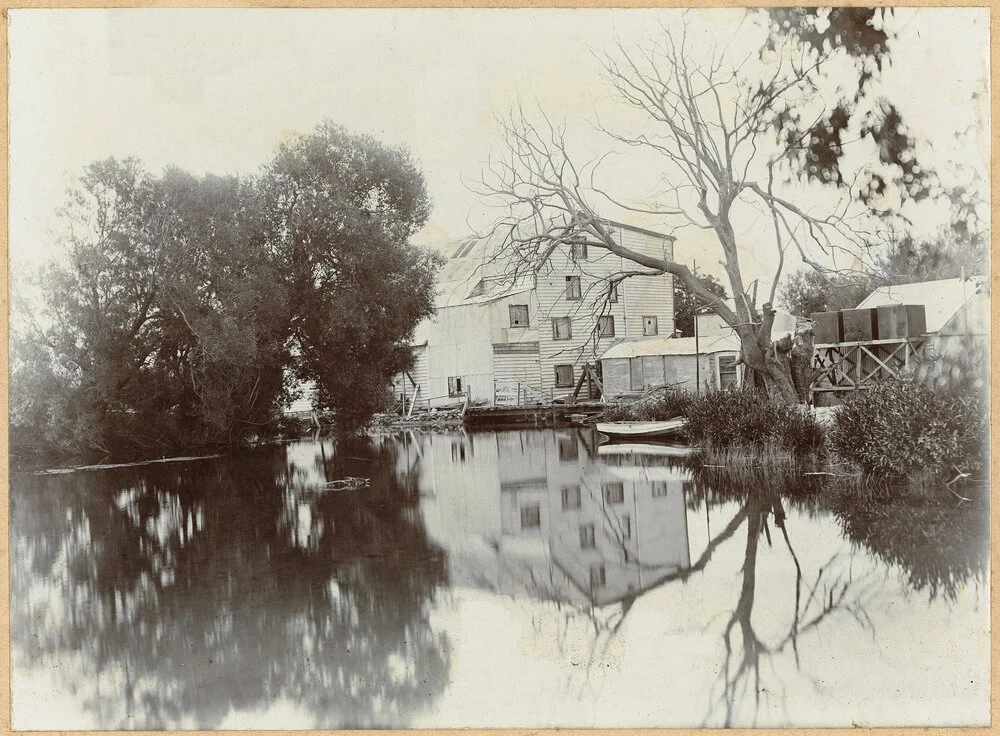
Robert Ellis, a man who was visionary and yet practical, became the father of electricity for the Waimea’s and Nelson district.
He was born in 1861 in Uxbridge, England, being one of 12 children born to Mr and Mrs Richard Ellis. At an early age he joined the Navy as a trainee, and it was there that he received his education.
At around age 21 he left the Navy and came to New Zealand to join his two older brothers, Richard Campbell and Louis Frederick, who had taken up a large sheep run of 17,000 acres in the Motueka Valley. He took over a portion of the property and commenced flax milling.
In 1888 Ellis married Kate Evans, daughter of one of the pioneers at Motupiko. Around 1905 Ellis began a flax and rope-making industry at Kohatu. Feeling he needed new and improved machinery, he made a trip to England. While there, he became interested in advances being made in electrical apparatus for lighting and cooking and he brought back a small plant for his own use at Kohatu. This was installed using waterpower from the Motueka River running through the property.
This plant was so satisfactory and economical that it gave Ellis the idea of developing a public supply of electricity and so he looked around for a suitable property. The flourmill at Brightwater, previously Saunders mill, was for sale and its central situation together with possibilities for the development of power so appealed to Ellis that he bought it and proceeded to make a start.
However, this started a battle of great opposition from authorities. The Hon. R. McKenzie, Minister of Public Works at the time, believed it was impossible for Ellis to do what he intended as there was not sufficient power. After a lot of argument and persistence, Mr McKenzie allowed him to go ahead as far as Brightwater. After further correspondence between the two men and more obstacles put in his way, Ellis gave up and devoted himself to the flourmill.
About a year later, the Hon. W. F. Massey came into power and brought out from England, Mr Parry, an eminent electrical engineer, to advise on the Government hydro-electric schemes. After reading about Ellis, his ideas and the obstacles that had been placed in front of him, Parry visited Ellis at Brightwater to encourage him to start an electric supply and said he would do what he could to help.
Despite opposition from both Government and local bodies, Parry arranged for Ellis to get a licence to supply electricity on the condition that he had plenty of power. As soon as the license was granted, Ellis found it was subject to permission being given by local bodies and on applying to the County Council for permission to erect lines on the roads he met with a definite refusal.
The Stoke Road Board, on hearing this, offered Ellis the use of their road to Richmond. While preparing to act on this, Waimea County Council changed their minds and wrote saying that he could use their roads provided he kept close to the fences and erected and supplied free of charge several streetlamps in Brightwater.
