
Following years of opposition and obstacles, Robert Ellis was able to settle and begin the process of erecting lines in Brightwater and Richmond in 1912.
Soon he was suppling five lights in Brightwater and around ten in Richmond, the total revenue equivalent to one shilling per night. All work was carried out in accordance with Sir Parry’s specifications, iron rails being used for poles and aluminium bare H.T. wires with a 40 k.w. alternator driven from a newly-installed turbine.
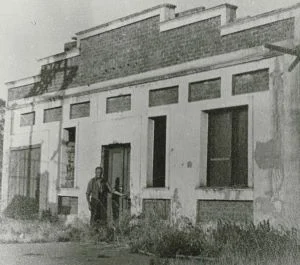
The plant was built in a concrete building near the mill race for convenience as Ellis was running the flourmill in the daytime. Houses were rapidly being wired and supplied with power, but this was too small to generate a profit and Ellis used money from the milling business to carry on. His company, the Waimea Electric Supply and Manufacturing Co., continued as an independent supplier for many years.
Further opposition came when the Flourmillers’ Association tried to shut the mill down by cutting prices, but Ellis was able to compete with this and the mill grew to full capacity. They then proposed to pay him a yearly subsidy if he would close down, but this was refused. Lines were extended to Wakefield, Stoke and later to Tahuna, using the large mill turbine at night to cope with the ever-increasing load.
In 1918, for private reasons, Ellis accepted an offer from a local syndicate to purchase the whole business and he returned to his property in Kohatu. Problems for the syndicate arose quite quickly, partially from inexperience with their policy of continually connecting new consumers without making provision for more power, and within a couple of years they were in trouble. In addition, the Government control of wheat affected the milling business and in the end the mill was shut down and dismantled and the electrical branch of the business was not big enough to stand alone.
The syndicate asked Ellis to return and help them out. To relieve the overloading problem, he built another powerhouse a short distance down the river below Brightwater on the site of an old flaxmill. After straightening out other matters, the syndicate decided to take the business back and Ellis again returned to Kohatu, but not for long as continual trouble caused the Government to threaten to close the plant down and the syndicate again appealed to him for help. This time he decided to return for good, feeling it was unfair to the consumers to be left without a supply.
What he came back to was a wreck of a business. The plant and lines were out of order due to lack of maintenance, the flour business was gone and there was an annual loss of about £5OO. To make matters worse, Parry had returned to England and instead of an attitude of assistance, the Government Department blamed Ellis for the defects caused during the time of the syndicate. Although under no compulsion to return, Ellis set about bringing the business back to a successful footing and saw it as a matter of honour and duty to consumers to straighten matters out.
