
ROBYN PARKES
Charles Jackson was born in Berrima, New South Wales, in 1863. He adopted several aliases including Henri le Strange and Professor Jackson but mostly used the name Felix Tanner, which he was known by in New Zealand.
In Australia, his drive for excitement and notoriety saw him tightrope walk over the Kiama Ocean Blow Holes and fast for 40 days, showing you could survive long periods of time just on water, charging people to observe the fast.
After moving to Waihi, New Zealand, Tanner created a device for a mock hanging, which, in a public display, dropped him seven feet leaving him grotesquely hanging. Other feats included a plan to build, unsuccessfully, an aerial balloon ship and being contracted to find the ship Elingamite which had sunk near the Three Kings Islands with gold on board. He successfully found the wreck, but not the gold.
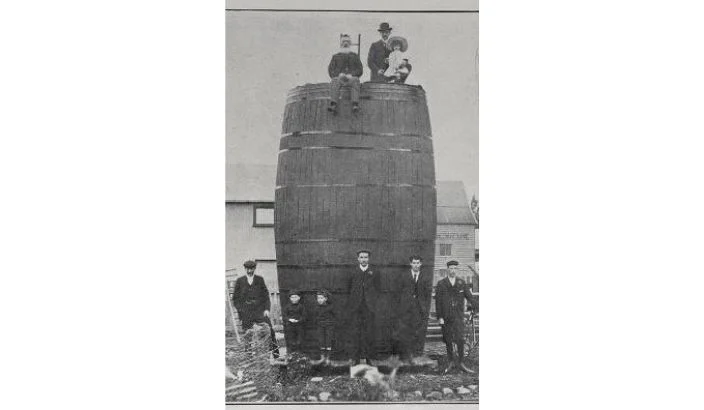
In 1903, Tanner devised a new idea to sail round the world in a barrel-shaped craft which became nicknamed The Ark.
He drew up the first design and built the craft in his backyard and managed to launch it, but within days vandals bored holes in it and it sank. After moving to Whanganui, he built Ark number two which was launched in April 1904, but had to be beached in Ohau Bay. In Wellington number three Ark was built, but while Tanner managed to get it across Cook Strait, a westerly gale all but ruined it and it was abandoned.
Tanner relocated to Wakefield around 1905 and continued his exploits. At the opening of E McPherson and Co’s new premises he mounted the tightrope and performed various feats. He then let off a large fire balloon which fell into a neighbouring property and caught fire. A second attempt was successful in rising into the air and slowly disappearing.
Tanner had not finished with his dream to sail his barrel shaped craft so in 1906 built number four Ark in his Arrow St backyard with the purpose of sailing it to the New Zealand International Exhibition in Christchurch.
The Ark was a conspicuous object from both road and railway and in November the craft was put on public display.
It was well fitted with watertight compartments, two cabins each with two bunks, and a self-emptying cockpit, all built in white pine. It was ketch rigged, 14ft long and 30ft overall with a 9ft 6in breadth and 6ft depth and weighed 2.5 tons with 5 tons of ballast. Nineteen flags were required to signal her due to not yet having come before the notice of the Registrar General.
On a Thursday, mid-December 1906, the Ark was taken to the port and Tanner, with young Thomas Vipont, set sail for Sumner. Customs had refused a grant to proceed to sea, but he took the risk anyway. On reaching Cook Strait heavy weather struck and he had to return to Nelson for additions to his crew. He sailed again on the 11th of February and successfully arrived in Lyttleton on the 21st.
Tanner invented the Wakefield Electric Propellor which prevented the “running away” or racing of marine engines. An Australian syndicate purchased the rights for £25,000.
By 1913 Tanner was living in England where he developed a crane for getting goods onto boats and in 1915 designed a shell specifically for destroying barbed wire entanglements.
Tanner, or Charles Jackson, died in 1943, having married three times and fathering 12 children. He was buried in the Rookwood General Cemetery in Sydney.
