
BY ROBYN PARKES
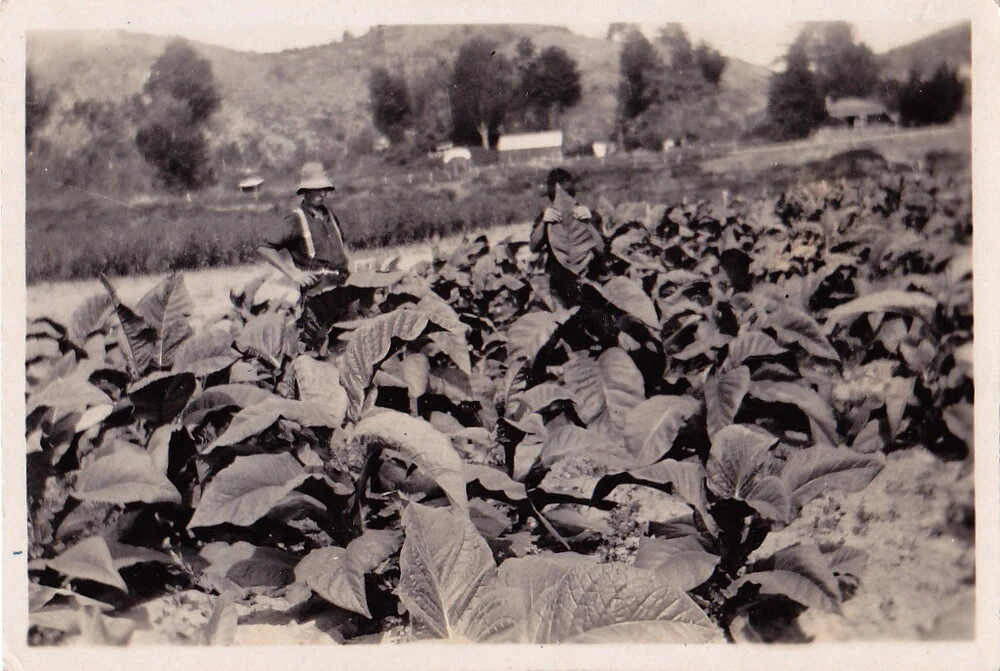
In July 1938, at a time when tobacco growing was one of the growing industries of the dominion, the Government, with their involvement in the tobacco industry, opened the new ‘Government Tobacco Factory’ in Motueka.
Around 500 residents from all parts of the district attended the official opening of the factory, performed by the Hon. P. C. Webb. The event was reported as being a milestone in the history of the tobacco industry in the Motueka district and one of significance to a district whose destiny was almost inseparably wrapped up with the progress of the tobacco industry.
Mr Charles Lowe, the Government Instructor, was instrumental in the development of the factory and had spent months in planning the layout to give maximum efficiency and minimum confusion.
The layout for efficiency started where the tobacco was received by lorry from the growers. A 20 foot veranda was provided to ensure the crops were unloaded safely in all weather. Inside the shed, the tobacco was placed in 60lb lots, weighed on scales and put in position ready for the 41 female graders. Their stands were against the wall on the south, and part of the east section of the shed and glass windows installed behind them gave good light.
The grader was surrounded by a collapsible platform on which the sorting of the leaves into the nine separate Government grades took place. These different grades were placed in wired off sections of the platform and were collected, one grade at a time. The graded leaves were then tied on to special “horses” and wheeled to the dark end of the shed, to prevent sun-light fading.
The most vital process came through the use of the Proctor-Schwass re-drying machine, at the time being the best on the market. It was fed by a series of wooden rails in which the tobacco was tied and fitted into a teethed chain to carry the tobacco onto the mattress bed of the machine.
The first process was a series of alternative up-and-down draft-producing fans to keep the tobacco at a constant temperature and to thoroughly dry it.
The temperature could be regulated through an observation porthole.
In the next process, the tobacco was moistened by the use of steam jets and was then passed through dry air at a thermostatic temperature, which was regulated to combat the varying conditions. It then passed out of the machine, the whole process taking from 20 minutes to three quarters of an hour, according to the grade of the tobacco.
Finally the tobacco was pressed in a hydraulic press which was conveniently placed at the other end of the Proctor-Schwass machine. There was adequate room provided at this end of the shed for the stacking of more than 200 pieces.
The current season was anticipated to be approximately 200,0001b. of leaf and Government assistance on export leaf guaranteed growers a return of 1/6 per lb with 6d being advanced at the time the leaf was received into the grading shed and the balance at the time of shipment.
With the factory declared open the instructor gave attendees a demonstration of the working of the plant.
