
BY ROBYN PARKES
With the dangers of people crossing the many rivers in Nelson the building of bridges became an important topic.
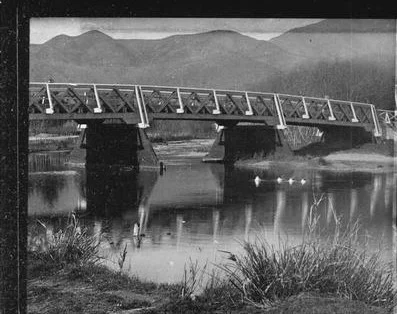
Maitai River, running through the township of Nelson, meant that several bridges had to be erected along it with Collingwood St being one of those areas.
In early 1858 a new wooden footbridge, 130ft long, 4ft wide, all resting on four piers, was built at a cost of £120.
The pontoons were ‘peculiarly’ shaped wooden boxes filled with stones and fixed into place.
At the opening of the bridge, the Superintendent delivered a brief address recognising the structure as being the first public work of any magnitude that had been built out of rates levied by the consent of the inhabitants themselves.
He noted that the bridge would be viewed as something of an experiment.
If it was found to resist the effects of flooding, the plans on which it was built were likely to be bought into general use.
In 1859 the bridge was damaged by flooding, so the approaches were improved, and piles replaced the pontoons.
Repeated damage occurred with each flood and a changing river environment.
In June 1867 the bridge was overhauled with pieces added to the trusses to stiffen them, rendered necessary by the shrinking of the timbers.
By early 1880 the bridge was in in desperate need of repair with piers, girders and flooring rotting, making it unsafe.
The council were informed that if any accidents occurred on the bridge due its state, they would be held responsible. As a result, the bridge was closed.
In September the council was petitioned to build a new bridge. Several options were presented for a replacement - a stone bridge costing £4,140, iron bridge at £3,478 or a wooden bridge at £1,680.
The Council unanimously voted to allow £1000 for a new wooden bridge.
The suggested plan for the wooden bridge was of three spans of 47ft by 18ft each.
The piles to be of puriri,12 by12; stringers of iron bark,15 by12; caps of heart of totara,12 by12; top rail of parapet,12 by12: trussing, heart of totora 6 by 4: joists of birch,10 by 4, and planking, 9 by 4, with the approach walls to be of stone.
In January 1881 the council began to look at the relative merits of different timbers for the bridge.
Puriri was known to be the most durable wood in or near water, was hard and would drive under any weight. The heart of totara was very durable and the surveyor recommended it for piles, except that the required length exceeded 14ft with the piles needing to be 27ft long.
The council decided to go with totara piles at an estimated cost of £1300 and a tender from J Gilbertson for the building was accepted.
In mid-February 1882, the new bridge was opened by the Chairman of the Works Committee but within 25 years it too suffered from rotting joists and was deemed to be dangerous and unsafe for heavy traffic.
In March 1907 the bridge was temporarily strengthened by means of adding six additional joists to the northern bays and much of the decking had to be replaced.
Ongoing repairs and adjustments continued on the bridge but in 1954 the bridge was partially washed out and needed to be replaced. A through truss steel structure was chosen and construction began in mid-1954 and was completed the following year.
