
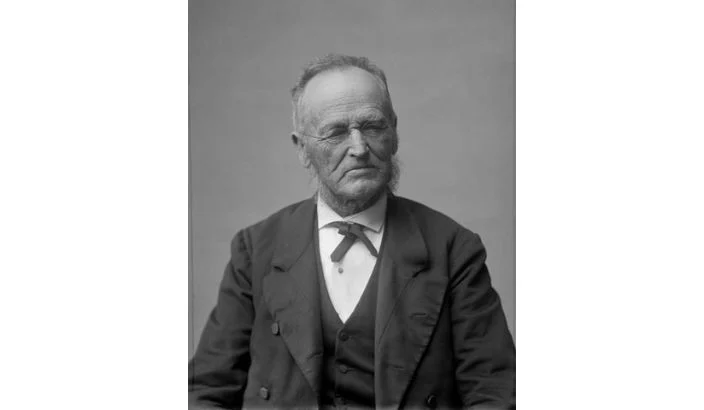
BY ROBYN PARKES
John Wallis Barnicoat was born in Falmouth, England, on 3 June, 1814, and was educated at Falmouth Proprietary School.
On leaving school he was apprenticed to learn civil engineering and surveying.
Following this he began business on his own account at Falmouth, but he afterwards entered the service of a leading railway engineer in London.
In 1841, John left his home country to resettle in Nelson, sailing on the ship Lord Auckland, arriving at Wellington on 8 February, 1842 and landing in Nelson about a fortnight later.
On arrival in Nelson, John and his partner Mr T. Thompson were engaged by the New Zealand Company to survey the districts known as Waimea and Stoke, and to divide them into allotments of 50 acres.
They had also surveyed and subdivided 10,000 acres of the Moutere district and were engaged in various smaller surveys until early in 1843, when they undertook a survey of the Wairau which ended with the Wairua affray.
The same year, John began a survey of the Motueka and Takaka districts which was not completed until March 1844.
He was then engaged with Mr Tuckett in exploring the East Coast of the South Island in search of a suitable site for the proposed Church of Scotland settlement, named New Edinburgh.
John purchased land of about 140 acres at Richmond and remained there for over 50 years.
When bought the land was completely uncultivated, but with hard work became one of the most attractive farms in the district.
ln 1849 he married Rebecca Hodgson, daughter of early pioneers William and Agnes Hodgson.
Rebecca came to Nelson in her teens with her brothers and sisters on the old East India Company’s vessel ‘Himalaya’.
Rebecca was known as being an exceptionally thoughtful and well-informed lady and enjoyed helping young people.
John played a prominent part in public life and when the Constitution Act, with its six local Parliaments, came into force, he was elected a member of the Nelson Provincial Council, being Speaker for 22 years.
He was also on the Waimea Rd Board and Nelson Education Board and fulfilled the role of chairman on both for many years, as well as being a Governor of Nelson College for over 40 years.
As if this was not enough, John was a member of several smaller local bodies, was one of the most active members of the existence of the Richmond Mechanics Institute and was a staunch supporter of the Church of England and member of the Synod.
In 1883 he was appointed to the Legislative Council, retiring in 1902. Rebecca died in 1902 and a year later John sold his farm and lived in retirement in Nelson city until his death on 2 February 1905. Both were buried in Richmond Cemetery.
Such was the affection that the community had for the couple that a stained glass ‘Barnicoat Memorial Window’ was placed in the chancel of the Holy Trinity Church in Richmond in their memory, in June 1910.
The window was formally unveiled on by the Bishop of Nelson with a large congregation assembled.
A short dedicatory service was held where, in the course of it, the bishop said that, as some years had elapsed since John and Rebecca had passed away, the occasion was one of gratitude for the friendship and the example of the couple.
The inscription said - “In memory of John Wallis Barnicoat died February 2nd, 1905; and of his wife Rebecca died November 17th, 1902. There remaineth therefore a rest to the people of God”.
