

The Recognised Seasonal Employer (RSE) scheme is a win-win for all countries and economies involved in the venture.
For RSE workers it must be an incredible feeling to return home knowing they have earned enough money to begin building a house for their family, buy a car or start up a small business.
For our community, the RSE scheme has been a game-changer. With our rich agricultural heritage, Motueka has long been a hub for fruit growing, and the arrival of RSE workers has allowed local growers to expand their businesses and take advantage of new opportunities.
But the benefits of the scheme go far beyond just the economic impact. RSE workers have become an integral part of our community, forming close bonds with local people and making a real contribution to the social fabric of our town.
At orchards, vineyards and hop plantations across our region, the RSE scheme allows opportunities to happen and as a result, our horticulture industry is thriving. For growers, a guaranteed workforce creates certainty which in turn enables business expansion. The piece of mind that comes from knowing there will be enough staff to handle larger crops is hugely reassuring.
We were lucky enough to spend some time with Louise Heywood, from Heywood Orchards, a multi-generational, family-owned company, with orchards throughout the Motueka and Riwaka area. Heywood’s grow 19 varieties of apples including, Ambrosia, Sassy and Envy, as well as pears and kiwifruit. The picking season is about half way through, the weather has been fantastic and all indications are for a good season.
“Our workers come from Fiji, Samoa and Vanuatu, we’ve around 75 workers in total. They stay with us for around 7months of the year,” says Louise.
It’s a glorious day in the valley, crunchy red apples line a large apple bin awaiting the next step in their journey. We watch as their hardworking staff climb up and down ladders, picking the juicy crop, warm smiles on their faces, it’s obvious they enjoy their work. Words of encouragement, alongside vibrant laughter make for a wonderful working environment. The added value of our regions wonderful RSE workers is obvious.
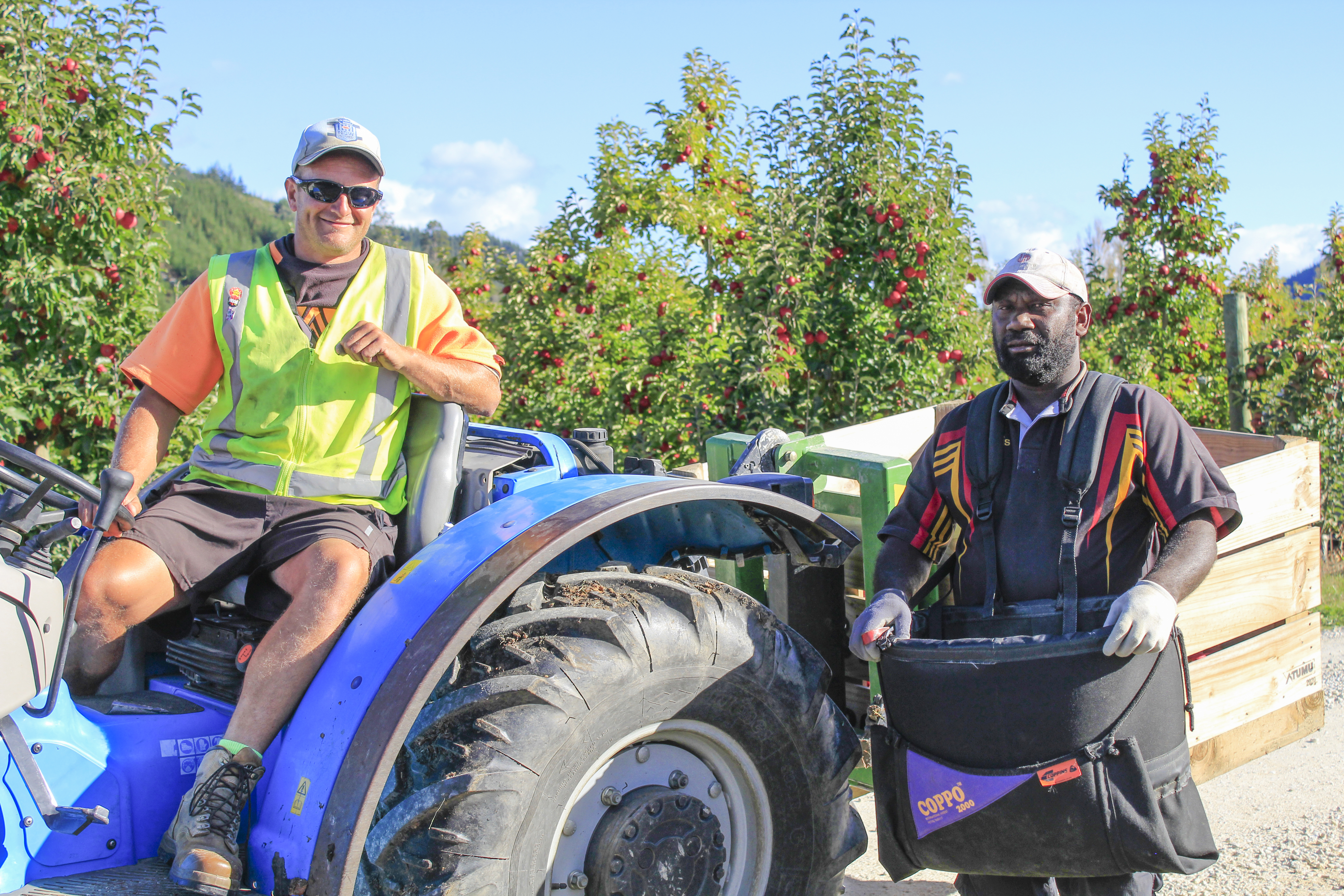
“The importance of our RSE workers is huge. We would be lost without them,” explains Louise. “They are great people, so valuable and add more to our community than the work they do for us. Their warm personalities and happy demeanours make our region a better place.”
A big thank you to all of the RSE workers across our region and all over New Zealand for helping to harvest our fruit and uplift our communities. We are a better place because of you.
The importance of pastoral care
An important component of being an RSE Employer is practising pastoral care. Under the RSE scheme employers are required to ensure a variety of best practices are taking place, for example:
• Providing a work induction programme to help workers settle in
• Arranging somewhere for workers to live at a fair price. In fact, our local orchardist’s Investment in accommodation supports our RSE workers while alleviating any toll on residential housing in our communities.
• Explain how and where they can get medical insurance, access banking services and send money home safely.
• Transport to and from work
• Translations of health and safety instructions
• Opportunities for recreation and religious observance.
Some of our local orchardists, including Heywood’s utilise a wonderful educational programme called Vakameasina (translating to ‘treasures we carry together’), funded by the Ministry of Foreign Affairs and Trade’s New Zealand Aid Programme. This programme enhances RSE workers lives by teaching valuable skills including English language literacy, numeracy, financial, digital literacy and practical life skills.
Beyond core modules focused on food and nutrition, health and safety, money management and digital technology, workers are asking for more knowledge and skills that will improve their life back home.
Evidence shows that Vakameasina is helping workers to develop the basic skills necessary for negotiating life and work in New Zealand. It brings added value, providing a safe space for workers to learn about New Zealand and discuss issues. As a result of participation in the programme, workers improved their literacy, numeracy and communication skills leading to improved confidence.
Other ways in which Vakameasina has proven helpful back home is in the area of communication skills. In one leadership programme, topics such as conflict management and effective communication were taught. Following which has been third party feedback from people in the Islands who have witnessed people using these techniques to solve problems.
To find out more about Vakameasina, check out their website vakameasina.co.nz and social media facebook.com/vakameasina
