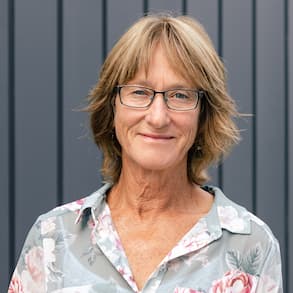

Shelley Hand doesn’t know how her 80-year-old mother will visit the family and grandkids now that the car parking space has been removed outside their Hill St home.
The flat entrance at the front of the property was the only way her mother could access Shelley’s home and likewise, the family’s other grandmother has emphysema which makes it difficult to negotiate the steps at the back of the property.
Shelley also runs a small home-based business and customers used the carpark to approach the front door.
“That little parking spot was important for us. It’s part of the reason we bought this house.”
The house sits on the corner of Hill St and an adjoining street, so has access at the rear of the property via a right of way, but she says there is no parking available there and visitors have to walk up steps to enter the house.
Hill St is undergoing its revamp for the Richmond Streets for People programme that adds cycle lanes, and in the case of Hill St, introduces a 30 kmh zone.
The project between Champion Rd and Queen St follows the programme’s other projects in William and Queen Sts which has stirred a community debate on cycle lanes, parking spaces and speed.
Council’s communication officer, Tim O’Connell, says Streets for People is trialling a new way of delivering projects, focused on testing and adapting, based on community feedback.
The Government-funded project fits the aim of the council’s Walking and Cycling Strategy that revolved around the need to do something about growing traffic congestion and safety for all road users in the urban environment. It is also part of the goal to reduce carbon emissions as transport produces 47 per cent of New Zealand’s CO2.
“Our target is to double the number of trips made by walking and cycling to work and school in our urban areas by 2030 and triple them by 2050.”
So far, Shelley is not impressed, and says the changes have made a lot of people angry. As well as losing the carpark outside their home, she says the stop sign on Templemore Drive is now set so far back to allow for the cycle lane on Hill St that there is no visibility and cars have to illegally edge out into the cycle lane to see traffic approaching.
She saw a courier parked in the cycle lane one day because there was nowhere to park and says cars turning right off Hill St into streets such as William St have to sit in the middle of the road now because there is no longer a turning lane.
“It’s quite frustrating and disappointing. The side streets are quite congested now with cars parking. You’re only going to move cars to other streets which is dangerous for cyclists, too. Surely it could have been done in a better way.”
The council is seeking feedback on the changes and Shelley says she given her feedback on Champion Rd and will be doing the same for Hill St, though she says it seems a bit belated when the work has been done.
“Don’t ask for permission, just ask for forgiveness.”
So far, Tim says there has been a range of feedback on William St and though some of it criticised the pedestrian crossing close to Hill St, there have also been numerous positive comments, especially from parents thankful for raised crossings slowing the traffic.
A wheelchair user also praised the raised crossings which made crossing the road safer and easier, helping to make Richmond “100 times more accessible for wheelchair users than Nelson”.
They wanted to see more raised crossings to improve accessibility for everyone.
“Human nature is to take the shortest route and good road design accounts for human nature.”
William St also got the thumbs up from a road policing staff member for adding raised pedestrian crossings to successfully slow traffic around the school.
Tim says the pedestrian crossing close to Hill St was placed there because they need to be located where pedestrians will use it. Otherwise, they will still cross there without a pedestrian crossing. As a raised platform, it makes drivers slow down and sight lines are clear for drivers and pedestrians to see what is coming.
Tim says feedback surveys on the projects will be one of the datasets presented to full council which will then decide if anything needs to be altered.
The 30 kilometre per hour trial on Hill St will be in place for up to two years and the road controlling authority will decide whether to make the various changes permanent, based on feedback from the public and council’s experience using the street layout changes.
