
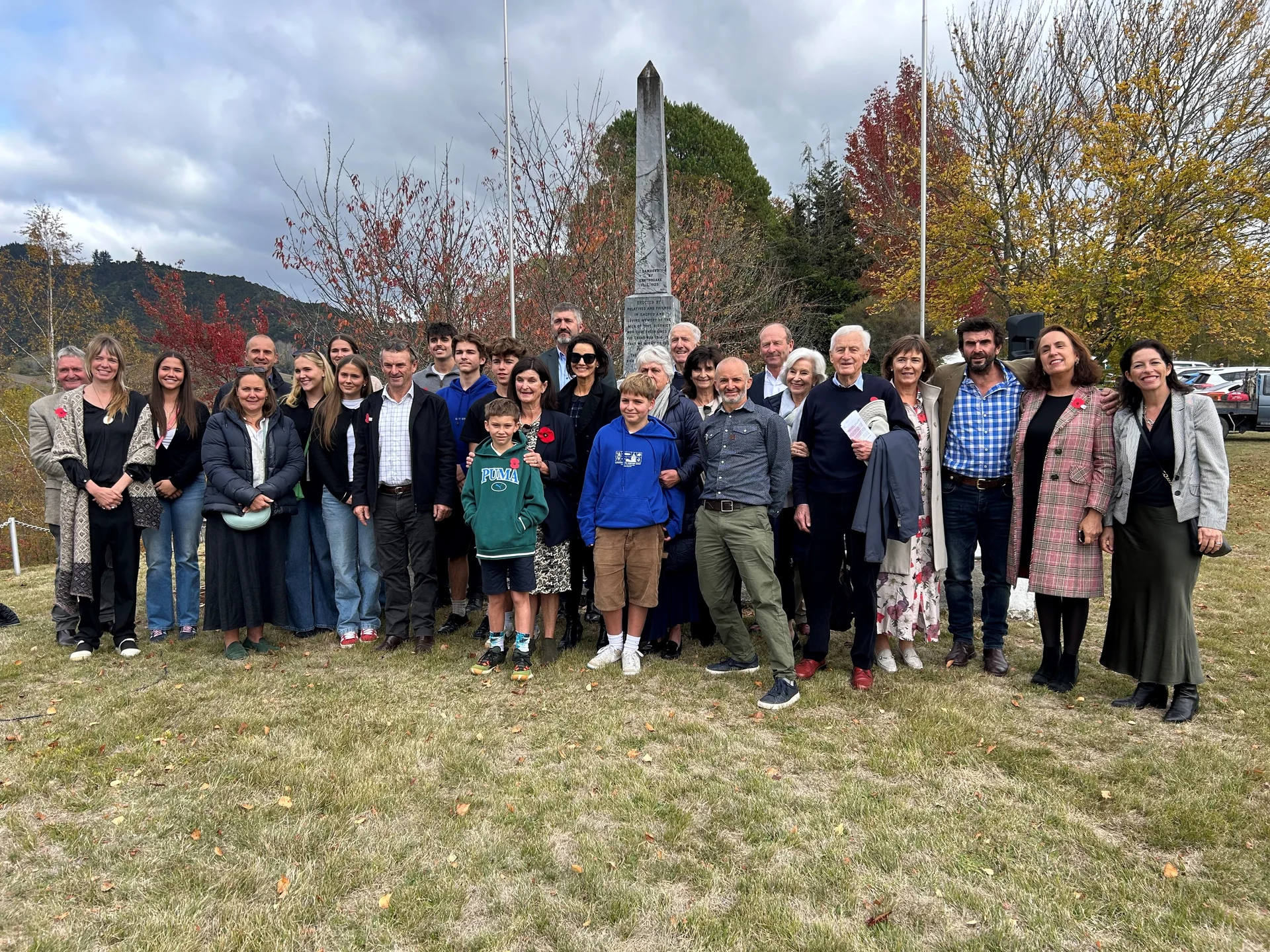
More than a century after his death at Gallipoli, a Motueka man has been commemorated with a family gathering at Ngatimoti’s St James Church on Anzac Day.
Three generations of descendants of Alan Hirst de Castro – 28 people in total – gathered at the church last Thursday, hailing from as far away as Dunedin, Christchurch, Gisborne and Hawkes Bay.
Motueka’s Ed Stevens utilised his own research, as well as the comprehensive resources pulled together by fellow local historian Anne McFadgen, to gather information about de Castro’s lineage, life and ultimately, his death in Gallipoli at Chunuk Bair, on 6 August, 1915. This was shared with the visiting family via an Anzac Day speech.
Speaking on behalf of the de Castro family, Aucklander Henry Martin says that the information was new to much of the family, and they were thrilled at how the day had gone. The dignified Anzac service through to the haunting rendition of The Last Post on the church lawn made it “one for the memory books”.
“The excellent turnout and the beautiful speech that traced Alan de Castro’s journey - from his schooling at Nelson Boys through his time in the Motueka area to his ultimate sacrifice at Gallipoli - provided a great insight into his life,” says Henry, whose mother was Alan’s niece.
“It was wonderful to see Alan’s sacrifice so beautifully remembered and made us all proud to be a de Castro.”
Alan de Castro, born in Blenheim on 14 June, 1889, was the second of four children. His parents were William Waring Knox de Castro, who for 20 years held a deputy registrar position with the Supreme Court in Nelson, and Helen “Nellie” Radcliffe Dixon, whose parents had been pioneers of settlement in the Takaka Valley.
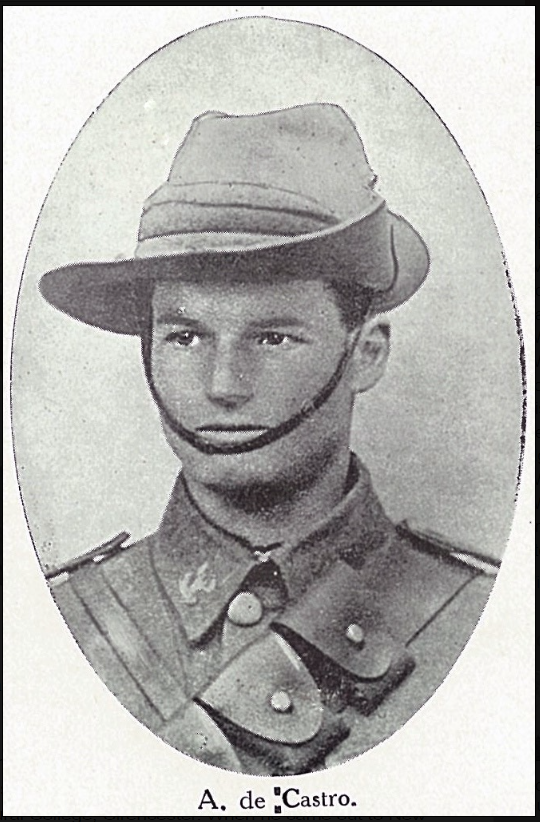
The family lived in Stoke, and Alan attended Stoke Public School and Nelson College. They had many friends in the Motueka and Motueka Valley areas – the Strachans, the Salisburys and the Guys among them – and so they visited often.
When his family moved south, following a promotion for his father, Alan instead chose to follow his friendships to Motueka, where he worked for orchardist William Briggs.
Like his father, Alan trained in mounted militia, serving in the 10th (Nelson) Mounted Rifles, and in August 1914, he enlisted in as a trooper with the 10th (Nelson) Squadron of the Canterbury Mounted Rifles.
Anne’s notes remark that “although fit, he must have just scraped through his medical, being exactly the minimum height for recruits at 5ft 4 in.”.
Aboard his troopship Athenic were Ngatimoti acquaintances Hector Guy, Private William Ham and Major Cyprian Brereton.
He arrived in Gallipoli in May 1915, a month before his 26th birthday, and died in battle three months later.
Squadron leader John Gordon McCallum, also from Motueka, wrote a letter to his wife, recounting the loss.
“It cost us several men, including little Alan De Castro, well known to many in Motueka and Riwaka,” he wrote. “He was the happiest and best of comrades and the keenest of soldiers, and his loss will be deeply felt by all who knew him”.
Another local, Private Ivan Stafford, wrote to his mother that “Alan De Castro was the pet of the whole regiment, the boys are very cut-up over his death”.
Alan’s final resting place is unknown. He is commemorated at the Chunuk Bair Memorial at Gallipoli, his faded name just visible on the list of Canterbury mounted rifle troopers. The Ngatimoti War Memorial also bears his name.
