
BY ROBYN PARKES
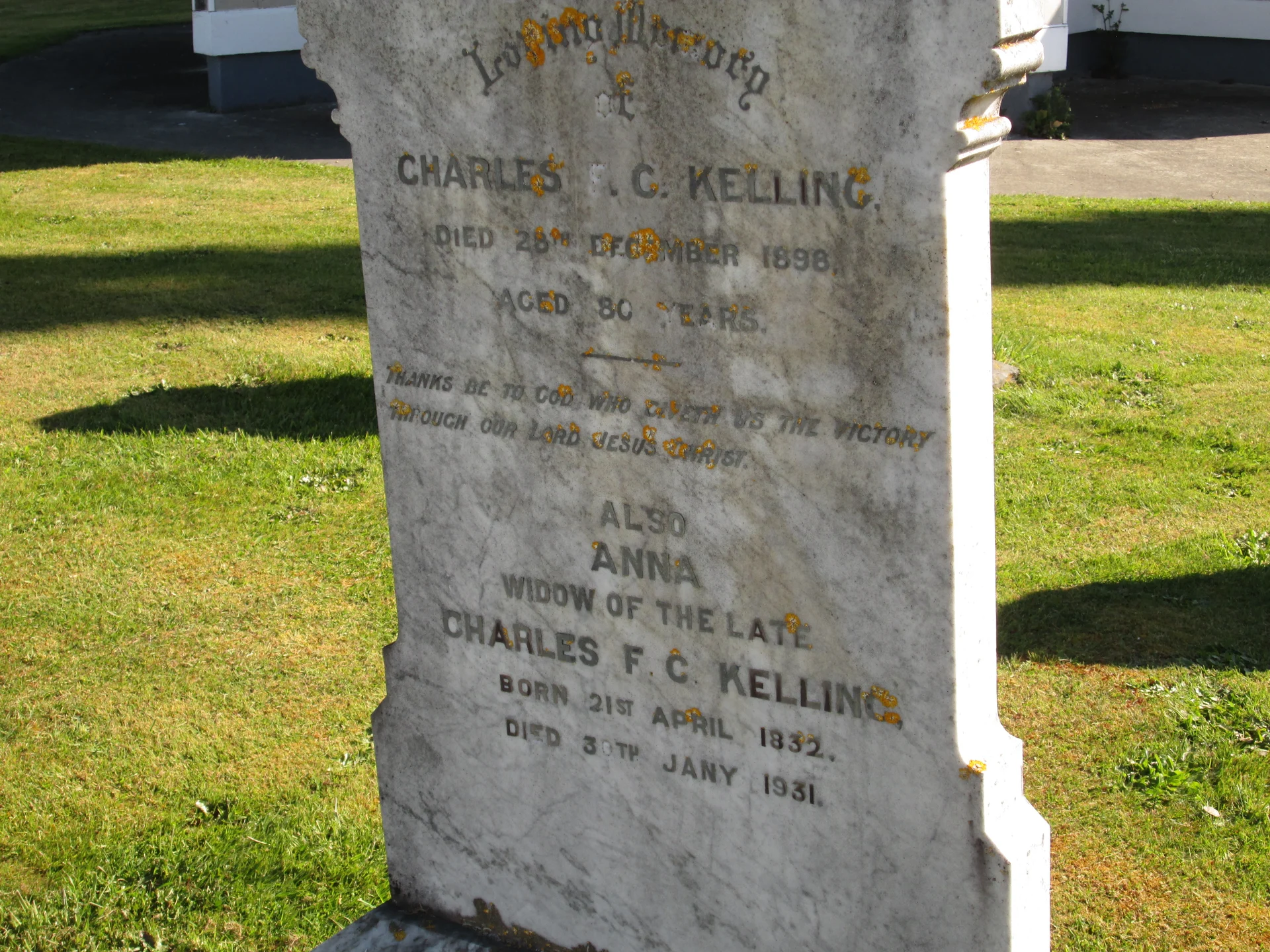
Carl Friederich Christian Kelling, known later as Charles, was born at Klutz in the grand duchy of Mecklenburg-Schwerin, on 21 June 1818 to Johann Kelling and Louise, nee Harms.
Charles and his brother Johann Frederich August (Fedor), along with Johann Benoit, were appointed as agents by Count Rantzau to manage his lands in Nelson.
The brothers, along with 140 immigrants, left Hamburg on board the ship Skoild in April 1844 and arrived in Nelson in September. Once in Nelson, both Charles and Fedor acted as colonising agents in connection with the settling of Germans in the Waimeas and Upper Moutere, the three villages being known as Ranzau, Sarau and Neudorf.
Unfortunately, the timing of their arrival was not good with the collapse of the New Zealand Company. Charles and Fedor were hard-working men and supported the German settlers through this period. The brothers took up land at Waimea East, later called Ranzau, and began to work their land where they soon planted crops, fruit trees and other produce. In 1850 Charles married Anna Buschl, daughter of Michael and Maria Buschl.
Anna was born in Bavaria in 1832 and immigrated to Nelson via the ship St Pauli with her parents. Her father purchased land in the Wairoa Valley and was one of the settlers who petitioned the Provincial Council to assist in opening up a road at the easterly branch of the Wairoa River. This request was referred on to a select committee.
Around 1856, Charles and Anna moved from Ranzau to Sarau where they lived a full and busy life. In total the couple had 12 children, four daughters and eight sons.
Charles became a prominent man in the district with his many public roles. He was a member of the first committee for the Moutere Educational District, served on the Moutere Road Board, was elected to the Nelson Provincial Council as a member for Moutere from 1862 to 1869 and for Waimea West from 1869 to 1873 and became a Justice of the Peace in 1867. He was also appointed a trustee of the public cemeteries in Moutere and Riwaka along with Messrs William Cook, William Drummond, William Best and C. Bensemann in 1864, and in November the same year he laid the foundation stone for the Lutheran Church at Sarau.
In seeking election onto Nelson Provincial Council, Charles attended many political meetings where he was asked his opinions on a range of topics. At one such meeting he was asked - ‘do you approve of giving pensions or retiring allowances to Government officials?’ His answer was an emphatic ‘NO’, explaining that officials should provide for their old age out of their own income as they were a class that was generally well and regularly paid.
In early 1898 Charles contracted influenza, and although he recovered was left in a weakened state and never recovered his strength. He and Anna sold their property around June 1898 and moved to Wakefield. Charles died six months later on 28 December and was buried in Upper Moutere. Anna lived for another 33 years and died on 30th of January 1931 in her 99th year.
