
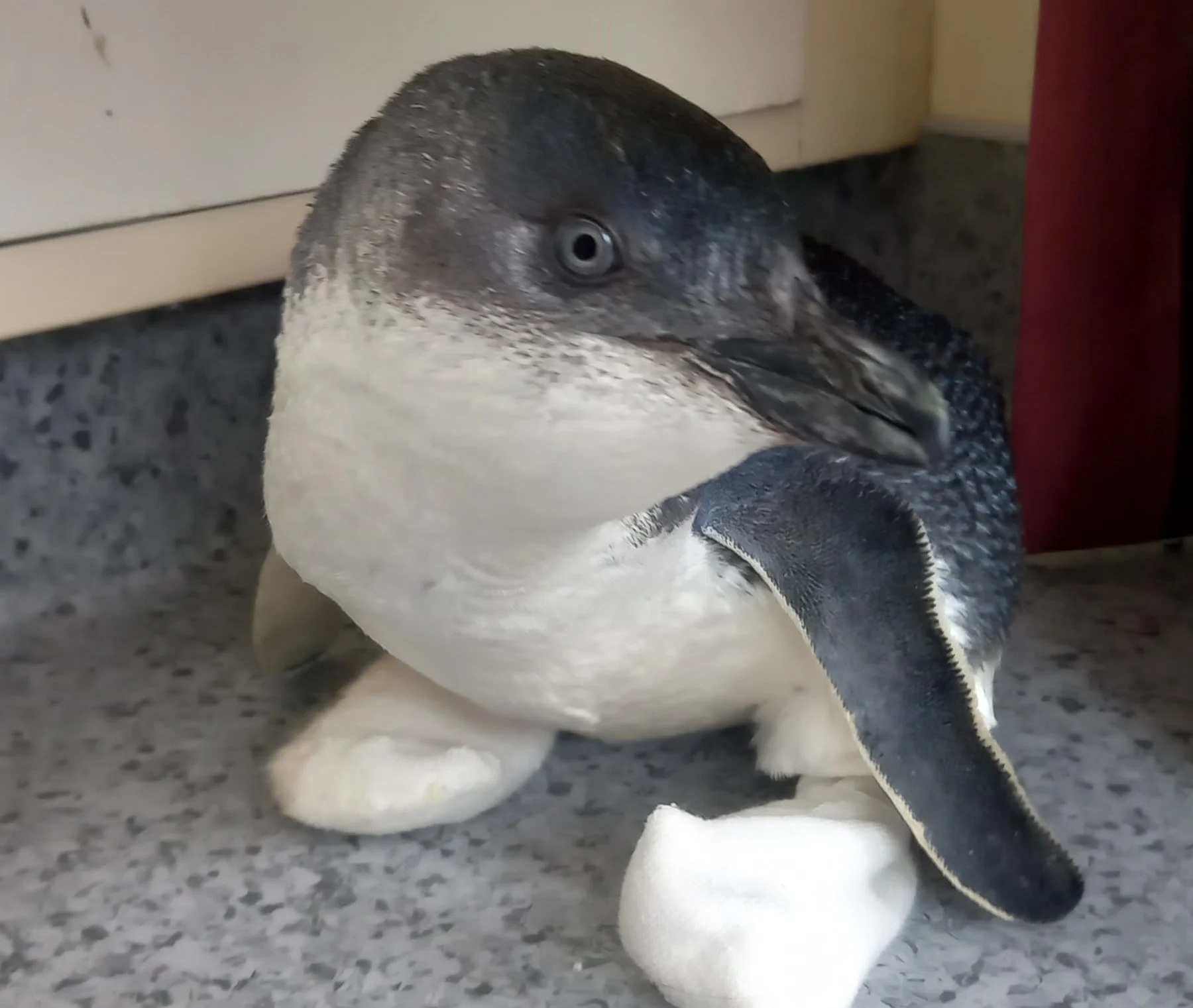
Most renovations do not need a specification that the flooring be “conducive to little penguin feet”.
The Tasman Bay Blue Penguin Trust’s rehabilitation clinic has recently been upgraded, with new curtains to help regulate temperature, and new flooring that was chosen especially to fit the above criteria, according to trustee Linda Jenkins.
She says the clinic, which is located on a private property in the Tasman district, is now an improved space for the region’s native wildlife patients which require care for a range of reasons, including injuries, malnutrition and abandonment.
The facility upgrade was enabled through a Network Tasman Trust grant, as well as a donation from the Nelson Building Society and other private donors.
“It is working wonderfully for our little blues,” Linda says.
The clinic is quietly administered by Dr Mana Stretton, the trust’s “honorary wildlife vet” who donates many hours of her time, says Linda, and little blue penguins, or kororā, are one of the most frequent patients.
Their conservation status is “at risk/declining”, and they are under pressure from habitat loss, dog attacks, car and boat strikes, and malnutrition brought on by climate change.
The kororā is native to New Zealand and is the world’s smallest penguin, weighing in at about a kilo and measuring about 25cm in height.
What they lack in stature, however, they make up for in personality.
“I think the biggest thing for me is just how tenacious they are. They put up with so much human-induced interference,” Linda says. “They are very adaptable, if we give them half a chance.”
There are little blue populations in Tāhunanui, Ruby Bay, the wider Kaiteriteri area, and Pōhara, to name a few nesting areas.
They waddle under the radar and are often invisible to their human neighbours, as their onshore activity happens during the night.
Although it is hard to pinpoint exactly how many little blue penguins there are regionally, a study was undertaken in 2020 using a survey handler and a penguin detection dog.
It took the team a week to work their way from Tapu Bay to Split Apple Rock, and they located 173 active burrows in this area alone.
Linda says that each burrow will contain an active adult pair, and commonly two chicks.
However, if one of the adults does not make it home to its burrow, the nest fails, because the remaining parent cannot feed the chicks by itself. Linda explains that the solo parent waits for as long as it can before abandoning the nest, effectively leaving the chicks to starve.
“It’s a really tragic family story.”
Although humans are almost entirely responsible for the challenges that little blues face, they can also be part of the solution.
Linda says that people can make a huge difference by reducing driving speeds and keeping dogs on leads around habitat areas, keeping cats contained, and helping with beach clean-ups and predator-trapping programmes.
She says that positive rehabilitation outcomes, such as Punch’s happy ending, help to raise awareness of kororā, which in turn increases community engagement and motivation to make a positive difference for the tenacious penguins.
“Little blues can do with all the support we can give them,” she summarises.
More information about the Tasman Bay Blue Penguin Trust can be found here.
