
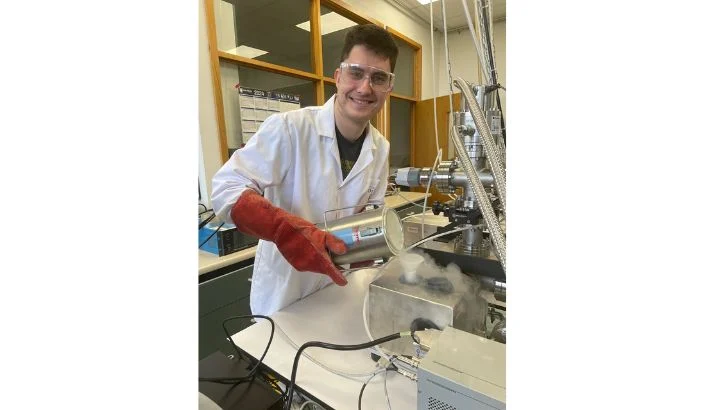
A former Garin College student is headed to NASA after he was awarded a New Zealand Space Scholarship.
Tait Francis is one of six tertiary students to be selected to work on NASA projects through a scholarship. In June, he will head to Pasadena, California, to spend three months working at the NASA Jet Propulsion Laboratory (JPL).
Tait is currently in the third year of his postgraduate research degree (PhD) at University of Otago, the subject of which is all about chemistry in space, specifically chemistry of ice particles in the atmosprere of Saturn’s largest moon, Titan.
“My research is basically witchcraft. I’m learning about how crystals absorb energy and vibrate,” he says light-heartedly.
He says the scholarship will not only give him access to different equipment but has given him an open line of communication with staff at both NASA and the New Zealand Space Agency (NZSA).
“I’m continuing the research I am doing here but with much fancier and sophisticated equipment,” he says. “We have different kinds of equipment here, so I can take different kinds of information and measurements which will be complementary.”
He says he’s already learnt lots about Saturn’s largest moon, but is looking forward to learning more.
“Something that’s interesting about Titan is it’s like Earth in many ways. It has a thick atmosphere, it has lakes all over the surface, but it’s way colder and the lakes are full of methane and ethane, so basically petrol.”
As part of their internships, students are partnered with NASA scientists, who serve as the students’ mentors. Students complete designated projects outlined by their mentors, gaining educational experience in their fields of study while also contributing to NASA missions and science.
Deputy head of NZSA, Andrew Johnson, says the cost of each scholarship is around $30,000 which covers airfares, accommodation, insurance, visas, food and other in-country expenses. The programme is government-funded and administered by the NZSA, part of the Ministry of Business, Innovation & Employment (MBIE).
Tait’s pretty sure he’s the first ever from the region to gain the scholarship, though neither he nor the NZSA can confirm this.
Tait says, once he’s finished his PhD, he hopes he will have answered his central research question: How can we use the structure of these ice particles to predict the formation of pre-cursors to life. He would then like to continue researching but also holds a passion for science communication and education, which he would like to combine, making science digestible and interesting to others.
For now, he will settle for working at NASA.
“Its a once in a lifetime opportunity. My parents are over the moon.”
