
BY ROBYN PARKES
The history of Methodism in Richmond goes back almost to the settlement of Nelson.
The first Methodist service in Richmond was held in 1843 and the first church was built the following year, being a small weatherboard structure. Rev. John Aldred was appointed minister to Nelson and during 1843 a preaching service was opened in Richmond.
The first marriage in the first church was Matthew Hawkins Little to Mary Ann Jackson, on 16 October, 1846, by the Rev. John Aldred, and the second was Joseph Batey to Mary Ann Wagstaff on 16 January, 1847.
Among the baptisms in the 1840s were the surnames of Harwood, Stirling, Stone, Wallis, Dodson, Ladley, Jefferies, Garnett, Best and Haycock.
In 1866, additional land was purchased on which was a cottage. The Rev. R Burn and his wife resided in the new parsonage and in the same year a new church was built costing £400. In 1877, a parsonage of eight rooms was built at a cost of £350. By the time of the church’s centennial in 1943, 21 families had lived in the old home.
In 1881, a separate circuit from Nelson was established with Richmond as the centre containing eight preaching places. Rev. Joseph Berry was the first superintendent of the new circuit.
The time came when a more suitable building was needed for the congregation and in January 1913 the ceremony of laying the foundation stone of a new church was performed in the presence of a very large number of people, a large proportion of whom journeyed out from Nelson by train.
The proceedings opened with the singing of a hymn, followed by a prayer by Rev. G. W. Bond. Rev. Mr. Eaton wished all those who had come to the gathering, especially Rev. Ready, a very hearty welcome. Prior to the laying of the foundation stone, Mr W. E. Wilkes, contractor for the building, presented Rev. Ready with a silver trowel as a memento of the occasion. The stone, which was of granite, was then lowered into position.
The new church was opened on a wet and wintery day in June. The congregation gathered at the doors of the church and, after singing a hymn, Mr Eaton presented the key for the front doors, calling on Rev. S Lawry, President of the Methodist Conference, to open the doors and lead the way into the church.
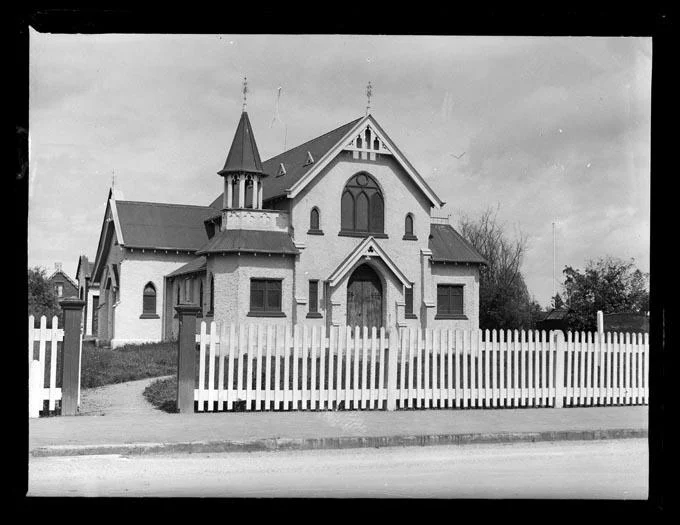
Services were held morning and evening with a children’s service held in the afternoon. The church was built on the site of the old one and it was noted that the pretty design could not fail to attract notice.
Besides the main building, the dimensions of which were 45 by 30 feet, there was also a gallery, vestry, two ante-rooms, belfry, and a front and side porch. Seating accommodation was provided for about 180 people. The walls were of plaster, finished in rough cast and the roof was painted iron. The interior walls were also plastered with a dado panelling, the furnishings being in stained wood and lighted with kerosene lamps.
The whole building was of Gothic design, costing around £810. The church accommodated the congregation for many years before being condemned in 1989 and demolished in 1992.
