
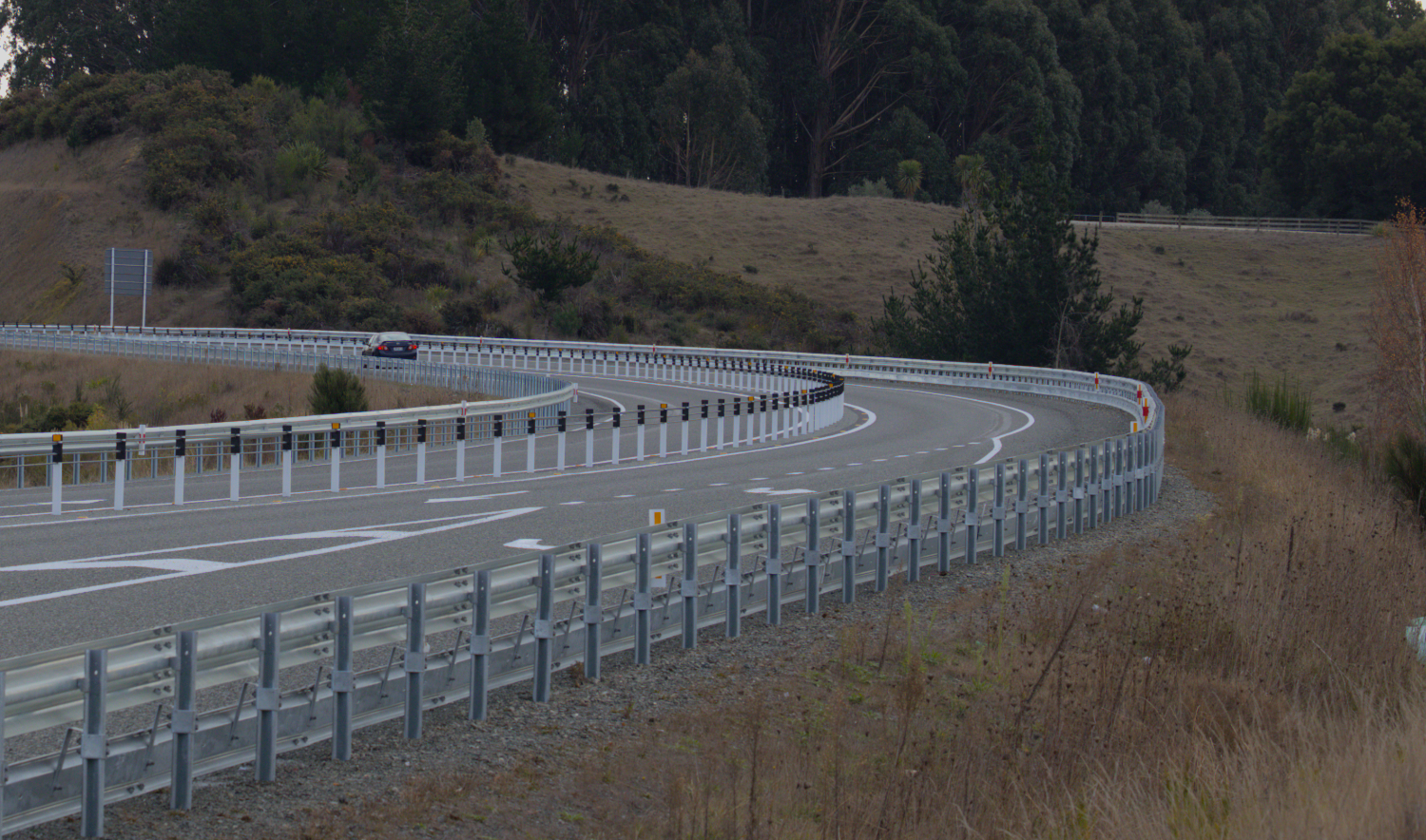
Tasman district residents are slowly adjusting to the new safety barrier that separates the north and southbound lanes on the Ruby Bay bypass.
The project began on the 7km stretch of road between the Dominion and Harley Roads turnoffs in February, with traffic management slowing travel in both directions, and was due to be completed this week.
Installation issues on the barriers, installed to prevent head-on collisions, have meant that the work will now not be finished until early next month.
This means motorists will be navigating further night-time closures and reduced speeds until late July.
NZTA regional manager infrastructure delivery, Wellington and Top of South, Jetesh Bhula, says the work has included several steps prior to installing the flexible road safety barriers.
“Since February, 3.6 kilometres of road has been widened, new drainage installed, and 3.7 kilometres of new side barrier and a new right-turn bay at Tasman View Road intersection completed.”
Residents online have spoken about the metal barriers’ reflective nature, citing both sun glare and headlight reflections as causing a distracting flicker. The “strobing” effect of oncoming vehicles’ headlights was also discussed.
Jetesh agrees that the galvanised steel safety barriers are highly reflective, saying that after their “initial ‘shine’ period” they will become duller. There are also reflectors on every tenth post, so that they can be easily seen when visibility is low.
NZTA reports that over the five years from 2019 to 2023, this stretch of State Highway 60 has been the site of two casualties, three victims of serious injury and eight victims of minor injury.
Police senior seargent Martin Tunley says that although the stretch is not a high accident zone, the Ruby Bay barriers are part of national work that aligns with multi-agency safety outcomes.
Jetesh says that safety barriers such as the ones being installed have been proven to virtually eliminate head-on crashes and reduce deaths and serious injuries from run-off-road crashes by up to 50 per cent.
“Head-on crashes are the leading cause of death on state highways and account for approximately half of all deaths recorded. Safety barriers offer a second chance. They help reduce the chance of a simple mistake costing lives and destroying families.”
He says the total construction cost of widening, drainage, and installation of a new right-turn bay and median and side barriers along SH60 Ruby Bay Bypass is approximately $5.5 million and is funded through the National Land Transport Programme 2021-24.
A 2019 Ministry of Transport report puts the social cost of a single road fatality at just under $5 million. This includes intangible and financial costs, as well as economic costs to society. The figure for a serious crash is almost $1 million, and $104,000 per minor crash.
Jetesh says that all crashes, no matter how severe, generally require emergency service attendance and can result in roads being closed for crash investigation and clean-up.
In choosing which areas to install median barriers, NZTA takes into account the crash history, road environment, ease of installation and the overall ability to save lives in the future.
“SH60 has a medium to medium-high collective risk. It’s cost-effective for us to install these barriers; the money we spend on them provides excellent outcomes in helping to reduce deaths and serious injuries and the costs of these crashes to the community and people affected by them.”
An NZTA spokesperson also pushed back about the criticism of these types of barriers as “cheese-cutters” for motorcyclists, saying that that was not borne out in the evidence.
“Research shows installing roadside barriers – particularly flexible road safety barriers – reduces motorcycle casualties between 50-60 per cent. This is because motorcyclists are much more likely to survive an impact with a roadside or flexible road safety barrier than an impact with trees, poles or oncoming vehicles.”
The spokesperson says that these flexible road safety barriers have about half the fatality rate of steel beam barriers, with concrete barriers being the most dangerous of all to motorcyclists.
