
BY ROBYN PARKES
A special meeting of the Motueka Borough Council was held in July 1919 to discuss a report by Mr J. Crombie Scott to introduce an electricity scheme for the borough.
Such was the enthusiasm that the council unanimously affirmed the wish to have electric light in the borough and accepted the report of Mr Scott who recommended a suction gas plant. A loan of £10,000 was required to carry out the work which had to be agreed to by ratepayers. The recommended site was the council’s property in Fearon St.
Mr Scott’s report included two methods of dealing with the supply; firstly by charging a fixed rate for current by installing change-over switches where ironing plugs were installed so as to prevent light and heating from being used simultaneously which eliminated the necessity of purchasing meters, and secondly, by meter as a number of meters would be required to suit large customers who may find the fixed rate too costly. The revenue for the first five and a half years was estimated at £2100, and the expenditure for the same period at £1719.
Mr Scott’s estimates of the loan were for the amounts: £7400 for the cost of the plant, £400 to cover one year of interest, and £1000 for the installation department, making a total of £8000. An alternative water-power scheme, to cost £16,860, was also submitted by Mr Scott.
The ratepayers of the borough voted in favour of the Borough Council’s loan proposal but for a loan of £14,000 to cover: (1) The construction, erection, and installation of a powerhouse building and suction gas plant tor generating and supplying electricity at the cost of £13,000, (2) the purchase of the buildings and plant at a cost of £150, and (3) the sum of £850 for owners or occupiers of premises to connect with the light and provide service fittings and meters.
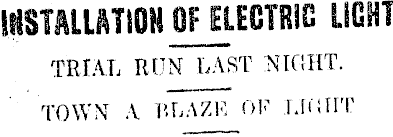
On 20 July 1921, a trial of the plant was successfully tested with a large crowd of people in the streets to witness the event. The town was lit up with the glare said to have been visible from Nelson, giving the impression that a large fire was the cause. At the time of the trial, there were 60 streetlights of 80 candle power each, and up to 40 house connections with 100 connections to be completed within a short time.
The light was generated by means of a suction gas plant (Browett Lindley & Co, British manufacture) of 90 h.p. and supplemented by a 25 h.p. petrol kerosene engine, made by Mason Porter of Auckland. The National Electric Engineering Co., Wellington, was the contractor for a good part of the work, with John Chambers and Son undertaking some work.
The official opening of the electric light and power installation took place at the powerhouse in January 1922 with the representation of people and councils from across the district.
The Mayor of Motueka, Mr A. McGlashen, recalled the attempts that had been made to give the township better light. Kerosene and acetylene had been tried. All had been discarded in favour of electric light, but there had been some delay in establishing the plant due to the war and its effects.
The installation came in within budget of £14,000, with £500 in hand. The wiring and reticulation had been installed to a quality that enabled Motueka to connect with a hydro scheme that may be undertaken in the future.
The mayor completed the opening by starting the machinery declaring the powerhouse open.
