
BY ROBYN PARKES
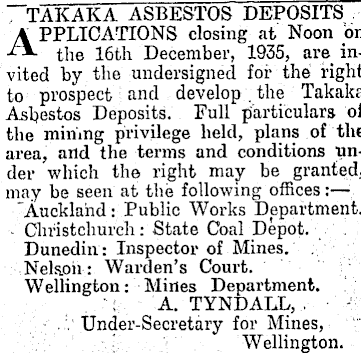
After the acceptance of the tender for mining asbestos, Mr W. Hume, managing director of the Hume Pipe and Hume Steel Company, and Mr Strand, the New Zealand representative of the Companies, viewed the site and the asbestos deposits.
Asked as to what the prospects were in connection with the deposits, Hume stated that a considerable amount of prospecting had been done since his last visit and he considered the prospects to be excellent.
With the assistance of Mr. W. Jones of the Department of Geological Survey a large area of the mountain side was marked where drives and cuts should be made.
Large amounts of asbestos were found to be available over a wide area, from slip-fibre to long weaving cross-fibre.
To develop the production of asbestos cement, the Hume Pipe Company (Australia) Limited formed a subsidiary New Zealand company with most of the capital provided locally. The company’s objective was to develop in Tākaka an industry capable of supplying the country’s requirements for cement-asbestos goods, and to have for export a quantity of weaving fibre. It was the company’s intention to provide asbestos corrugated roof covering at prices reasonably competitive with corrugated iron and to provide fireproof wallboards at a price at which they could be used for building homes.
Meanwhile, the Waimea Power Board had been investigating sources of hydro-electric power in the Nelson district with Gowan, the Cobb, Boulder Lake and other areas considered. Interest began to centre on the Cobb and the Government was asked by the Power Board to develop it as a major scheme for the district, or, failing that, allow private enterprise to do so under conditions safeguarding the public interest.
The Government agreed to allow private enterprise to undertake the work, provided bulk power was supplied to the district on terms of Government supply in similar districts in other parts of New Zealand. Under Government schemes, Power Boards had to guarantee to take sufficient energy within five years to recompense the Government for its outlay.
The guarantee required meant that revenue had to be found, either by increasing charges, or rates, or some other means. The Hume Pipe Company, with an eye on the asbestos and other mineral deposits, intimated it would be prepared to develop the Cobb scheme and supply the Power Board and Nelson City areas with energy at standard Government rates, provided it had the right to supply large consumers direct. The company’s offer was accepted.
The formation of a subsidiary hydroelectric company was commenced, the contract for the power plant signed, and around 50 men engaged in constructing the road up Tākaka River from Upper Takaka to the site of the power station. From the power station site, a road was constructed for about four miles on to the foot of the asbestos fields and there it was proposed to build the mills.
Each scheme was dependent on the other, the Cobb Scheme was too big for ordinary Power Board requirements, and it was uneconomic to build without a large power demand such as that connected with the milling of asbestos. It would be impossible to do anything on a large scale with asbestos without ample power for crushing.
By 1941, considerable development and construction work had taken place at the deposits and marketable fibre was being produced on a commercial scale.
Mining continued until 1964 when it was closed down as no longer being viable, twenty-eight years after the first concerns were raised about the dangers of asbestos.
