
BY ROBYN PARKES
Tasman (Aporo), in a short space of around four years, 1910-1914, had seen a transformation. The population had grown considerably due to the land changing from being covered by thick manuka to being planted with thousands of fruit trees. With the changes a good labour force was required and by 1914 the population had grown to about 140 people.
The growing community had established a debating club, a brass band, a committee in charge of the recreation domain and they were in the process of establishing a club room for young men and building a new Presbyterian Hall.
Up until mid-July 1914, the local children had been taught in a building which was not conducive to learning, being too small and unsuitable in every way.
In understanding that the children needed an environment that would support them in their learning an application was made to the Education Board for a grant to erect a building for the new Tasman School.
After some delay the grant was approved.
The Tasman Fruit Lands Company donated an acre of ground for a site, near the head of the Moutere Lagoon and the Board acquired an additional three-quarters of an acre. The school was built by Mr H. Olsen at a cost of about £3OO.
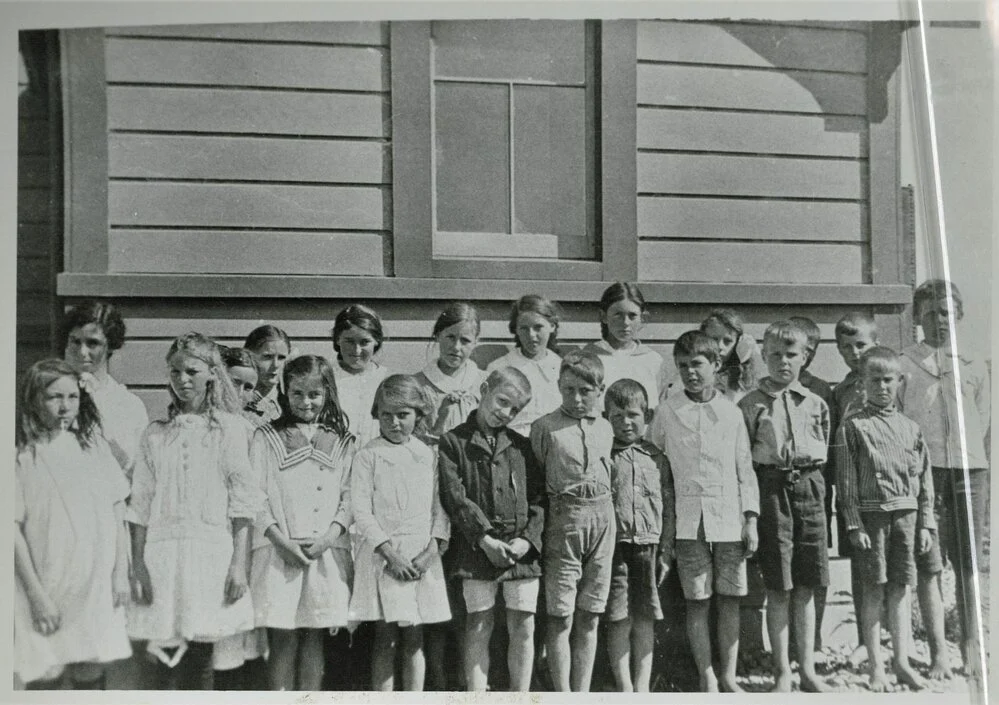
The new school building was opened in July 1914 with Mr Lock, Chairman of the Education Board, performing the opening ceremony in front of around 70 people. An afternoon tea party and lolly scramble caused great excitement for the children and in the evening the pupils took part in a concert and dance held in the new building.
The crowd was informed by Mr Lock that the community were fortunate in having a good staff of teachers, men and women of high intellectual attainments and moral worth, and that substantial increases in their salaries would shortly to be made.
Once declared open, Mr Lock planted a tree in commemoration of his visit, alongside the children who planted a number of shrubs and native trees. Photographs were taken of the proceedings to form a record in the history of the settlement.
In 1919, headmaster Mr A Hamilton was congratulated for ‘the general tone’ of the school and the high standard of examination results. The school, in the five years it had been open had grown from a roll of nine to around 40 pupils. The following year there was a movement to purchase a portion of an adjoining property to the school for playing fields. In 1923 the Department granted an additional £6 10s for a playing area.
Headmaster Hamilton retired in 1923 and it appears that after this there were a number of changes in teachers and this resulted in a lowering of the level of education, as in1926 the Education Board reported that the work of the children had been seriously interfered with due to frequent changes.
For a time in 1928, there was great unrest as conditions at the school worsened, said to be from the present teacher, Miss Webb, ignoring the need for discipline and her general conduct, causing a good deal of conflict between the committee and the people of Tasman. The unrest resulted in Miss Webb being transferred to another school.
Over the ensuing years a dental clinic and school swimming pool were added. Despite some difficulties the school continued to thrive and now, over 100 years later, the school has a strong active community with the children taught to reach for the stars.
