
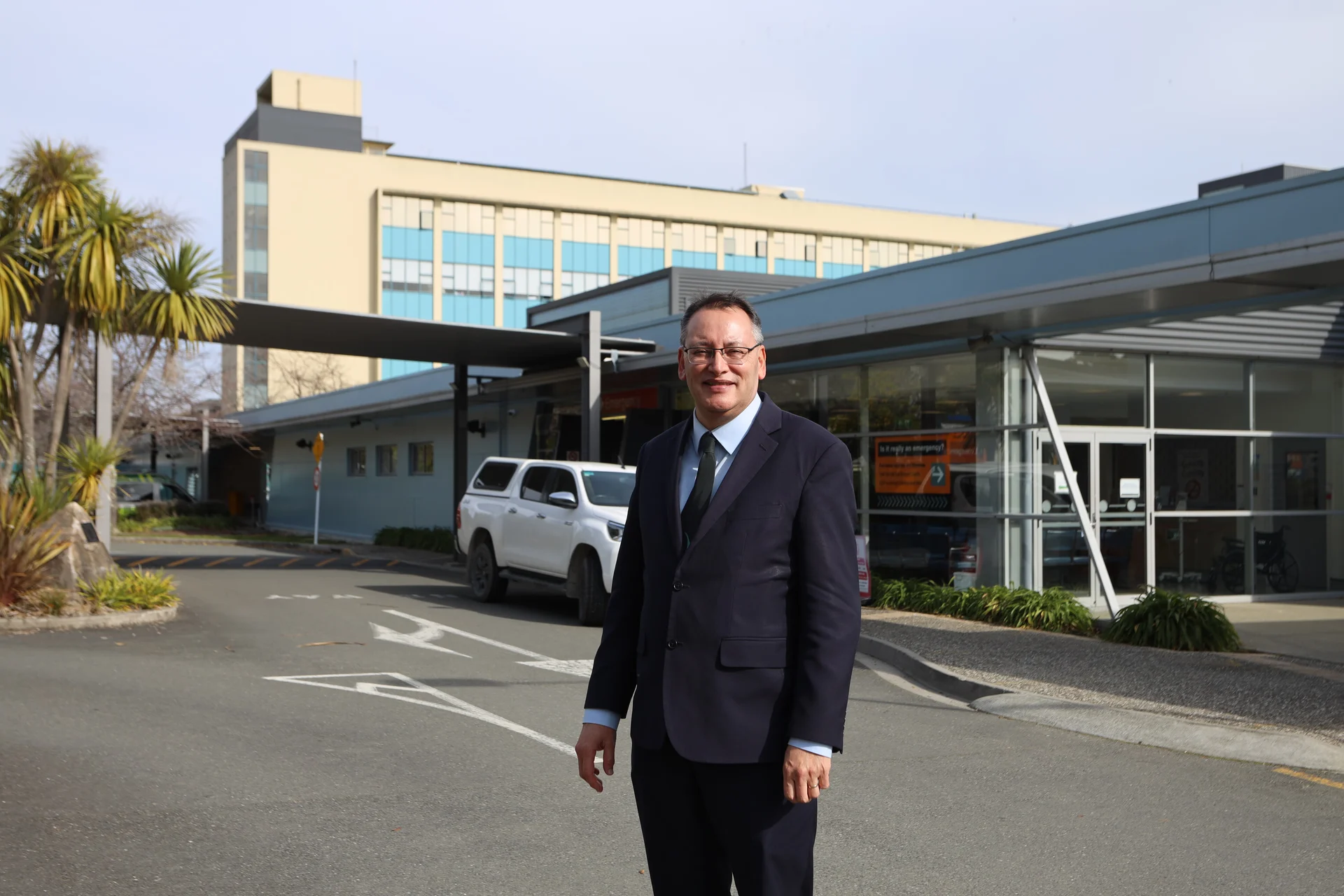
A new Nelson Hospital would progress quicker under a phased approach according to Health Minister Shane Reti.
The minister announced today, during a tour of the hospital, that a detailed business case, or at least a draft, is expected by the end of this year as opposed to the end of 2025.
He says that is because they can now do “better remediation seismic work” than was previously expected.
Reti says that building the hospital in “phases” also meant they could bring forward the work programme.
However, he remained non-committal to a date for construction to start or an expected timeline of when the rebuild would be complete.
He says the phased approach will mean domestic companies will have the opportunity to tender for the construction work, rather than large Australian companies that are involved with Dunedin Hospital.
“All of this is a good signal to people of Nelson that we will build this hospital, that we're on track and, in fact, we're moving at pace and looking at... how we can move even quicker.”
He says the build would be “standardised” across the entire health sector where possible.
“An operating theatre is an operating theatre, there can be small differences such as a bigger door... a patient room is a patient room, we should standardise that.
“That creates huge design opportunities, reduces costs and increases the speed with which we can build, so Nelson will benefit from all of that.
Reti could not confirm bed numbers, or whether it would be the same increase to 255 beds as the former Labour government had proposed, saying that was a matter for the business case to look at.
However, he says that modelling would be based on 2043 projections, five years later than previous plans.
“So the detailed business case will determine exactly what those numbers will be.”
He says the provisional cost for the build was still planned to be more than $1 billion, but his hope was that the phased build would be complete earlier than one large build, which had been flagged to be complete by 2031.
When pushed further on committing to a timeline for completion he would not budge.
“I wouldn't want to preempt the detailed business case, and that would, of course, need to go to cabinet as well.”
He says the rebuild will mean one new building is complete and moved into before work begins on the next.
“Potentially it could be two substantive buildings side-by-side.”
He says, despite the George Manson building being rated among the poorest condition in the country, it would remain in place under the phased approach.
Built in 1960, the 6863sqm block was found to have fire separation issues, a likelihood of asbestos, and seismic restraint issues during a national stocktake of hospital infrastructure.
In January 2020, Nelson City Council issued earthquake-prone building notices for the George Manson building, including the operating theatres and ambulatory care unit, along with the Percy Brunette building, with the health board required to carry out seismic work by November 2028.
The Percy Brunette building will also stay, according to Reti.
“With the seismic remediation and the new information we have, there are parts of those buildings that will have a longer life than was initially anticipated... they will be suitable to move in administration and management.
“So what's happened here is a slightly longer life to some of those buildings that wasn't anticipated in the program business case.”
He says speaking with frontline staff on Thursday, they were “enthusiastic” about the timeline of the build.
“What I've heard from the frontline staff is an ongoing need for workforce and a desire for this build to get up so that they can start start working with it.”
When questioned on whether there would be budget to staff a hospital with more beds his response was “to have a hospital built and not have staff is not cool”.
Health New Zealand Te Whatu Ora chief medical officer Te Tauihu Dr Nick Baker says the new building would be constructed in an area that was currently home to a range of houses and outpatient buildings.
Reti says they are mindful of lessons learnt in the build of Dunedin Hospital, where “no one actually put a spade in the ground and said ‘we start now’”.
“Certainly it's our intention to move at pace, as you can see with the enhanced time frame on the detailed business case that we want to move quickly with this. So that's the best reassurance I can give you.”
He said, despite the opposition labelling the phased build as cost-cutting, “it’s not”.
“It's how we can get the best fit-for-purpose hospital for Nelson, and how we can make a start and get it underway.”
But Nelson's Labour MP, Rachel Boyack, was unconvinced.
“Cutting corners by pushing for a quick and cheap renovation instead of the full rebuild Nelson Hospital needs will leave our region worse off,” she says.
“More delays and a smaller hospital are a slap in the face for Nelson. We can’t kick the can down the road – we have a rapidly growing population, and an aging population – we need to invest in the future of Nelson’s health.”
