
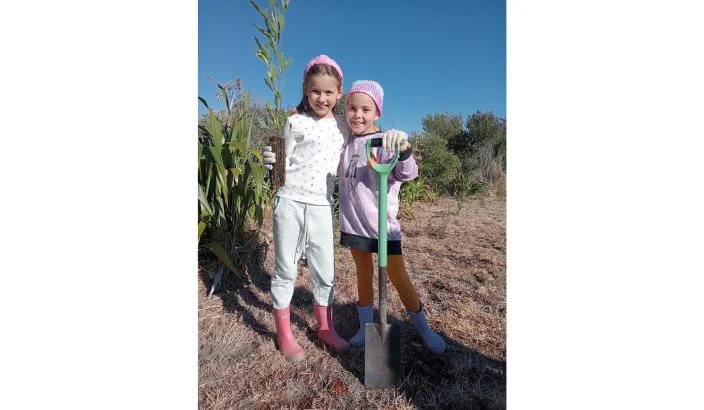
Motupipi School students have been plunging their spades into the sandy soil of the Tākaka Golf Club to help restore the area’s native bush.
The group of 25 children spent the morning planting 1100 trees earlier this month, as a joint project with the golf club and environmental educators Tasman Bay Guardians (TBG).
TBG’s Caz Gray, who presents the organisation’s Wai Connection programmes, says that the planting day followed on from the school’s engagement in the Whitebait Connection last term. She reckons the eight-to-ten year olds approached the project with great enthusiasm, whipping through the planting of the manuka, akeake, kowhai, coprosma and harakeke.
She says the regeneration will help to create a native corridor that will stabilise the land, as well as providing habitat for the lizards and wading birds that live around the estuary.
The school has a history with the nine-hole golf club, having assisted with the planting of 4500 native trees about a decade ago.
The trees were planted on parts of the course that is not currently in play, and greenskeeper Dave Win says that this will reduce the need for mowing – and therefore the course’s carbon footprint.
Also, he says, “native trees look a hell of a lot better than stinky gums and pines”.
“I was just so impressed with the kids and the parents and helpers.
“I thought if we could plant 400 trees, that would be quite good, but we’d done that in an hour and a half,” he laughed, adding that he had gathered another 700 trees for the working bee participants to carry on with.
A links course is a type of golf course typically found in coastal areas and characterized by natural terrain that has been shaped by wind, rain and the sea. The terrain is firm and well-draining, and while this makes the planting easy, it also means that the trees need to be well-mulched to ensure they survive.
