
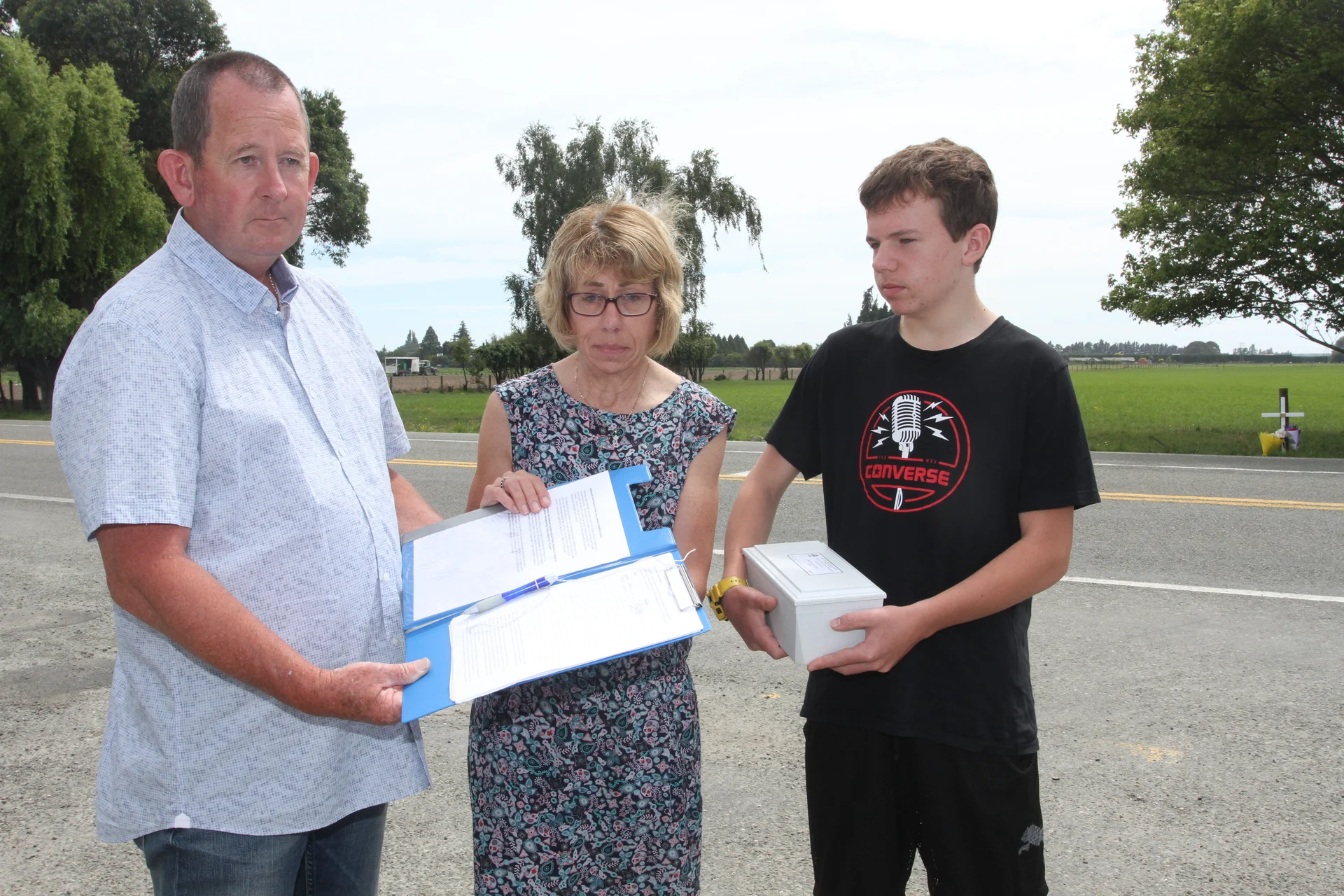
It’s been seven years since 23-year-old Matthew Dow’s life was cut short on the Appleby Highway by a drugged driver.
The Christchurch man was driving back from Kaiteriteri to his family’s annual holiday spot at Tāhunanui when he was killed in a head-on crash on New Year’s Eve in 2017, by a Tākaka woman under the influence of methamphetamine and cannabis.
His bereaved parents, Karen and Peter Dow, with then Nelson MP Nick Smith in support, launched a petition in 2018 on the first anniversary of his death, calling for random roadside drug testing for drivers.
Close to 6000 signatures were gathered before being presented to Parliament in May 2019.
The Government has now announced a $1.3 billion Road Policing Investment Programme (RPIP) to clamp down on drugged and drunk drivers over the next three years to augment road user safety.
The Crash Analysis System, managed by NZTA Waka Kotahi, recorded five deaths in the Nelson district that involved drugs and/or alcohol between 2019 and 2024 and nine in Tasman over the same period.
The government’s announcement includes $20 million ringfenced for roadside drug testing, with a target for police to undertake 50,000 oral fluid tests annually once the regime is enacted.
The bill, which is before the Transport & Infrastructure Select Committee, with submissions closing on 29 August, would mean drivers who return two positive screening tests at the roadside will be prohibited from driving for 12 hours to address any immediate roadside safety risk.
Evidential oral fluid testing would be done in a laboratory before infringement notices are issued.
Karen Dow, whose late son would now be 30, says the announcement was “a long time coming”, having pleaded with ministers to introduce roadside drug testing since 2019.
She now hoped road deaths caused by drugged drivers would diminish under the crackdown.
“Certainly, seeing this come to fruition would be an honour to Matthew, who was very righteous, a very honest young man, and it would be good to have that as his legacy, that hopefully we can save other people the grief that we continue to go through,” she says.
“The general public deserve the right to expect that you can get from A to B without being hit head-on by somebody who’s not in a condition to be able to drive, as it happened to Matthew,” she says.
“The police will need as much assistance as possible to be able to enforce this, and things need to be carried through to the judicial system whereby penalties imposed are an actual deterrent.”
Karen says Matthew had missed “so much of life” since his death, including possible marriage and children, and grandchildren for her and husband Peter.
She says the Dow whānau continue to visit Matthew’s Appleby Highway memorial and holiday at Tāhunanui, and one of Matthew’s close friends gave Matthew as the middle name of his child in his memory.
She also acknowledged now Nelson Mayor Nick Smith for his support in the campaign.
Nick, who made a joint submission with the Dows to the select committee, equally welcomed the government’s plans for roadside drug testing after his battles to fast-track it as an MP.
The previous government passed legislation on roadside drug testing, but progress to have the programme rolled out had stalled since police couldn’t find an appropriate roadside screening device.
“I gave a commitment to [Matthew’s] family that I would do everything possible to push with them for drug testing and am frustrated it is taking so long,” he says.
“Our submission supports the law change but pleas for police and the Ministry of Transport to ensure this second attempt works.”
The RPIP also includes more alcohol breath tests with a target of 3.3 million annual roadside alcohol breath tests, a requirement that 65 per cent of breath tests are done at high or extreme alcohol risk times, and a focus on speed offences on open roads and high-risk locations. Funding will be performance based.
